
Improv prompts for classes, teams and game night
Writing list
40
- 5 tags
- Printable
The short answer
Good prompts for improv name a location, a relationship, an opening line or a problem, such as two chefs sharing one tiny kitchen and one very strict deadline. This page has 40 family-friendly ones in four groups, and one location plus one pair makes a whole scene.
Running a session for eight new actors or a team offsite? Tell the AI writing prompt generator for improv the group size and level, and it'll write a fresh set of starters.
40 improv prompts
Filter by tag
Showing all 40 prompts
Two chefs share one tiny kitchen and one very strict deadline.
A lost tourist asks directions from a person who has never left their street.
Two colleagues are stuck in a lift and one of them has a surprise party to get to.
A grandparent teaches a grandchild how to use a phone, but the roles keep switching.
A new employee finds out the office plant has been in charge for years.
A museum guard and a statue have an argument about opening hours.
Two friends build flat-pack furniture with one instruction sheet in a language neither reads.
A coach gives the team a pep talk but forgot which sport they're playing.
Two neighbours meet at the fence to decide who owns an apple that fell over.
A waiter has to describe a dish that doesn't exist.
A taxi driver and a passenger both think they're the one who's giving directions.
The last two people at a party are trying to leave politely.
A nervous magician and a very honest assistant.
A sleepy lifeguard and a swimmer who needs constant attention.
A librarian who loves silence and a noisy superhero looking for a book.
A teacher and a student who has just found out the teacher is new too.
A lighthouse keeper and a ship captain who communicate only by flashlight.
A farmer and a time traveller who has landed in the wrong field.
A detective who is scared of the dark and a witness who is not scared of anything.
A dentist and a patient who wants to talk about everything except teeth.
Two astronauts running out of snacks and patience.
A grumpy gardener and a very cheerful snail.
The last bus stop on the line, just before it turns around.
A rooftop garden during a surprise thunderstorm.
The queue for the world's slowest roller coaster.
A tiny bookshop that's about to close for the evening.
The lost property office at a train station.
A school kitchen on a Monday morning with no groceries.
A lighthouse with a broken lamp and a visiting inspector.
A hotel lobby where the clocks all show different times.
"I told you we should have brought a map."
"You're not going to believe what the cat just did."
"Just so you know, this isn't how I normally spend a Tuesday."
"The good news is, nobody was hurt."
"I've been meaning to tell you about the dragon."
"Do you hear that, or is it just me?"
"Welcome to the worst day of my career."
"We have exactly four minutes, so let's get started."
Freeze the scene and let a third player tap in as a new character who changes the scene's location.
Play a scene where each line must start with the next letter of the alphabet.
Want more? Brainstorm with AI
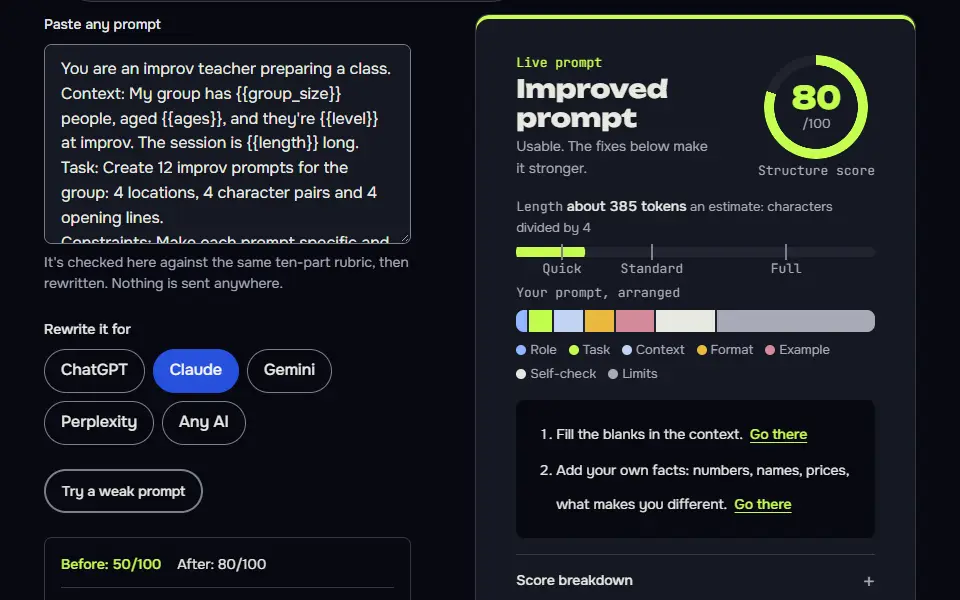
Paste this into any chat AI. It writes fresh improv prompts in the same style.
Build an improv prompt set for your group
The pairs are built with an imbalance of status, a secret, a shared goal and opposite wants, which are the things that make a scene move.
Your details
Type in any field. The prompt fills in as you go. Leave one empty? It stays a highlighted blank.
Your prompt
You are an improv teacher preparing a class.
Context: My group has {{group_size}} people, aged {{ages}}, and they're {{level}} at improv. The session is {{length}} long.
Task: Create 12 improv prompts for the group: 4 locations, 4 character pairs and 4 opening lines.
Constraints: Make each prompt specific and playable in 90 seconds. Keep everything family friendly and suitable for the ages given, with no real people, brands or trademarked characters. Don't write the scenes. Make the 4 pairs include one with a power imbalance, one with a secret, one with a shared goal and one with opposite wants.
Output format: three labelled lists (Locations, Pairs, Opening lines), then a 3-step plan for how to run them in the time given.
How to use
- Copy it with the button above.
- Fill the blanks in {{double braces}} with your own details.
- Paste it into ChatGPT, Claude or Gemini and send it.
- Then follow up: ask for one change at a time.
Before you run “Build an improv prompt set for your group” for the first time, the lesson on how to use writing prompts with AI walks through copying, filling and sending it.
Before you start
These 40 improv prompts work for any audience: drama classes, work teams and game night at home. They don't need props, and you won't need a stage. The groups are built to mix, so you can spin a location and a character pair together and get a scene nobody's played before.
How do I run an improv scene spinner for a group?
To run an improv scene spinner for a group, draw one location and one character pair, give the players 60 seconds to agree who starts, then begin the scene. Call time after 60 to 90 seconds (1 to 1.5 minutes) and swap in the next pair, so the energy doesn't drop.
- Split into pairs or groups of three, so nobody's waiting long for a turn.
- Draw one location card and one character pair card at random.
- Give the players 60 seconds to agree who's who and who speaks first; don't let them plan the ending.
- Run the scene, call "freeze", and spin a new combination for the next pair.
What are the 5 basic rules of improv?
The 5 basic rules of improv are say 'yes, and', listen more than you plan, be specific, make your partner look good and commit to every choice. Teachers word them differently, and some lists run to 7, but these five show up in nearly every class, and they're easy to remember. Each rule is stated as a short action, matched to the question people ask most about improv.
- Say 'yes, and'. Accept your partner's idea and add one thing to it.
- Listen more than you plan. You can't script a partner's next line.
- Be specific. "My sister's wedding cake" beats "some food".
- Make your partner look good. Set them up instead of chasing the laugh.
- Commit to every choice. A half-made choice stalls the scene, and the audience can tell.
Which improv prompts suit a class or a work team?
The improv prompts that suit a class or a work team are the character pairs for classes and the opening lines for teams, since both start a scene with no setup. A class of students gets a ready-made relationship from a pair card, and a work team that's never done improv only needs to say one line out loud.
Save the 2 game cards for game night, where a bigger group can join in. Lines of dialogue from the Tumblr-style writing prompts list double as strong opening lines for a scene. Students who freeze on an essay often find a story after a scene, and the examples for UC prompt 3 show how a talent becomes a UC answer.
Need a custom set for your team's size and skill level? The AI helper on this page builds one from your group size, ages, level and session length.
Prompts for improv FAQ
Still stuck? Build it in Prompt Studio. It'll score each part as you go.
What are good improv prompts for a short speech?
Good improv prompts for a short speech are the opening lines on this page, used as the first sentence of a one-minute talk. Give one reason and one story, and you don't need jokes; it's fine if you aren't sure where the talk ends.
How do I use improv prompts for writing practice?
Use improv prompts for writing practice by writing the scene as dialogue for five minutes, then reading it aloud with a partner. Keep the best lines you didn't plan; that's where a character's voice shows up, and it's quicker than you'd think.
Are these improv prompts family-friendly?
Yes, these improv prompts are family-friendly, with no adult themes, so they work in schools and at home. None of them asks a player to mock a real person, and there aren't any rude setups.
How many players does an improv prompt need?
An improv prompt needs two players for a character pair and three or more for a location scene, and the games suit bigger groups. A solo player can't run a scene, but they'll still get practice writing it as dialogue.