
Common App essay prompts and brainstorming questions
Writing list
44
- 9 tags
- Printable
The short answer
The prompts for the Common App are seven essay prompts for 2026-27, and you write one personal statement of up to 650 words on the prompt you pick. This page quotes all seven, then gives you 44 original brainstorming questions tagged by prompt number, so you aren't starting from a blank page.
Stuck before the first draft? Use the AI writing prompt generator for Common App essays to get an interview that asks you questions, and keep every sentence of the essay your own, since the application asks you to confirm the work is yours.
44 Common App essay prompts
Filter by tag
Showing all 44 prompts
List five objects in your room that someone could not understand without your story. Which one has the best story behind it?
What do your friends or family tease you about that is actually a clue to who you are?
Describe a smell, sound or taste that takes you straight back to the place you come from.
What would a stranger misunderstand about you after reading only your grades and activities list?
Which tradition, language, skill or habit would you be sad to lose, and what's the first memory attached to it?
Write the first sentence of your story as a scene, not a statement. Place it in a specific room, on a specific day.
Who taught you the thing you're most proud of knowing, and what exactly did they say or do?
Describe the exact moment you realised something had gone wrong. What did you see, hear or feel?
What did you do in the first hour after the setback, and what would you do now?
Write three sentences: what you expected, what happened, what you changed afterwards.
Whose advice did you ignore during this time, and was that a mistake?
What's something you now do every time, because of that failure?
If you could tell your past self one sentence the day before, what would it be, and why wouldn't it have worked then?
Name a belief you held strongly at fourteen that you no longer hold. What was the first crack in it?
Describe a time you disagreed with someone you respect. How did you say it, and how did they react?
Which rule at school, at home or on your team did you question? What happened when you asked why?
Write the question you asked yourself in one line. Then list three pieces of evidence you looked for.
What idea did you defend in an argument, then later try to disprove yourself?
Where did your doubt come from: a book, a conversation, an experience? Describe the first moment it showed up.
List three small acts of kindness toward you that nobody else remembers. Which one surprised you most?
Write about someone who helped without being asked. What did it cost them, and did they mention it?
Complete this sentence in three ways: "Because of what they did, I started to..."
How have you passed on that kindness, and who was on the receiving end?
Describe the room, the weather and the exact words when you first felt thankful in a way that changed something.
Is there a thank-you you never said out loud? Draft the first two lines of it.
Pick an accomplishment and describe the day before it. Who were you, and what did you think was impossible?
Which realisation about another person made you act differently, and what was the first thing you changed?
What did you stop doing, or start doing, after the event? How long did it take to feel natural?
Draw a before and after: two columns, three bullets each, showing how you thought, acted and spoke.
Who noticed the change in you first, and what did they say?
What does growth look like in an ordinary Tuesday for you now, compared with a year ago?
When did you last lose track of time? Describe the activity minute by minute for the first ten minutes.
What's the strangest rabbit hole you've gone down, and which question started it?
Which three people, channels, books or websites do you turn to when you want to know more? What does each one give you?
Write the question you can't stop asking about this topic. Then list what you've done to answer it.
If you could spend a month on this topic with no grades, what would you build, read or ask?
Explain your topic to a ten-year-old in four sentences. Which sentence is hardest to write?
Write a list of ten things you could write about, including ones that seem boring. Circle the three you'd enjoy explaining.
What ordinary routine in your life has more going on in it than people realise?
Which essay would your best friend say only you could write, and why?
Choose a single object, place or sentence as an anchor. How does each paragraph connect back to it?
What's a true story from your life that always gets a laugh, and what does it show about you?
Which of your past stories has the most dialogue? Dialogue often makes a strong opening scene.
Draft a one-line summary of your essay: "I used to think X, but when Y happened I started to Z."
Want more? Brainstorm with AI
Paste this into any chat AI. It writes fresh Common App essay prompts in the same style.
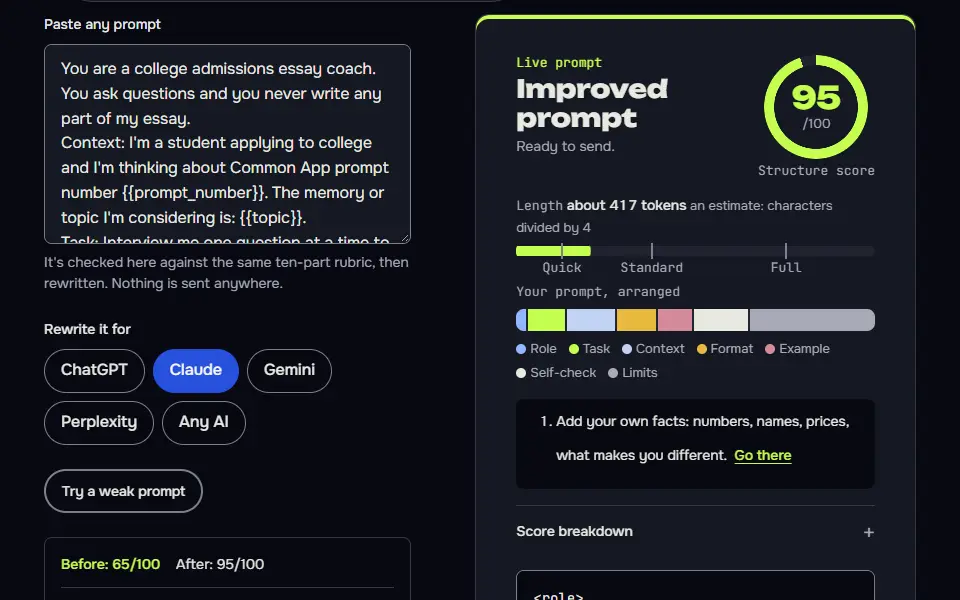
Have an AI interview you before you write
The AI only asks and collects, so every sentence in the final essay is yours.
Your details
Type in any field. The prompt fills in as you go. Leave one empty? It stays a highlighted blank.
Your prompt
You are a college admissions essay coach. You ask questions and you never write any part of my essay.
Context: I'm a student applying to college and I'm thinking about Common App prompt number {{prompt_number}}. The memory or topic I'm considering is: {{topic}}.
Task: Interview me one question at a time to help me find specific details, a turning point and what I learned. Wait for my answer before you ask the next question.
Constraints: Ask 8 questions in total, each under 30 words. Push for concrete details such as places, words people said and what I did. Don't suggest lines, sentences or a thesis. Don't judge the topic. If I say I don't know, rephrase the question.
Output format: after question 8, give me a short bullet list of the best details I mentioned, in my own words, and one sentence on which detail might make the strongest opening scene.
How to use
- Copy it with the button above.
- Fill the blanks in {{double braces}} with your own details.
- Paste it into ChatGPT, Claude or Gemini and send it.
- Then follow up: ask for one change at a time.
Before you run “Have an AI interview you before you write” for the first time, the lesson on how to use writing prompts with AI walks through copying, filling and sending it.
Before you start
The official wording comes from Common App's first-year essay prompt page on commonapp.org, which we checked on 10 November 2026. Common App kept the same seven prompts for the 2026-27 cycle. The brainstorming questions are ours: they help you find material, but you'll write the essay yourself.
What are the seven Common App essay prompts for 2026-27?
The seven Common App essay prompts for 2026-27 are background or identity, a setback, a challenged belief, gratitude, personal growth, a deep interest and a topic of your choice, quoted exactly here. Source: Common App, first-year essay prompts, checked 10 November 2026.
- Some students have a background, identity, interest, or talent that is so meaningful they believe their application would be incomplete without it. If this sounds like you, then please share your story.
- The lessons we take from failure can be fundamental to later success. Recount a time when you faced a challenge, setback, or failure. How did it affect you, and what did you learn from the experience?
- Reflect on a time when you questioned or challenged a belief or idea. What prompted your thinking? What was the outcome?
- Reflect on something that someone has done for you that has made you happy or thankful in a surprising way. How has this gratitude affected or motivated you?
- Discuss an accomplishment, event, or realization that sparked a period of personal growth and a new understanding of yourself or others.
- Describe a topic, idea, or concept you find so engaging that it makes you lose all track of time. Why does it captivate you? What or who do you turn to when you want to learn more?
- Share an essay on any topic of your choice. It can be one you've already written, one that responds to a different prompt, or one of your own design.
Each prompt asks for one thing, and it's worth reading them slowly. Prompt 1 wants the part of you the rest of the form can't show. Prompt 2 wants what you did after a failure, not the failure itself. Prompt 3 wants your thinking, step by step. Prompt 4 wants a debt you didn't expect to owe. Prompt 5 wants a before and an after. Prompt 6 wants a curiosity you feed on your own time. Prompt 7 takes any essay that's good enough to stand alone.
How do I choose a Common App prompt that fits my story?
Choose a Common App prompt that fits your story by listing three moments that changed you, matching each to a prompt and keeping the one you can tell in 650 words. Start with the story, not the prompt list.
- Write down three moments in one line each, such as a setback, a surprise and a turning point.
- Match each moment to the prompt it answers best. Most real stories fit two prompts, and that's fine: you don't have to pick the obvious one.
- Keep the moment where you can show a clear change in what you thought or did. A big event with no change in you makes a weak personal statement.
Filter the brainstorming questions by prompt number to test a moment fast. Five honest answers to one prompt's questions tell you whether there's enough material for a full essay. If you can't answer three, it isn't your prompt.
How do I turn a Common App brainstorm into an outline?
To turn a Common App brainstorm into an outline, sort your answers into five beats: hook, moment, change, meaning and close, with about 130 words per beat. Five beats of 130 words land on the 650-word limit, and you'll trim from there. Don't polish any beat until all five exist.
- Hook: one scene with a place, a time and a detail only you'd remember.
- Moment: what happened, told in order, with what you wanted or feared.
- Change: what you did differently afterwards, even if it's small.
- Meaning: what that change says about how you think now.
- Close: a line that returns to the hook and shows where you're heading.
The eight questions tagged Outline turn this into practice: write a one-line summary, then a before and after in two columns. Counsellors who teach younger grades too can pull short warm-ups from the writing prompt list for kids. When a student can't find a moment, a scene from the picture prompts for descriptive writing list often brings back a place worth writing about.
Prompts for Common App FAQ
Still stuck? Build it in Prompt Studio. It'll score each part as you go.
What is the most popular Common App prompt?
The most popular Common App prompt is prompt 7, the topic of your choice, picked by 28% of applicants in 2025-26, with prompt 2 on a setback second at 23%. Those shares come from Common App's 2025-26 data as reported by College Transitions and Oriel Admissions. Popularity shouldn't pick your prompt, though: your strongest true story should, and that's the one you'll write best.
Can I use AI to write my Common App essay?
No, you shouldn't use AI to write your Common App essay, since the application asks you to confirm the work is your own. Use AI only to ask you brainstorming questions about a memory, then write every word yourself. Read Common App's fraud policy and each college's own rules before you apply.
How long is the Common App personal statement?
The Common App personal statement is 650 words at most, with a 250-word minimum, and the form won't accept a longer text. Write long first, then cut: trimming a 700-word draft down to 650 is easier than stretching a 400-word one.
Is the Common App prompt wording the same every year?
No, the Common App prompt wording isn't fixed every year, so check commonapp.org for the current cycle. This page quotes the 2026-27 set, which Common App kept unchanged from 2025-26, as checked on 10 November 2026.