
Narrative writing prompts with a beginning, conflict and end
Writing list
40
- 2 tags
- Printable
The short answer
Prompts for narrative writing are story starters that set the opening, name the problem and leave the ending for you to decide. The 40 cards here are tagged personal (15) or fiction (25), and each one gives you a start, a conflict and your job.
Prefer to plan out loud with a model? Paste a card into the AI writing prompt generator for narrative writing and it'll build plot questions around your start and conflict.
40 narrative writing prompts
Filter by tag
Showing all 40 prompts
Start: you wake up and know today is different. Conflict: something you planned goes wrong in the first hour. Your job: decide what you learned by the end.
Start: you stand at the edge of a pool, a stage or a starting line. Conflict: you almost walk away. Your job: show the moment you choose.
Start: you are given a job nobody else wants. Conflict: it turns out to be harder than it looks. Your job: show what the work changed in you.
Start: a friend stops answering your messages. Conflict: you find out why from someone else. Your job: write the first conversation afterwards.
Start: you move to a new place in the middle of the year. Conflict: nobody saves you a seat. Your job: end on the first small thing that felt like home.
Start: you are the youngest person in the room. Conflict: you have to speak. Your job: let the reader hear your first sentence.
Start: you find an old photograph of yourself. Conflict: you don't remember the day. Your job: work out what it shows and how it makes you feel.
Start: you lose something you were trusted with. Conflict: you have to tell someone. Your job: write the conversation and the aftermath.
Start: you are teaching someone a skill you know well. Conflict: they struggle and you get impatient. Your job: show what you realise about patience.
Start: a family meal where one chair is empty. Conflict: nobody mentions it. Your job: say it out loud in a way that changes the room.
Start: you win something you didn't expect. Conflict: it comes with a cost. Your job: show whether you would do it again.
Start: a blackout hits your street. Conflict: you are alone with a problem to solve. Your job: show how you cope in the dark.
Start: you are told you're not ready. Conflict: you decide to prove otherwise. Your job: end on what you really proved.
Start: you walk home a different way than usual. Conflict: you meet someone or something unexpected. Your job: show how the day shifted.
Start: you are asked to say sorry for something. Conflict: you don't think you were wrong. Your job: let the apology change you, or don't.
Start: a girl finds a door in the back of her wardrobe. Conflict: it opens only when she lies. Your job: decide what is on the other side.
Start: a boy inherits his grandfather's fishing boat. Conflict: he can't swim. Your job: take him out to sea.
Start: a robot's first day at a school. Conflict: nobody told the children. Your job: resolve the morning without anyone getting hurt.
Start: a baker opens the shop to find every loaf has been shaped into the same animal. Conflict: she's never baked that animal. Your job: find out who did it.
Start: two rival neighbours both claim a plum tree. Conflict: a storm splits it in two. Your job: end with the fruit.
Start: a lifeguard spots something odd far out in the water. Conflict: nobody else sees it. Your job: decide whether to swim.
Start: a scientist's experiment works. Conflict: she is the only person who can see the result. Your job: decide whether to tell.
Start: a kitten follows a boy to school. Conflict: the teacher has a strict no-pets rule. Your job: end the day with a solution that surprises everyone.
Start: an astronaut hears knocking on the outside of the ship. Conflict: nobody else is out there. Your job: open the airlock or don't.
Start: a cook receives a recipe with the final step torn off. Conflict: a customer is waiting. Your job: decide what the missing step is.
Start: a girl and her grandmother share a secret garden. Conflict: a builder arrives with plans. Your job: protect it without a fight.
Start: a runner leaves the village at dawn with a message. Conflict: the road she knows is gone. Your job: deliver the message.
Start: a bus driver's route changes overnight. Conflict: the new stops don't exist on any map. Your job: complete the route.
Start: a brother and sister are left alone at a lakeside cabin. Conflict: the lights go out. Your job: end with the sunrise.
Start: an orchestra tunes up. Conflict: one violin is playing a different song. Your job: finish the concert.
Start: a girl wins a trip but has never left her town. Conflict: she is afraid of the airport. Your job: get her on the plane.
Start: a lighthouse keeper finds the lamp has been polished by someone else. Conflict: nobody will admit it. Your job: reveal the polisher.
Start: a soldier's letter arrives a hundred years late. Conflict: the person it was written to has a descendant. Your job: decide what the descendant does.
Start: a chef finds out the food critic is her childhood friend. Conflict: she must serve her the worst dish. Your job: save the evening.
Start: a dog digs up a small, locked box. Conflict: the key is nowhere to be found. Your job: open it.
Start: a boy builds a raft to cross a pond. Conflict: halfway across, he's no longer alone. Your job: write who joined him.
Start: a town's only clock runs backwards. Conflict: a festival depends on it. Your job: end with the right time.
Start: a girl is chosen to ring the bell. Conflict: she can't be heard. Your job: make the bell heard.
Start: a market trader is offered a coin from a land that doesn't exist. Conflict: he spends it, and the coin buys back his own lost memories instead of bread. Your job: decide which memory he gets first, and what it costs him.
Start: a pilot has to land on a runway lit only by car headlights. Conflict: the cars are leaving. Your job: touch down.
Want more? Brainstorm with AI
Paste this into any chat AI. It writes fresh narrative writing prompts in the same style.
Plan a narrative with a three-part check
Questions one at a time keep you thinking, and the plan stays in your own words.
Your details
Type in any field. The prompt fills in as you go. Leave one empty? It stays a highlighted blank.
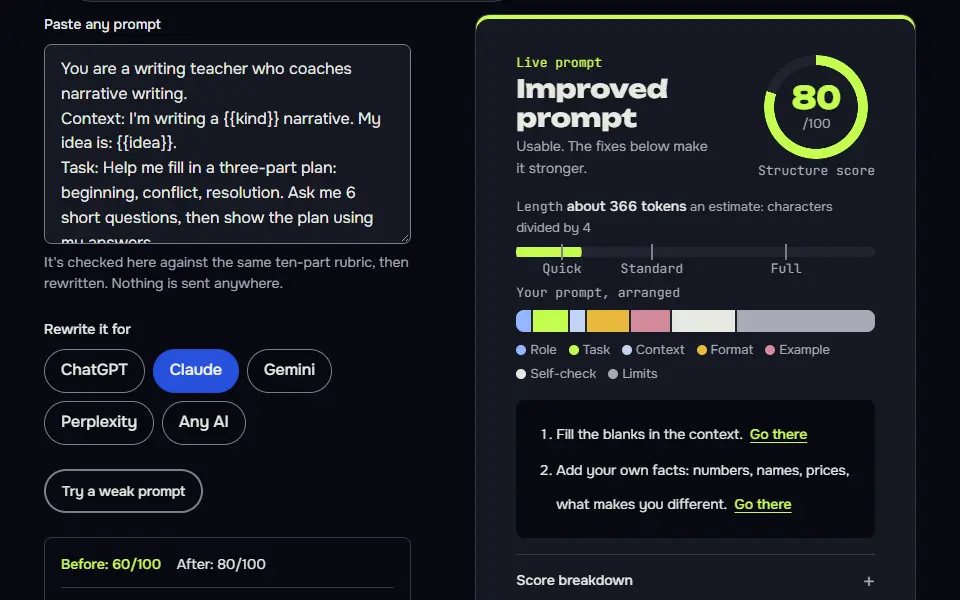
Your prompt
You are a writing teacher who coaches narrative writing.
Context: I'm writing a {{kind}} narrative. My idea is: {{idea}}.
Task: Help me fill in a three-part plan: beginning, conflict, resolution. Ask me 6 short questions, then show the plan using my answers.
Constraints: Ask one question at a time and wait for my reply. Don't write the story or any story sentences. Keep every question under 20 words. If my conflict is too small, tell me and ask a question that raises the stakes.
Output format: after the questions, give a table with Beginning, Conflict and Resolution, one line each, in my own words, then a checklist of 3 things to check in my draft.
How to use
- Copy it with the button above.
- Fill the blanks in {{double braces}} with your own details.
- Paste it into ChatGPT, Claude or Gemini and send it.
- Then follow up: ask for one change at a time.
Before you run “Plan a narrative with a three-part check” for the first time, the lesson on how to use writing prompts with AI walks through copying, filling and sending it.
Before you start
Narrative writing is storytelling where something happens, it matters, and something changes. Personal cards ask for a true story from your life; fiction cards hand you an invented character with something at stake. Don't worry if you haven't got a plot yet, since the card gives you one.
What is an example of a narrative writing prompt?
An example of a narrative writing prompt is 'Start: a girl finds a door in the back of her wardrobe. Conflict: it opens only when she lies. Your job: decide what is on the other side.' It's a fiction card, and every card on this page has the same three labels.
- Start sets the scene and the character.
- Conflict blocks the character, so the story has a problem to solve.
- Your job is the decision the writer makes, which is where the story becomes yours.
What are the three parts of a narrative story plan?
The three parts of a narrative story plan are a beginning that sets the scene, a conflict that blocks the character and a resolution that shows what changed. That's the whole story structure, and it lines up with each card: the start is your beginning, the conflict is your conflict, and your job becomes the resolution.
A story that's got no conflict reads as a list of events, and one that's got no resolution stops without a point. The change at the end doesn't need to be big, and it shouldn't feel forced. A character who finally asks for help has changed enough for a page.
How do I plan a narrative in three lines?
To plan a narrative in three lines, write one sentence for the beginning, one for the conflict and one for the resolution, then draft from those three lines.
| Part | Ask yourself | One-line example |
|---|---|---|
| Beginning | Who is where, and what do they want? | Maya wants to get home before the storm. |
| Conflict | What blocks them, and what's at stake? | The bridge is flooded and the bus has left. |
| Resolution | What changes, and what do they understand now? | She asks a stranger for help and learns to trust. |
Can't write the three lines? Then the idea isn't ready yet, you haven't failed, and it's quicker to pick another card than to force it.
How do I choose between a personal and a fiction narrative prompt?
Choose a personal narrative prompt when you have a true moment that changed you, and a fiction prompt when you'd like to invent the problem. The quick test: can you name the day it happened? Then go personal.
Personal narratives use 'I' and a true event, so details come easily, since you've lived them. Fiction gives you more freedom, but you'll find it's harder to make believable. A teacher who's running a personal narrative unit can filter to the 15 personal cards and skip the sorting. A story moment that's too small for a page can turn into a short poem, and prompts for poetry give each form its own limit. Middle school teachers will find narrative tasks sized for one class period in the 7th grade writing prompts set.
Prompts for narrative writing FAQ
Still stuck? Build it in Prompt Studio. It'll score each part as you go.
What are some good topics for narrative writing?
Some good topics for narrative writing are a time you were lost, a surprise, a mistake you fixed and a first or last day. The best ones have a clear before and after, so the reader can see what changed.
How long should a narrative writing piece be?
A narrative writing piece should be as long as the three parts need: a beginning, a conflict and a resolution, which is often three to five paragraphs in school. Follow the length your teacher sets, when there is one.
What are some ideas for a narrative writing lesson?
Some ideas for a narrative writing lesson are planning one prompt in three lines as a class, then letting each student draft from a personal or fiction card. Give ten minutes for the plan, have pairs swap and say which line is clearest, and don't mark the first draft for spelling.
Can an AI model plan a narrative without writing the story?
Yes, an AI model can plan a narrative by asking plot questions, when the prompt tells it to return questions only. You'll answer them in your own words, so the story stays yours.