
Chain of thought prompting with copy-paste prompts
Free prompt courseLesson 11 of 228 minVideoGo to the lesson
Guide
4 min
- Plain English
The short answer
Chain of thought prompting asks a model to work through a problem in steps before giving the final answer. It helps most on math, logic and multi-step planning. Add 'think step by step' or show a worked example. On reasoning models it's often unnecessary, since they already reason internally before replying.
What is chain of thought prompting and where does it come from?
Chain of thought prompting is a method where the model writes out its reasoning steps before the final answer, first set out by Google researchers in 2022. In Chain-of-Thought Prompting Elicits Reasoning in Large Language Models (Wei et al., 2022), prompts that included worked examples with intermediate reasoning steps improved results on arithmetic, commonsense and symbolic tasks.
A follow-up the same year, Large Language Models are Zero-Shot Reasoners (Kojima et al., 2022), showed that the plain line "Let's think step by step" could trigger the same effect, and you didn't need any examples. That gives two flavours: zero-shot CoT, where you just ask for steps, and few-shot CoT, where you show a worked example first (see few-shot prompting). Writing the steps out gives the model room it wouldn't otherwise have to catch its own slips, and that's why the gain shows up on multi-step problems.
How do you write a chain of thought prompt?
To write a chain of thought prompt, state the problem, ask for the reasoning first, mark where the final answer goes and show one worked example. Already have a prompt that skips the working? Paste it into the free prompt optimizer tool and it'll add a reasoning step and an answer line for you.
- State the problem and give every number the model will need.
- Ask for step-by-step reasoning first and the answer after: "Work through this step by step, then give the final answer on its own line."
- Mark the answer so you can find it, with an answer marker such as
Answer:or an<answer>tag. - For tricky problem types, show one worked example with the steps you'd want copied.
Don't overthink the wording; "step by step" is fine. What's important is the work before the answer and a fixed place for the answer. The worked prompts on this page cover each case, including a steps builder that writes a custom reasoning order.
What does a chain of thought example look like?
A chain of thought example looks like a word problem followed by numbered reasoning lines and one line that starts Answer:. Take this one: a bakery sells muffins in boxes of 4 at 6 dollars a box, and you need 18 muffins.
- 18 divided by 4 is 4.5, so 4 boxes isn't enough.
- You'll need 5 boxes, which hold 20 muffins.
- 5 boxes at 6 dollars each is 30 dollars.
Answer: 30 dollars for 5 boxes. The middle lines are the chain of thought, and a wrong-looking step is useful: it's a mistake you've caught before it reached the answer.
What did reasoning models change for chain of thought prompting?
Reasoning models changed chain of thought prompting by reasoning internally before they answer, so an explicit step request adds little and can add cost. A reasoning model thinks before answering, and three vendors say so in their own docs:
- OpenAI's reasoning best practices say that prompting reasoning models to "think step by step" or "explain your reasoning" is unnecessary (source).
- Anthropic's guidance prefers general instructions like "think thoroughly" over a hand-written plan, and keeps manual chain of thought as a fallback for when thinking is off (best practices).
- Google says Gemini 2.5 and 3 models generate internal thinking, so visible step-by-step output is usually unnecessary (prompting strategies).
Written steps still earn their place in 3 cases: smaller or older models, working you want visible so you can check it, and steps you need in a set order. Treat the written steps as something to review, not proof of how the model got there. Test both ways; you'll often find the plain prompt works as well, and the added cost goes away.
How is chain of thought prompting different from prompt chaining?
Chain of thought prompting is different from prompt chaining in that it asks for steps inside one answer, and prompt chaining splits the job across several prompts. With chain of thought, the model reasons and answers in a single reply that you can't pause halfway. With chaining, each output feeds the next prompt, so you can check or change things between stages.
They aren't rivals, and you'll often use both. A chain's middle stage can itself ask for reasoning, and a long chain of thought that keeps going wrong at one step is often a sign the job wants splitting into stages.
Chain of thought prompting before and after
The same request, asked two ways. Read the second one slowly. Each line does a job.
A shop sells pens at 3 for 4.50 and notebooks at 2 for 7. I buy 9 pens and 5 notebooks. What do I pay?
A shop sells pens at 3 for 4.50 and notebooks at 2 for 7. I buy 9 pens and 5 notebooks. Work out the cost step by step: price per pack, packs needed (say if any item doesn't divide evenly), cost of each item type, then the total. Put the final total alone on the last line, starting with "Final answer:".
Why it works
Naming the steps stops the model skipping the 5 notebooks problem (they don't sell in singles) and makes the answer easy to check.
Chain of thought prompting examples
Zero-shot chain of thought with a findable answer
It asks for reasoning first and a fixed answer line, which is the pattern in the original papers.
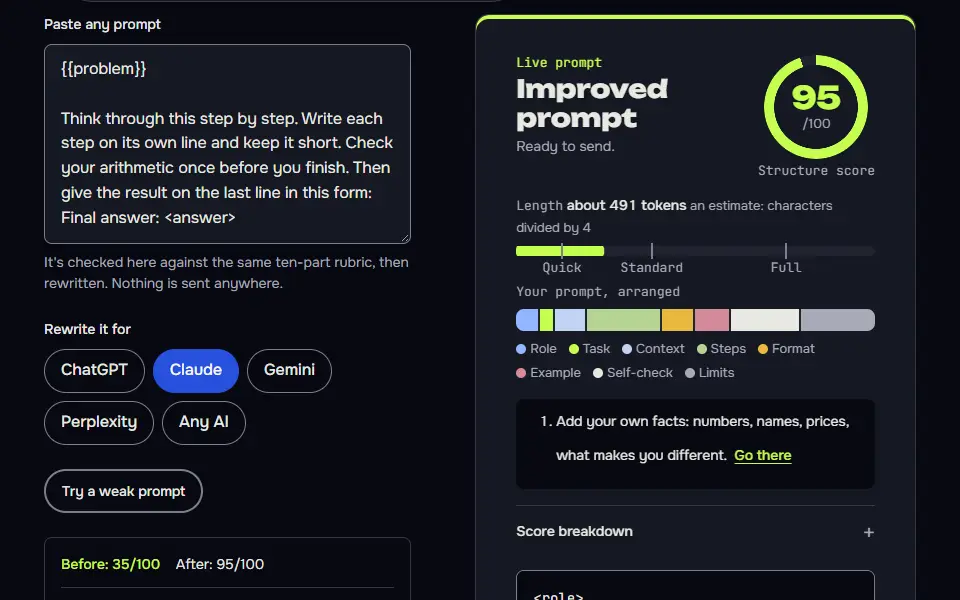
{{problem}}

Think through this step by step. Write each step on its own line and keep it short. Check your arithmetic once before you finish. Then give the result on the last line in this form:
Final answer: <answer>How to use
- Copy it with the button above.
- Fill the blanks in {{double braces}} with your own details.
- Paste it into ChatGPT, Claude or Gemini and send it.
- Then follow up: ask for one change at a time.
Before you run “Zero-shot chain of thought with a findable answer” for the first time, the lesson on how to use AI prompts step by step walks through copying, filling and sending it.
Few-shot chain of thought with one worked example
The example shows the level of detail you want in the steps, which a bare 'think step by step' can't.
Solve the problem the same way as the example. Show the steps, then the final answer.

Example
Question: A cafe sells 12 muffins an hour for 5 hours, then 8 an hour for 3 hours. How many in total?
Steps: First period is 12 x 5 = 60. Second period is 8 x 3 = 24. Total is 60 + 24 = 84.
Final answer: 84

Your turn
Question: {{question}}
Steps:Build your own reasoning steps
You decide the reasoning order instead of leaving it to the model, which is the main reason to use CoT on modern models.
Decide: {{decision}}

Reason through it in this order, one short paragraph per step:
1. {{step1}}
2. {{step2}}
3. {{step3}}

When a step compares options, compare like for like: the same units and the same amount (hours worked, months, items) on both sides, and show the working.

Then give a recommendation in one sentence, and name the single assumption that would change it. If you need a fact I haven't given you, say so instead of guessing.
Lesson 11 of 22Techniques8 min
Lesson: Chain of thought prompting
Chain of thought prompting asks the AI to show its working as steps before the answer. You get an answer you can check line by line, which matters for maths, logic and decisions.
Use it when
- Maths, scheduling, logic or any answer you need to audit.
- Decisions where the reasons matter as much as the result.
- The AI got a multi-step question wrong and you want to see where.
Skip it when
- Simple lookups or rewrites: steps just add length.
- Reasoning models already think internally; ask for shown steps only when you need to check them.
A train leaves at 09:40 and arrives at 13:15. A second train takes 25 minutes longer. How long is the second journey?

Think through this step by step. Write each step on its own line and keep it short. Check your arithmetic once before you finish. Then give the result on the last line in this form:
Final answer: <answer>
Step 1: First train departs 09:40 and arrives 13:15.
Step 2: From 09:40 to 13:40 is 4 hours.
Step 3: 13:15 is 25 minutes earlier than 13:40, so the journey is 4 h − 25 min = 3 h 35 min.
Step 4: The second train takes 25 minutes longer: 3 h 35 min + 25 min = 3 h 60 min.
Step 5: 3 h 60 min = 4 h 0 min.
Check: 09:40 + 3 h 35 min = 13:15 ✓. Adding 25 min gives 3 h 35 min + 0 h 25 min = 4 h 0 min ✓.

Final answer: 4 hours
What to notice: Every step is short and checkable, and the check line verifies the first journey before adding 25 minutes. The awkward "3 h 60 min" in step 4 is the kind of slip shown working lets you catch; here it was converted correctly in step 5.
Try it in Prompt StudioOpens the studio with the Step by step reasoning technique already selected.
Quick check: 3 questions
Practice: write your own
Write a step-by-step prompt for a problem from your own life: a budget, a schedule or a comparison. Ask for short numbered steps, a check, and a fixed final line.
Prompt Studio's rubric scores it right here. Nothing's sent anywhere.
Your progress is saved in this browser only. No sign-up.
When should you use chain of thought prompting?
You should use chain of thought prompting on non-reasoning models for maths, logic puzzles, scheduling and comparisons with several criteria, and anywhere a wrong first guess is likely.
Don't add it to simple lookups, rewrites or format conversions. It won't fix a missing fact, and it'll pad the reply. For a plain task, try a zero-shot prompt first and only add steps once the answers start to slip. Once a job outgrows one reply, a prompt chain gives each stage its own prompt and lets you review between them. Self-consistency votes across several attempts, tree of thought branches and prunes, and the full set lives on types of prompting.
Chain of thought prompting FAQ
Still stuck? Build it in Prompt Studio. It'll score each part as you go.
What is chain of thought prompting in one line?
Chain of thought prompting is asking a model to show its reasoning steps before it gives the final answer. The steps sit in the reply, so you can check where the logic slipped.
Does 'think step by step' still work as a chain of thought trigger?
Yes, 'think step by step' still works as a chain of thought trigger on non-reasoning models, and it adds little on reasoning models. Those models already think before they reply, so the line mostly lengthens the answer.
Is few-shot chain of thought better than zero-shot chain of thought?
Yes, few-shot chain of thought is often more reliable than zero-shot chain of thought on a fixed problem type, as the worked example shows the step format. Zero-shot is quicker to write, so it's the better first try on a one-off question.
Does chain of thought prompting cost more tokens?
Yes, chain of thought prompting costs more tokens, as every reasoning step is output text. A reply with five steps can run several times longer than a bare answer, so drop the steps when you don't need to read them.