
Least to most prompting: split hard tasks into sub-questions
Free prompt courseLesson 12 of 228 minVideoGo to the lesson
Guide
4 min
- Plain English
The short answer
Least-to-most prompting breaks a hard problem into easier sub-questions, then answers them in order, feeding each answer into the next question. The last sub-question is the original problem. It helps when a task is harder than the examples a model has seen, and it's the AI sense of the term, not the Applied Behavior Analysis (ABA) therapy technique.
What is least-to-most prompting in AI?
Least-to-most prompting in AI is a method that splits a hard problem into easier sub-questions and answers them in order, passing each answer into the next. It comes from Google Research in Least-to-Most Prompting Enables Complex Reasoning in Large Language Models (Zhou et al., 2022, arXiv 2205.10625). It's got 2 stages:
- Decomposition stage. The model splits the problem into simpler sub-questions, ordered from easiest to the full question.
- Sequential solving stage. It answers sub-question 1, then sub-question 2 with the first answer added to the prompt, and so on. That answer passing is what makes it a ladder.
The paper's point was compositional generalisation: a model shown only easy examples could still solve harder problems by rebuilding them from easy steps. It doesn't need to be clever about the whole problem, only about the next rung. One naming note: in Applied Behavior Analysis (ABA) therapy, "least-to-most prompting" means a prompting hierarchy for supporting a learner. That's a different thing, and it isn't what this page covers.
What is an example of least-to-most prompting?
An example of least-to-most prompting is a multi-part word problem split into 3 sub-questions, where the last sub-question is the original problem. Here's a problem you'd find in a school workbook: "A bakery makes 120 rolls a day and gives 12 away. It sells the rest in bags of 6 at 3 dollars a bag. How much does it earn a day?"
- How many rolls are left to sell? 120 minus 12 is 108 rolls.
- How many bags is that? Using 108 rolls, 108 divided by 6 is 18 bags.
- How much does the bakery earn a day? Using 18 bags, 18 times 3 dollars is 54 dollars.
Each rung takes the previous answer as its input, and the last rung's the question you started with. Nothing's guessed: you can check every number before it moves up. The second worked prompt runs this ladder on your own problem.
How does least-to-most prompting differ from chain of thought?
Least-to-most prompting differs from chain of thought by answering sub-questions in separate turns, while chain of thought writes all steps inside one answer. The comparison table sets 4 techniques side by side: chain of thought, least-to-most, prompt chaining and tree of thought.
| Technique | Where the steps happen | What each step receives |
|---|---|---|
| Chain of thought | Inside one reply | Its own earlier reasoning in the same pass |
| Least-to-most | Across turns, easiest first | The answers to every easier sub-question |
| Prompt chaining | Across prompts | The output of a stage with a different job, such as research then write |
| Tree of thought | Branches | Scores for competing options, not a single ladder |
How do you run least-to-most prompting in a chat?
To run least-to-most prompting in a chat, ask for the sub-questions first, check their order, then answer them one turn at a time. A ladder you'll reuse is worth saving as a prompt sequence, which keeps the saved steps and their order ready, so you won't rebuild the ladder next time. In a chat, follow 4 steps:
- Paste the hard problem and ask only for the breakdown: "List the sub-questions in order, easiest first. Don't answer them."
- Check the ladder. Fix it if a rung's missing or out of order; it's much cheaper to fix a list than a finished answer.
- Ask for sub-question 1, then 2, pasting the earlier answers, and tell the model to use only those answers.
- Finish with the original question.
Don't skip step 2; it's the checkpoint. The third worked prompt checks a decomposition before you commit: it tests whether each sub-question can be answered from the ones before it.
Does least-to-most prompting still matter with reasoning models?
Yes, least-to-most prompting still matters with reasoning models, though less than in 2022, since current reasoning models split many problems on their own. That internal decomposition is why OpenAI tells developers these models work best with plain goals, not spelled-out steps (reasoning best practices).
The technique's still worth it in 3 cases: you want to see and fix the breakdown, the task is a project, not a puzzle, or the full problem is too big for one clean answer. You'll often find the breakdown itself is the useful part, and that's something a hidden reasoning step won't show you.
Least to most prompting before and after
The same request, asked two ways. Read the second one slowly. Each line does a job.
Plan how to launch a weekly newsletter for my bakery in four weeks.
First, list the sub-questions I need answered to plan a four-week newsletter launch for a one-person bakery, ordered from the simplest to the full plan. Don't answer them yet. After I approve the list, we'll answer them one at a time, and each answer will use the earlier answers.
Why it works
The decomposition becomes a checkpoint, and each later answer builds on settled ones instead of guessing at the whole plan at once.
Least to most prompting examples
Least-to-most in two stages
Splitting decomposition from solving gives you a review point before any answers are built on a bad breakdown.
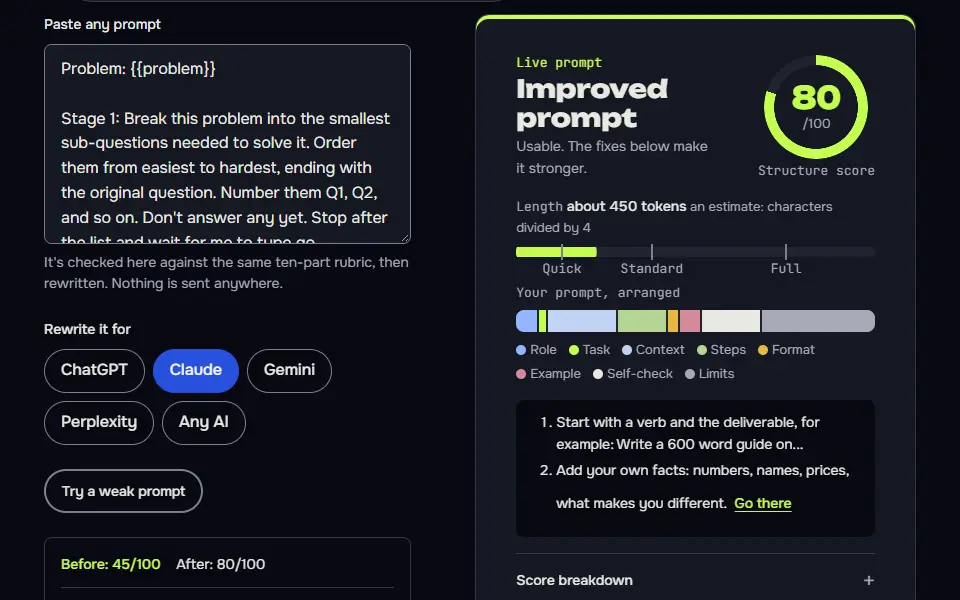
Problem: {{problem}}

Stage 1: Break this problem into the smallest sub-questions needed to solve it. Order them from easiest to hardest, ending with the original question. Number them Q1, Q2, and so on. Don't answer any yet. Stop after the list and wait for me to type go.

Stage 2 (when I type go): answer Q1 only. Then wait. Each time I type next, answer the following question, using only the answers already given. Show each answer in one to three sentences. For the final question, combine the earlier answers and show how you got the result.How to use
- Copy it with the button above.
- Fill the blanks in {{double braces}} with your own details.
- Paste it into ChatGPT, Claude or Gemini and send it.
- Then follow up: ask for one change at a time.
Before you run “Least-to-most in two stages” for the first time, the lesson on how to use AI prompts step by step walks through copying, filling and sending it.
A worked ladder for a multi-part word problem
A built-in check that the ladder ends at the real question catches a common failure.
Solve this by least-to-most prompting.

Problem: {{problem}}

Step 1: write the sub-questions from easiest to the full problem. Step 2: answer each one in order, writing the answer on its own line starting with its number. Each answer may use only earlier answers. Step 3: write "Final answer:" with the result for the original problem. Check that the last sub-question is the original problem, and if it isn't, fix the list before answering.Check a decomposition before you commit
The decomposition is where this technique succeeds or fails, so it gets its own review prompt.
Here is a problem and a list of sub-questions someone wrote to solve it by least-to-most prompting.

Problem: {{problem}}

Sub-questions:
{{ladder}}

Review the list. Tell me: 1) any sub-question that can't be answered from the earlier ones, 2) any step that's missing, 3) any step that's out of order, and 4) whether the last one is the original problem. Then give a corrected list. Don't answer the questions.
Lesson 12 of 22Techniques8 min
Lesson: Least-to-most prompting
Least-to-most prompting breaks a hard problem into sub-questions, from easiest to the full problem, and answers them in order, each using the answers before it. It's decomposition with a strict order.
Use it when
- A problem has parts that build on each other.
- The AI gets the whole thing wrong but could get each part right.
- You want to see which sub-step fails.
Skip it when
- The parts are independent: a batch or a list is simpler.
- It's a one-step question.
Solve this by least-to-most prompting.

Problem: A choir has 48 singers. Two thirds are adults and the rest are children. Each adult pays 12 for the term and each child pays 7. How much does the choir collect in total?

Step 1: write the sub-questions from easiest to the full problem. Step 2: answer each one in order, writing the answer on its own line starting with its number. Each answer may use only earlier answers. Step 3: write "Final answer:" with the result for the original problem. Check that the last sub-question is the original problem, and if it isn't, fix the list before answering.
**Step 1: Sub-questions (easiest to full problem)**

1. How many adults are in the choir? (two thirds of 48)
2. How many children are in the choir? (48 minus the adults)
3. How much do all the adults pay in total?
4. How much do all the children pay in total?
5. How much does the choir collect in total (adults plus children)?

Check: Sub-question 5 is the original problem (total collected by the choir), so the list is correct.

**Step 2: Answers in order**

1. Adults: 48 × 2/3 = 32
2. Children: 48 − 32 = 16 (uses answer 1)
3. Adult payments: 32 × 12 = 384 (uses answer 1)
4. Child payments: 16 × 7 = 112 (uses answer 2)
5. Total: 384 + 112 = 496 (uses answers 3 and 4)

**Final answer:** The choir collects **496**.
What to notice: Five sub-questions from easiest to the full problem, and it checked that the last one is the original question before answering. Each answer names the earlier answers it used, so you can follow the ladder. 384 plus 112 is 496.
Try it in Prompt StudioOpens the studio with the Decompose technique already selected.
Quick check: 3 questions
Practice: write your own
Write a least-to-most prompt for a problem of your own with parts that build on each other: a quote, a plan or a calculation.
Prompt Studio's rubric scores it right here. Nothing's sent anywhere.
Your progress is saved in this browser only. No sign-up.
When does least-to-most prompting beat one big prompt?
Least-to-most prompting beats one big prompt on compositional problems, such as multi-part word problems and plans with dependencies, plus long answers built from facts that each need working out first.
Don't use it for simple questions or for steps with no natural order; chain of thought is lighter there, and it won't cost you extra turns. Two neighbours pair well with it. Putting a broad principle before the first rung is step back prompting, which helps the model pick the right method for the ladder. And a short role prompt, such as "a patient maths tutor", keeps the tone of each rung steady across turns. The overview is on types of prompting.
Least to most prompting FAQ
Still stuck? Build it in Prompt Studio. It'll score each part as you go.
What is the purpose of least-to-most prompting?
The purpose of least-to-most prompting is to solve problems harder than the examples a model has seen by building up from easier parts. Each answer becomes context for the next, so the final answer rests on settled steps instead of one large leap.
Is least-to-most prompting in AI the same as in ABA therapy?
No, least-to-most prompting in AI isn't the ABA therapy technique; the AI method splits problems, and the ABA term describes a prompting hierarchy for learners. In therapy it means giving the smallest cue first and adding support only if it's needed.
Is least-to-most prompting the same as chain of thought?
No, least-to-most prompting isn't the same as chain of thought: it answers sub-questions in order, and chain of thought reasons in one pass. Least-to-most first asks for a decomposition, then feeds each answer forward, so it's closer to prompt chaining with a difficulty ladder.