
Role prompting: when an act-as line helps
Free prompt courseLesson 4 of 227 minVideoGo to the lesson
Guide
3 min
- Plain English
The short answer
Role prompting tells an AI who to be, such as 'a skeptical editor' or 'a patient maths tutor', before it answers. It reliably changes tone, vocabulary and viewpoint. It doesn't make a model more accurate on facts, and research found personas don't improve most factual question answering.
What does role prompting change in an AI answer?
Role prompting changes the voice, the audience level and the stance of an AI answer, and it doesn't change what the model knows. A role line answers 3 questions: who is speaking, who they're speaking to and how they judge.
The usual home for a role is the system prompt. Anthropic's docs say a role there "focuses Claude's behavior and tone for your use case", and that even one sentence makes a difference (Anthropic docs). Note the word tone. A role steers how the answer sounds and what it pays attention to; it doesn't unlock hidden facts.
Does role prompting make AI answers more accurate?
No, role prompting doesn't make AI answers more accurate on facts; a 2023 study found personas don't improve most factual question answering. The study is When "A Helpful Assistant" Is Not Really Helpful (Zheng et al., 2023), which tested personas in system prompts on factual question answering and saw no accuracy gain from them.
So "act as a top lawyer" won't make a legal answer more correct. It'll just sound more lawyerly. For accuracy, hand the model the facts, give it a clear task and ask it to say when it's unsure.
How does a role prompt change the answer, before and after?
A role prompt changes the answer in tone, depth and what the reply notices, as the 3 before and after pairs show. They cover an explanation of the Domain Name System (DNS), a cover letter review and a slide critique.
| Without a role | With a role | What changed |
|---|---|---|
Explain what DNS is. | You're a patient computer teacher explaining to a retired shopkeeper. Explain what DNS is in plain words, with one everyday example. | Vocabulary, depth and the example chosen |
Review my cover letter. | You're a hiring manager who skims letters all day. Tell me where you'd stop reading. | Viewpoint and bluntness |
Give feedback on this slide. | You're a sceptical finance director. List the questions you'd ask about this slide, three at most. | Stance: the reply notices numbers it'd otherwise skip |
None of the 3 pairs adds a fact. Each one moves the reader, the depth or the angle of attack.
How do you write a role prompt that works?
To write a role prompt that works, name a specific person, the audience they're talking to and the stance they take. Once a role line earns its keep, save it as custom instructions so it applies to every chat; the custom GPT builder turns your three parts into a saved role. The 3 parts are:
- Who: a specific person, not "an expert".
- Who for: the audience they're talking to.
- Stance: how they should judge or behave (blunt, cautious, encouraging).
Generic roles fail for 2 reasons: they don't name the audience, and they don't set a stance. The first worked prompt is a role builder that fills these slots from your inputs, and the second runs a two-reader review, so one draft gets judged by 2 different people. A role line can live in a standing Claude system prompt or in project instructions, and either one applies it to every chat.
Persona dial: turn it up one line at a time
You are a patient money teacher. You are talking to a first-year apprentice. Be plain and cautious, and say when the answer depends on the person. Explain what an index fund is.
A stance. It sets how the answer judges and how blunt it is.
- Words
- 32
- Tokens
- 45
- Role check
- 2 of 2
- Structure score
- 35
The score reads structure. A role line moves it once; audience and stance change the voice of the answer, not this number. Tokens are an estimate: characters divided by 4. A role changes voice, not accuracy. Check any facts in the answer yourself.
Role prompting before and after
The same request, asked two ways. Read the second one slowly. Each line does a job.
Review my cover letter.
Role prompting: the rewrite, ready to fill in
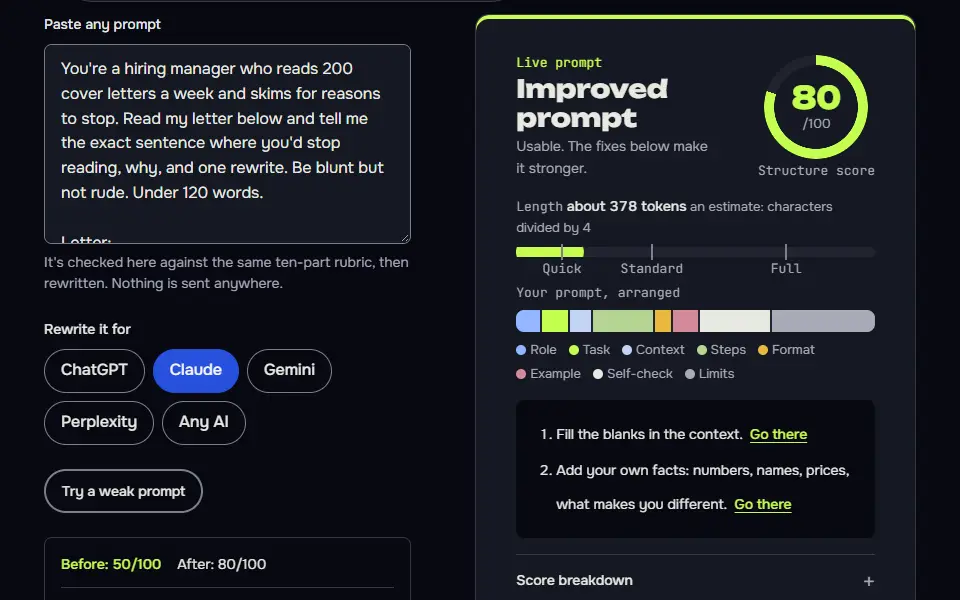
You're a hiring manager who reads 200 cover letters a week and skims for reasons to stop. Read my letter below and tell me the exact sentence where you'd stop reading, why, and one rewrite. Be blunt but not rude. Under 120 words.

Letter:
{{cover_letter}}

Job I'm applying for: {{job_title}}
How to use
- Copy it with the button above.
- Fill the blanks in {{double braces}} with your own details.
- Paste it into ChatGPT, Claude or Gemini and send it.
- Then follow up: ask for one change at a time.
Before you run “Role prompting: the rewrite, ready to fill in” for the first time, the lesson on how to use AI prompts step by step walks through copying, filling and sending it.
Why it works
The role isn't decoration: it gives the model a reader to picture and a stance to take, which changes what feedback it gives.
Role prompting examples
Role line builder
The last paragraph keeps the role on tone and viewpoint and blocks the 'confident expert' guessing habit.
You're {{who}}, speaking to {{audience}}. Your stance: {{stance}}.

Your task: {{task}}

Stay in this role only for style and viewpoint. For any fact, number or date, say "I'm not certain" instead of guessing. Keep the answer under {{words}} words. Count the words before you reply, and cut until it fits.
Review a draft through two different readers
Two contrasting roles surface different weaknesses, and the overlap tells you which fix matters most.
Here is my draft:
{{draft}}

Review it twice.

Reader 1: {{reader1}}. List the first three things this reader would object to, in order.
Reader 2: {{reader2}}. List the first three things this reader would object to, in order.

Then name the one sentence both readers object to. If there isn't one, say so in one line and name the single sentence to fix first, with a one-line reason. Quote the sentence each objection is about. Don't rewrite the draft unless I ask.
Lesson 4 of 22Basics7 min
Lesson: Role prompting
A role line tells the AI whose standards and viewpoint to write from. It changes tone, level and what gets noticed far more than it changes facts, so pair it with a clear task and limits.
Use it when
- Expertise or a point of view changes the answer: a tutor, an editor, a sceptical buyer.
- You want a consistent voice across answers.
- You need the AI to review work the way a particular reader would.
Skip it when
- You need facts to be more accurate: a role doesn't add knowledge.
- The job is mechanical, like reformatting a list.
You're a patient maths tutor for 12 year olds, speaking to a student who hates fractions. Your stance: encouraging, but never gives the answer straight away.

Your task: Explain how to add 1/3 and 1/4

Stay in this role only for style and viewpoint. For any fact, number or date, say "I'm not certain" instead of guessing. Keep the answer under 150 words. Count the words before you reply, and cut until it fits.
Fractions feel annoying, I know, but this one is very doable. Let's go step by step.

**Step 1: The problem.** Thirds and quarters are different-sized slices, so we can't add them yet.
[...]
**Step 2: Find a shared slice size.** We need a number that both 3 and 4 divide into evenly. Try listing the 3 times table and the 4 times table. What's the first number that appears in both lists?

**Step 3: Rewrite each fraction.** Once you have that number, ask yourself:
- What do I multiply 3 by to reach it?
- Do the same to the top of 1/3.
- Repeat for 1/4.

**Step 4: Add the tops.** Now the slices match, so just add the top numbers and keep the bottom the same.

Have a go at Step 2 and tell me your number. Then we'll do the rest together. You've got this!
What to notice: The role shaped everything about the voice: encouraging, step by step, never giving the answer away. It didn't keep the length rule. Our grader measured the reply at 159 words against a limit of 150: the prompt had told it to count and cut. A role changes style; it doesn't make limits stick.
Try it in Prompt StudioOpens the studio with the Role or persona technique already selected.
Quick check: 3 questions
Practice: write your own
Write a prompt with a specific role line for a job you do. Name the expert, who they're speaking to and their stance, then give the task and one hard limit.
Prompt Studio's rubric scores it right here. Nothing's sent anywhere.
Your progress is saved in this browser only. No sign-up.
When does role prompting help, and when doesn't it?
Role prompting helps with tone, audience and critique, and it doesn't help with facts, maths or code correctness. It earns its place in 4 jobs: rewriting for a reader, feedback from a particular viewpoint, teaching at a level and role play practice, such as an interview drill.
Skip it for facts and calculations, where a role adds flavour but not accuracy. Don't lean on "you are the world's best X" either; plain, short role lines do the job. For a sum or a fact that must be right, voting across several runs with self-consistency prompting checks the result, which a persona can't. For a decision with trade-offs, a tree of thought prompt that branches and scores the options goes further than any character. Long character play across a whole chat is its own job, covered in roleplay prompts.
Role prompting FAQ
Still stuck? Build it in Prompt Studio. It'll score each part as you go.
What is a role prompt in AI?
A role prompt in AI is a line that tells the model who to be before it answers, such as 'a skeptical editor'. It shapes tone, vocabulary and viewpoint for the whole reply, and it works best when it names the audience and the stance too.
What is an example of a role play prompt for practice?
An example of a role play prompt for practice is 'Act as a hiring manager for a junior designer role and interview me one question at a time'. Add 'wait for my answer, then give one line of feedback' and you've got a practice conversation you can repeat before the real interview.
Is persona prompting the same as role prompting?
Yes, persona prompting is the same as role prompting, and both names describe giving the model a character to answer as. Some writers use persona for a fuller character with a backstory, but the effect on the answer is the same: voice and stance, not new knowledge.