
Meta prompting, with a prompt you can paste
Free prompt courseLesson 17 of 228 minVideoGo to the lesson
Guide
3 min
- Plain English
The short answer
Meta prompting means asking an AI to write, critique or improve a prompt for you, instead of writing it yourself. You describe the goal, the model drafts the prompt, you test it and feed the result back. It's quick for turning a vague idea into a clear brief, but it needs your real context.
What are the two meanings of meta prompting?
Meta prompting has 2 meanings: using an AI to write your prompt, and the research method that gives a model a structure to follow instead of content examples. Most people searching for it want the first one, so that's what this page teaches.
The everyday meaning is an AI writing your prompt from a goal description. Anthropic's Claude Cookbook has a well-known version, the metaprompt, which turns a task description into a full prompt template.
The research meaning is structure-first prompting. The paper Meta Prompting for AI Systems (Zhang, Yuan and Yao, 2023) builds prompts around the formal shape of a task instead of worked, content-specific examples. A related paper, Meta-Prompting (Suzgun and Kalai, 2024), has one model act as a conductor over specialist copies of itself. For the everyday kind, the three rounds under “How do you run meta prompting in three rounds?” do the drafting.
How do you run meta prompting in three rounds?
To run meta prompting in three rounds, describe the goal, test the draft prompt and feed the problems back to the model. Prefer to skip the back and forth? The AI prompt generator and Prompt Studio runs the first round for you from a one-line goal, and it's the home tool on this site.
- Describe the goal, not the prompt. Name the job, the audience and what a good result would look like. Tell the model to ask questions about anything that's missing, so you get questions back before a draft.
- Test the draft prompt. Run it on a real input. Don't judge a prompt by reading it.
- Feed back the problems. Paste the prompt, the output and what went wrong, then ask for the smallest edit that fixes it. That's the prompt critique step, and the minimal-edit repair prompt on this page does exactly that.
What does a three-round meta prompting example look like?
A three-round meta prompting example looks like a request for a complaint-reply prompt, two questions back from the model, a tested draft and one fix. Here's how it played out for a small tea shop that gets late-delivery complaints.
Round 1
You ask for a prompt that drafts replies to late-delivery complaints. The model asks two questions, about the refund policy and the tone, you answer, and it returns a prompt with a role, the policy, a tone note and a 90-word cap.
Round 2
You run it on a real complaint. The reply is warm, but it promises a refund the policy doesn't allow.
Round 3
You paste the prompt, the reply and the problem: the shop gives store credit, never refunds. The model adds a hard rule and a check step, and the next test passes.
Notice who did what: the model wrote the structure, and you supplied the facts and judged the output. That split is the technique.
Where does meta prompting fall short?
Meta prompting falls short whenever the model lacks your real context, so its first draft reads generic until you add the facts. Three limits come up most:
- No access to your context. The model can't see your business, so it fills gaps with plausible guesses. Make it ask first.
- Generic, long first drafts. Generated prompts tend to run long. Cut anything that doesn't change the output.
- Grading its own work. A model that wrote the prompt will rate it kindly, and a prompt that reads well can still fail on real input. Test it yourself.
That's the honest answer in this section: meta prompting is a drafting aid, and you're still the editor. You'll get the best drafts when you've got a real example of good output to share.
Meta prompt before and after
The same request, asked two ways. Read the second one slowly. Each line does a job.
Write me a good prompt for replying to unhappy customers.
I run a small tea shop. Write a reusable prompt that drafts replies to customers whose orders arrived late. Before writing it, ask me up to 4 questions about anything you need to know (policy, tone, signature). Then produce the prompt with: a role line, my policy as rules, a tone note, a 90-word cap, and a final self-check step. Mark the place where I'll paste each customer message with the label Customer message.
Why it works
The after version describes the goal and tells the model to ask first, which turns a generic prompt into one that fits your shop.
Meta prompt examples
Meta prompt: have the AI write your prompt
It makes the model ask before it drafts and ships a test plan, so you can judge the prompt on real inputs.
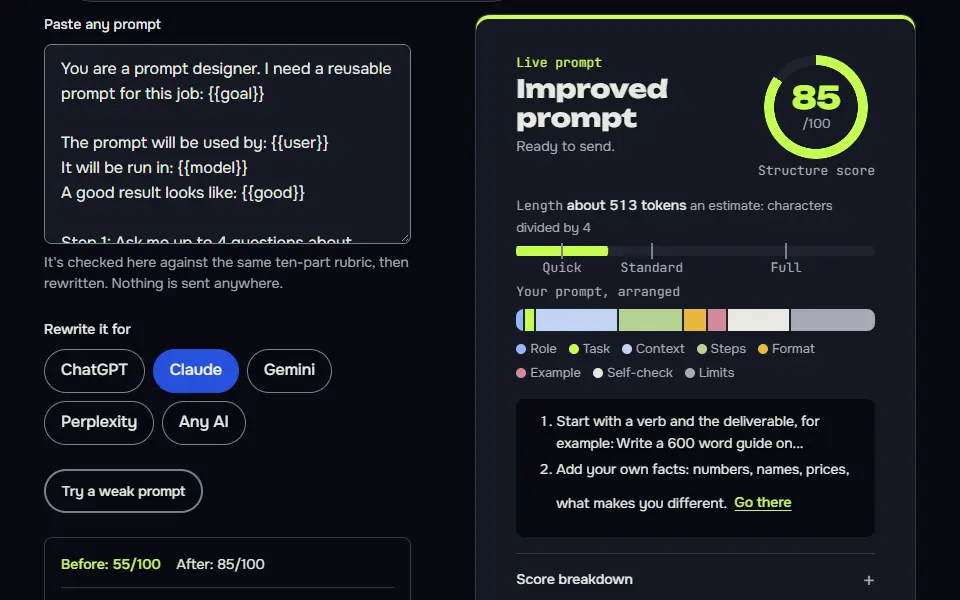
You are a prompt designer. I need a reusable prompt for this job: {{goal}}

The prompt will be used by: {{user}}
It will be run in: {{model}}
A good result looks like: {{good}}

Step 1: Ask me up to 4 questions about anything you need to know before writing. Wait for my answers.
Step 2: Write the prompt with these parts: role, context, task, constraints, output format and a short self-check. Mark every place a user will paste something with a short name in double curly braces.
Step 3: Add a 3-line test plan: one normal input, one awkward input, one missing-information input, with what a correct result looks like for each.

Keep the prompt under {{words}} words and don't invent facts about my business.
How to use
- Copy it with the button above.
- Fill the blanks in {{double braces}} with your own details.
- Paste it into ChatGPT, Claude or Gemini and send it.
- Then follow up: ask for one change at a time.
Before you run “Meta prompt: have the AI write your prompt” for the first time, the lesson on how to use AI prompts step by step walks through copying, filling and sending it.
Meta prompt: fix a prompt from its failure
Asking for the smallest edit prevents the common failure where a rewrite breaks parts that worked.
Here is a prompt I use:
<prompt>
{{prompt}}
</prompt>

Here is an input I gave it and the output it produced:
<run>
Input: {{input}}
Output: {{output}}
</run>

What was wrong: {{problem}}

Diagnose in two sentences why the prompt allowed this. Then give the smallest edit that fixes it, showing only the changed lines with the old line above the new line. Don't rewrite parts that worked. End with one new test input that would catch the same failure again.
Lesson 17 of 22Techniques8 min
Lesson: Meta prompting
A meta prompt asks the AI to write the prompt for you. Done well, it interviews you first, then drafts a reusable prompt with blanks and a test plan, so you're not starting from a blank page.
Use it when
- You'll reuse the prompt many times, or hand it to someone else.
- You know the job but not how to phrase it for an AI.
- You want the model to tailor the prompt to itself.
Skip it when
- It's a one-off: just ask for the thing.
- You won't answer the questions: the prompt will be generic.
You are a prompt designer. I need a reusable prompt for this job: Draft replies to late-delivery complaints

The prompt will be used by: me and one part-time assistant
It will be run in: ChatGPT
A good result looks like: warm, under 90 words, follows our store credit policy

Step 1: Ask me up to 4 questions about anything you need to know before writing. Wait for my answers.
Step 2: Write the prompt with these parts: role, context, task, constraints, output format and a short self-check. Mark every place a user will paste something with a short name in double curly braces.
Step 3: Add a 3-line test plan: one normal input, one awkward input, one missing-information input, with what a correct result looks like for each.

Keep the prompt under 250 words and don't invent facts about my business.
Before I write the prompt, I need a few facts so I don't invent anything about your business.

1. **Store credit policy:** What exactly is it? Please paste the wording, or give the amounts, the conditions (for example, how many days late), and who can approve it.
2. **Other remedies:** Besides store credit, can you offer refunds, free reshipping, or expedited shipping? Or is credit the only option?
3. **Voice and sign-off:** How should replies sound (for example, friendly and casual, or polished), and how should they be signed (your name, the store name, or a team name)?
4. **What the assistant will have on hand:** For each complaint, what information will you or your assistant have (order number, promised date, tracking status, customer name)? And is there anything the reply must never promise, such as a new delivery date?

Once you answer, I'll write the prompt and the test plan.
What to notice: Step 1 worked as designed: it asked four focused questions and wrote nothing until it had the answers. Each question targets something that would otherwise be invented, starting with the store credit policy. That's the sign of a good meta prompt: it asks before it guesses.
Try it in Prompt StudioOpens the studio with the Meta prompt technique already selected.
Quick check: 3 questions
Practice: write your own
Write a meta prompt for a prompt you'd reuse: replies, reports or social posts. Say who will use it and where, what good looks like, and ask for questions before the draft.
Prompt Studio's rubric scores it right here. Nothing's sent anywhere.
Your progress is saved in this browser only. No sign-up.
When should you ask the AI to write the prompt in meta prompting?
Ask the AI to write the prompt when you're facing a blank page, need a reusable template, or have a prompt that keeps failing and you can't see why. Write it yourself for one-off questions, or once you already know the exact output you want: that's quicker.
A generated prompt for a maths or logic task often benefits from a reasoning scaffold, and the chain of thought prompting template shows the lines to ask for. For a short job, compare the draft with a plain instruction from a zero-shot AI prompt before you keep the longer version. For writing by hand: how to write a good AI prompt. For reusable forms: prompt templates.
Meta prompt FAQ
Still stuck? Build it in Prompt Studio. It'll score each part as you go.
What is a meta prompt, in short?
A meta prompt is a prompt that asks an AI to write or improve another prompt. You give it the goal, it drafts the prompt, and you test what comes back.
What is a good meta prompt example?
A good meta prompt example is 'Ask me up to three questions, then write a prompt that drafts replies to late-delivery complaints in a calm tone'. It works since it gets questions back first, and the copy-paste version in the worked prompts adds a role, a policy line and a word limit.
Is meta prompting better than writing prompts myself?
No, meta prompting isn't better than writing prompts yourself when you already know the output; it's faster when you're starting from a vague idea. The model doesn't know your business, so it'll guess where you haven't told it.
Is meta prompting the same as prompting Meta AI?
No, meta prompting isn't the same as prompting Meta AI; meta prompting is a technique, and Meta AI is one company's assistant. The 2 terms are a homonym pair, and you can run meta prompting in Meta's assistant, ChatGPT, Claude or Gemini alike.