
Self-critique prompting: draft, score, rewrite
Free prompt courseLesson 18 of 226 minVideoGo to the lesson
Guide
3 min
- Plain English
The short answer
Self-critique prompting asks the AI to write a draft, judge it against a checklist you supply, list what failed, and rewrite it to fix every fail, all in one reply. It works best when the checklist is concrete: word counts, required facts, banned claims. Vague criteria such as make it better give vague critiques.
How does self-critique prompting work?
Self-critique prompting works in 3 steps: the AI writes a draft, scores it pass or fail against your checklist, then rewrites it to fix every fail. All three happen in one reply, so there's no back and forth. You give the job, your facts and a short checklist; the model hands back the draft, a scorecard with a pass or fail per item, and the rewrite. Ask for a two-line note on what changed, so you'll see the edits at a glance.
It's a one-reply version of ideas from research. Self-Refine (Madaan and colleagues, 2023) has a model give feedback on its own output and revise over repeated rounds. A related research name you'll meet is Reflexion, from Noah Shinn and colleagues in 2023, where an agent writes a critique of a failed attempt and keeps it in memory for the next try. Doing it in one prompt is quicker; doing it over several turns with you in the loop is the iterative prompting guide.
What makes a good self-critique checklist?
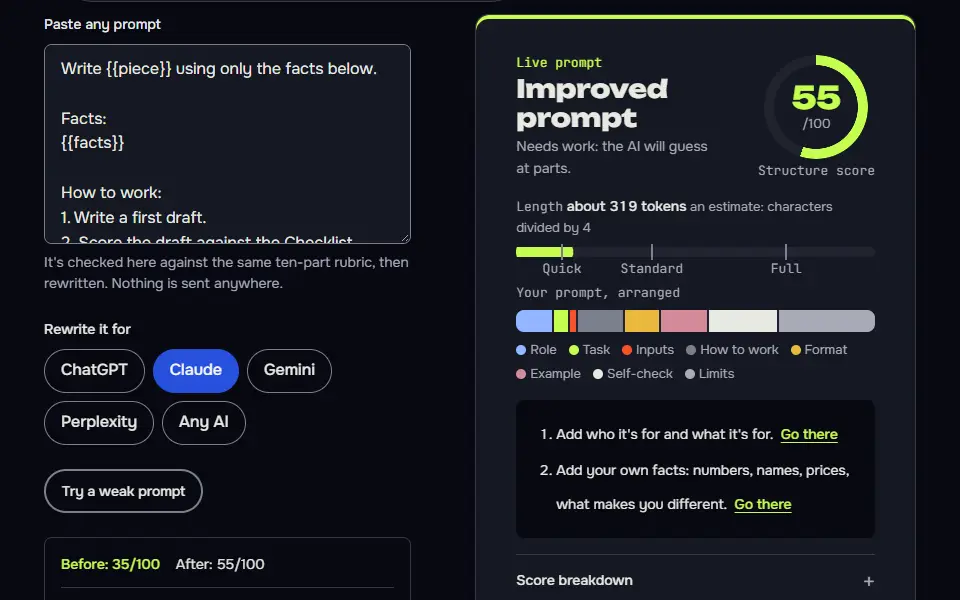
A good self-critique checklist has 3 to 6 checkable items, such as a word range, required facts and a ban on invented claims. With more than 6, the scorecard gets skimmed and you won't read it. Each item should be a countable rule, and a quick way to find the vague ones is to paste your checklist into the online prompt optimizer: it grades your checklist with its ten-part rubric and suggests a rewrite for any rule that's too loose to check.
- Countable rules: "60 to 80 words" is a rule the AI can count; "engaging" isn't, and it's the one rule a model can't check fairly.
- The rules you care about most: in our example, a cracked mug means a refund and a bad review, so the microwave warning had to be clear.
- A ban on invented claims: models add flattering words that aren't in your facts, and a rule against them gives the critique something to catch.
Write the checklist yourself. Don't let the AI write its own criteria and then mark itself against them: it'll be generous.
What did the tested self-critique run catch?
The tested self-critique run caught an invented word, "sturdy", and a draft one word under the limit, and fixed both. The job was a 60 to 80 word description of a hand-thrown stoneware mug, with 5 checklist rules. The scorecard failed "sturdy", which wasn't in the facts, and failed the length at 59 words. The final version dropped the word, spelled out the microwave warning and landed at 62 words. We recounted both drafts, and the model's counts were right.
Self critique prompting before and after
The same request, asked two ways. Read the second one slowly. Each line does a job.
Write a product description for my handmade mug and make it really good.
Write a product description for the mug below, then critique it and rewrite it.
1. Draft, 60 to 80 words.
2. Score the draft against the Checklist, pass or fail per item.
3. Rewrite it to fix every fail.
Checklist: first sentence says what it is and who it's for; the microwave warning is clear; no invented claims; 60 to 80 words; ends with the price.
Mug: 350 ml stoneware mug, hand glazed in navy blue, for coffee and tea drinkers. Gold rim, so not microwave safe. Hand wash only. Price £18.
Why it works
"Make it really good" gives the AI nothing to check. The rewrite turns good into 5 rules: a clear first sentence, a clear microwave warning, no invented claims, a word range and a closing price. The scorecard shows you exactly which ones it fixed.
Self critique prompting examples
Draft, scorecard, final: for any short piece
A checklist you write is a checklist the model can't quietly soften.
Write {{piece}} using only the facts below.

Facts:
{{facts}}

How to work:
1. Write a first draft.
2. Score the draft against the Checklist, pass or fail per item, and list what failed.
3. Rewrite it to fix every fail.

Checklist:
{{checklist}}
- No claims that aren't in the facts.

Output: Draft, then Scorecard (a table: item, pass or fail), then Final version, then Changes made in 3 lines or fewer.
How to use
- Copy it with the button above.
- Fill the blanks in {{double braces}} with your own details.
- Paste it into ChatGPT, Claude or Gemini and send it.
- Then follow up: ask for one change at a time.
Before you run “Draft, scorecard, final: for any short piece” for the first time, the lesson on how to use AI prompts step by step walks through copying, filling and sending it.
Critique my draft, then fix only what fails
Keeps your own voice: only the failing sentences change.
Here is my draft:
"""
{{draft}}
"""

Check it against these rules, pass or fail each, quoting the sentence that fails: {{rules}}. Then rewrite only the sentences that fail and leave everything else exactly as it is. Show the fixed draft, then list each change in one line.
Lesson 18 of 22Loops and agents6 min
Lesson: Self-critique: draft, score, rewrite
Ask for a draft, a pass or fail scorecard against your checklist, and a rewrite that fixes every fail. It's the quickest way to make an AI enforce your own rules on its first answer.
Use it when
- Quality matters more than speed: copy, proposals, descriptions.
- You have clear rules: length, facts to include, claims to leave out.
- You keep making the same fix by hand.
Skip it when
- You can't say what good looks like as checkable rules.
- The risk is wrong facts: the model won't reliably catch its own. Ground it instead.
## Role
You are a copy editor who writes clear product descriptions for small online shops.

## Task
Write a product description for the item below, then critique it and rewrite it.

## Inputs
- Product: a hand-thrown stoneware coffee mug
- Holds 350 ml
- Dishwasher safe, not microwave safe
- Made in Cornwall by one potter
- Glaze: speckled oatmeal; each one varies slightly
- Price: 28 pounds

## How to work
1. Write a first draft, 60 to 80 words.
2. Score the draft against the Checklist, pass or fail per item, and list what failed.
3. Rewrite it to fix every fail.

## Checklist
- The first sentence says what it is and who it's for.
- The microwave warning is clear.
- No invented claims (no "best", no awards, no reviews).
- 60 to 80 words.
- Ends with the price.

## Output format
Draft, then Scorecard (a table: item, pass or fail), then Final version, then Changes made in 3 lines or fewer.
## Draft

This hand-thrown stoneware mug is made for coffee lovers who like their morning cup with a bit of character. Shaped by one potter in Cornwall, it holds 350 ml and wears a speckled oatmeal glaze, so no two are exactly alike. It is dishwasher safe, but please keep it out of the microwave. A sturdy, handsome everyday mug. £28

## Scorecard

| Item | Result |
|---|---|
| First sentence says what it is and who it's for | Pass |
| Microwave warning is clear | Pass |
| No invented claims | Fail ("sturdy" isn't in the inputs) |
| 60 to 80 words | Fail (59 words) |
| Ends with the price | Pass |

## Final version

This hand-thrown stoneware coffee mug is for anyone who likes a morning cup with a bit of character. Made by one potter in Cornwall, it holds 350 ml and is finished in a speckled oatmeal glaze, so each mug varies slightly from the next. It is dishwasher safe but not microwave safe, so please never put it in the microwave. Price: £28.

*(62 words)*

## Changes made

- Removed "sturdy, handsome everyday mug", which was unsupported by the inputs.
- Stated "not microwave safe" explicitly, followed by a direct instruction.
- Brought the count to 62 words, and ended on the price.
What to notice: The scorecard caught an invented word ("sturdy") and a draft one word under the limit, and the final version fixed both. We recounted, and the model's counts are right: the draft is 59 words and the final version is 62. The checklist did the work: each fail it found was one of your rules.
Try it in Prompt StudioOpens the studio with the Self-critique and revise technique already selected.
Quick check: 3 questions
Practice: write your own
Write a self-critique prompt for a short piece of your own: an email, a bio or a description. Include your facts and a checklist of three to six checkable rules.
Prompt Studio's rubric scores it right here. Nothing's sent anywhere.
Your progress is saved in this browser only. No sign-up.
What are the limits of self-critique prompting?
The limits of self-critique prompting are weak fact checking and longer replies: a model rarely doubts a claim it made, so pair it with a grounded prompt. The honest split is that it's strong on rule checks (length, format, banned words, required items) and much weaker at spotting a confident error. The fix for facts is a different lesson: how to prevent AI hallucinations shows the grounded prompt that pairs with this one, so the source handles facts and the checklist handles rules.
The other cost is length, and it's easy to underrate. You'll scroll past 3 parts, the draft, the scorecard and the final version, so ask for only the final version once you trust the checklist. On important pieces, read the scorecard yourself: an item marked pass isn't proof. It's lesson 18 of the free prompt course.
Before adding a checklist to a site prompt, fill its blanks as using the prompts step by step explains.
Self critique prompting FAQ
Still stuck? Build it in Prompt Studio. It'll score each part as you go.
Is self-critique prompting the same as Self-Refine?
No, self-critique prompting isn't the same as Self-Refine: Self-Refine revises over repeated rounds, while self-critique does one round in one reply from your checklist. They're close in spirit. Self-Refine is a 2023 research method; the one-reply version is the practical shortcut for everyday writing.
Does asking the AI to critique its own work help?
Yes, asking the AI to critique its own work helps with rule checks such as length and banned words, and much less with facts. In our test it caught an invented word and a short draft and fixed both. A claim the model already believes rarely gets doubted, so you'll still check facts against a source.
How many items should a self-critique checklist have?
A self-critique checklist should have 3 to 6 items; with more than 6, the scorecard gets skimmed. Pick the rules you've had to fix by hand before. A rule you couldn't check yourself in 10 seconds probably isn't one the model will check well either.