
Prompt chaining examples
Free prompt courseLesson 20 of 229 minVideoGo to the lesson
Guide
4 min
- Plain English
The short answer
Prompt chaining means splitting one big task into a sequence of smaller prompts, where each answer feeds the next one. You get checkpoints to review and fix, and each step stays focused. Use it for research, long writing and analysis, and skip it when one clear prompt does the job.
What is prompt chaining?
Prompt chaining is splitting one big task into a sequence of smaller prompts, where each answer feeds the next one. It turns "write me a report" into four stages: gather, outline, draft and check. Google's prompting docs describe the mechanic plainly: "the output of one prompt in the sequence becomes the input of the next prompt", and the last output is the final result.
A chain gives you two kinds of control: you read every stage, and you can edit any stage before it's passed on. That's the point of the checkpoints. What you'd miss in one long answer, you'll see in a short one.
Does prompt chaining still matter with newer models?
Yes, prompt chaining still matters with newer models, though less than it did, as you still need checkpoints to review between stages. Anthropic's guidance says that with adaptive thinking, Claude handles most multistep reasoning inside one call, and that explicit chaining stays useful "when you need to inspect intermediate outputs or enforce a specific pipeline structure" (best practices).
So the test isn't hard: chain when you want a checkpoint, not out of habit. You'll know you've over-chained once you're pasting between six prompts for a job one prompt could do.
Which three prompt chaining examples can you copy?
The three prompt chaining examples you can copy are a research chain, a writing chain and an analysis chain, each with three prompts in the worked prompts section. Want a chain already built around a business goal? The prompt sequences hub has ready ones in ordered steps, from first idea to finished file.
- Research chain: collect facts with the type of source that'd confirm each, such as a regulator or a trade body like the Confederation of the European Bicycle Industry (CONEBI), rank them by reliability, then write a one-page brief using only the ranked facts.
- Writing chain: outline with word budgets, draft one section at a time, then run a consistency pass.
- Analysis chain: describe the data, find patterns, then write the recommendation with caveats.
All three share one design: every step has one job, one input and one output shape. Say what the output must look like so the next step can parse it. Don't make the steps clever; plain steps are easier to check, and you'll see exactly where step 2 broke.
How do you run a prompt chain in one chat?
Run a prompt chain in one chat by pasting each step yourself and asking for a STATE card at the end of every reply. Chat apps don't run chains on their own, so you move it along, and there's no code involved.
- Separate prompts. Paste step 1, read it, paste the answer into step 2, and so on. It's best when you want to edit between steps.
- One loop prompt. Paste a single prompt that holds every step. You type
nextto move on, and the STATE card records the current stage and what's done.
The STATE card doubles as a resume rule: paste the last card into a new chat and the single-chat loop picks up where it stopped. The last worked prompt on this page is a ready one. On the home page, the Prompt Studio has a Chain mode that exports numbered prompts or one loop prompt for ChatGPT, Claude, Gemini or Perplexity.
How is prompt chaining different from chain of thought prompting?
Prompt chaining is different from chain of thought prompting in that it uses several prompts in sequence, and chain of thought asks for steps inside one answer. In a chain you read each stage before the next prompt runs, so you're the one who catches a bad step.
Chain of thought keeps the steps inside a single reply that you can't stop halfway. The two mix well: a chain's middle stage can ask for reasoning, and a chain of thought that keeps failing at one step usually wants splitting into stages.
Prompt chaining before and after
The same request, asked two ways. Read the second one slowly. Each line does a job.
Research the electric bike market in Germany and write a one-page brief for my investors with sources and a recommendation.
Step 1 (collect): List 10 facts about the German e-bike market that an investor would care about. For each, give the claim, the likely source type and how confident you are. Output a table.
Step 2 (rank): Take the table and drop any fact you can't source. Rank the rest by reliability. Output the top 6.
Step 3 (write): Write a one-page brief using only the 6 ranked facts, then a recommendation with two risks.
Why it works
Each step has one job and a checkpoint, so you catch a made-up fact at step 2, before it's baked into a finished brief.
Prompt chaining examples
Research chain, step 1: collect
It asks for source types and confidence up front so step 2 has something to rank.
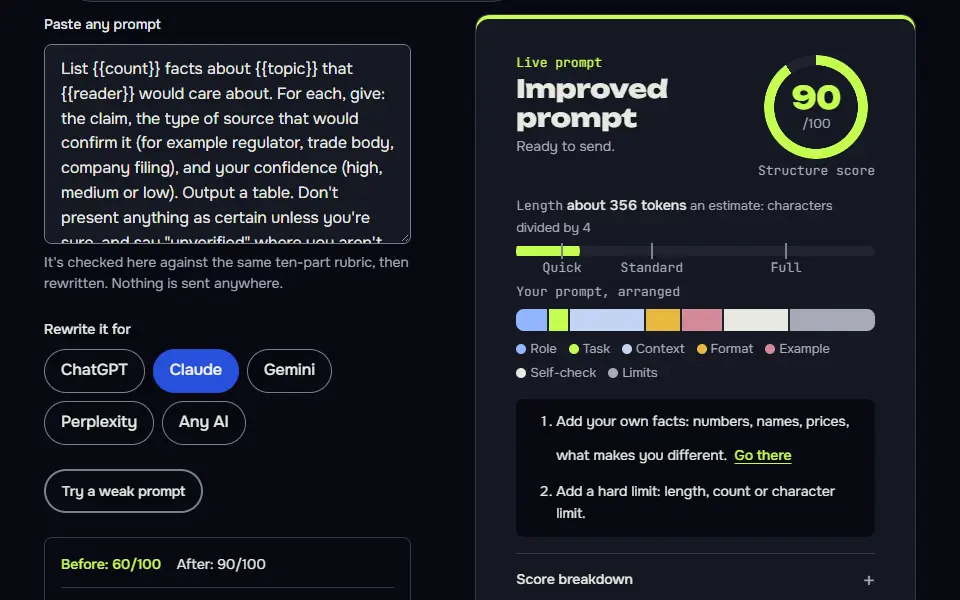
List {{count}} facts about {{topic}} that {{reader}} would care about. For each, give: the claim, the type of source that would confirm it (for example regulator, trade body, company filing), and your confidence (high, medium or low). Output a table. Don't present anything as certain unless you're sure, and say "unverified" where you aren't.
How to use
- Copy it with the button above.
- Fill the blanks in {{double braces}} with your own details.
- Paste it into ChatGPT, Claude or Gemini and send it.
- Then follow up: ask for one change at a time.
Before you run “Research chain, step 1: collect” for the first time, the lesson on how to use AI prompts step by step walks through copying, filling and sending it.
Research chain, step 2: rank
A separate pruning step is the checkpoint a single mega-prompt can't give you.
Here is the table from step 1:
{{step1_output}}

Drop any fact marked unverified or low confidence that I can't check myself. Rank the rest from most to least reliable, with a one-line reason each. Output the top {{keep}} as a numbered list, and list the dropped facts below it so I can see what went.
Research chain, step 3: write the brief
Restricting the writer to the ranked list keeps unchecked claims out of the finished page.
Using only the numbered facts below, write a one-page brief for {{reader}}. Structure: a two-sentence summary, the facts as short paragraphs with their numbers, then a recommendation and two risks. Don't add any fact that isn't in the list. If the list can't support a recommendation, say so.

Facts:
{{step2_output}}
Writing chain, step 1: outline
Word budgets in the outline give the later drafting steps a length to hit.
Create an outline for a {{length}}-word {{piece}} for {{reader}} on {{topic}}. Give 5 to 7 headings. Under each, one line on what it must answer and a word budget. The budgets must add up to about {{length}}. Don't write any section yet.
Writing chain, step 2: draft one section
Passing earlier sections in prevents the repeats that long single-shot drafts suffer from.
Outline:
{{outline}}

Write section {{n}} only, to its word budget. Open with the answer to the heading in the first sentence. Keep the voice plain and use contractions. Don't repeat points already made in these earlier sections:
{{earlier_sections}}
Writing chain, step 3: consistency pass
A read-only audit step catches cross-section problems without creating new ones.
Here is the full draft:
{{draft}}

Do not rewrite it. List: (1) phrases or ideas repeated across sections, (2) places where two sections contradict each other, (3) any claim that needs a source, (4) the weakest transition. For each, quote the text and suggest the smallest fix. Then stop and wait for me to say which fixes to apply.Analysis chain, step 1: describe the data
Catching bad data before analysis stops confident conclusions on a broken table.
I'm giving you {{data_desc}}. Before analysing anything, tell me: what each column or field appears to mean, anything that looks wrong or missing, and what you would need to ask me before drawing conclusions. Don't compute or conclude yet.

Data:
{{data}}
Analysis chain, step 2: find patterns
Requiring the competing explanation keeps the patterns from hardening into false certainty.
My answers to your questions: {{answers}}

Now find the three most important patterns in the data. For each: state it in one sentence, show the numbers that prove it, and say what else could explain it. Don't recommend anything yet.

Data:
{{data}}
Analysis chain, step 3: recommend with caveats
The cheap falsifying test turns the recommendation into something the reader can check.
Using these patterns:
{{patterns}}

Write a recommendation for {{decision_maker}} in under {{words}} words. Give one primary action, why it follows from the patterns, the single biggest caveat, and one cheap test that would show if you're wrong. This is analysis support, not professional advice, so say what a specialist should confirm.
Run any chain in one chat with next and a STATE card
It reuses the same Work, Check, State, Next shape across steps and survives a new chat through the resume rule.
You'll run a chain of steps with me in this chat. Goal: {{goal}}.

The steps:
{{steps}}

Round 1 (your first reply): restate the goal, list the steps with their IDs (S1, S2...), and ask for any input you need for S1. Then stop.
Each later round, when I type next: do the next step only, using the output of the previous step.

Commands:
next: approve the last step and run the next one.
revise: <note>: redo the last step with my note, change nothing else.
back: reopen the previous step.
status: print the state card only.
stop: print the state card and stop.
Anything else I type is a normal instruction. Do it, then end with the state card. If it falls outside the Goal, don't start it: say it conflicts with the Goal, ask which wins and wait.

Every reply: 1) Work for this step. 2) Check: one line, pass or fail for 'used only the previous output', 'matches the step's output shape', 'no new facts'. Fix a fail before replying. 3) State card. 4) Next: one line.

State card, in a code block under 100 words:
STATE | chain | step 2 of 5
Goal: ...
Done: S1 (approved)
Queue: S2, S3...
Decisions: D1...
Last command: next

If this chat gets long, I'll open a new one, paste this prompt, the latest state card and the approved outputs, and type resume. Trust the card over anything else. Stop after step {{max}} and ask whether to continue.
Lesson 20 of 22Loops and agents9 min
Lesson: Prompt chaining
Prompt chaining splits a job into separate prompts that run in order, each using the last one's output: collect, then rank, then write. You can check and fix each stage before the next one builds on it.
Use it when
- Jobs with clear stages: research, then outline, then draft.
- One stage's mistakes would spoil everything after it.
- You want to reuse a stage on its own.
Skip it when
- It's a short job one prompt can do.
- The items are independent: use a batch instead.
List 10 facts about the German e-bike market that an investor would care about. For each, give: the claim, the type of source that would confirm it (for example regulator, trade body, company filing), and your confidence (high, medium or low). Output a table. Don't present anything as certain unless you're sure, and say "unverified" where you aren't.
Caveat: I have no browsing and my knowledge stops before today (Nov 2026), so I haven't seen the 2025 market data or later. Figures are approximate and should be checked against the sources listed. Where I'm unsure, I say "unverified."

| # | Claim | Source type that would confirm it | Confidence |
|---|---|---|---|
| 1 | Germany is Europe's largest e-bike market by annual unit sales. | Trade body (ZIV, Zweirad-Industrie-Verband; CONEBI at European level) | High |
[...]
**Other points to check:**
- The EU Batteries Regulation (2023/1542) will affect e-bike battery design, labelling and replaceability, but I'm unsure of the phase-in dates and which provisions apply to light-means-of-transport batteries. Check the regulation text.
[...]
If it helps, I can narrow this to a segment such as cargo bikes, components, leasing or retail.
What to notice: This is step 1 of a three-prompt chain: collect claims with a confidence level, before anything gets ranked or written up. It opened with a caveat about its knowledge cut-off and flagged what to check, which is exactly what step 2 needs. Our grader noted the table should give each figure's year in its own column.
Try it in Prompt StudioOpens the studio with the Sequencing or chaining technique already selected.
Quick check: 3 questions
Practice: write your own
Write step 1 of a chain for a job of your own, and end it with a short block that holds only what step 2 needs.
Prompt Studio's rubric scores it right here. Nothing's sent anywhere.
Your progress is saved in this browser only. No sign-up.
When should you split a task into a prompt chain?
Split a task into a prompt chain when it has stages with different jobs, when you need to check work between stages, or when one output is too long, and once a single prompt keeps dropping instructions.
Skip it for short tasks, quick rewrites and anything one clear prompt handles; a chain costs your time. The self-correction loop (draft, review against criteria, refine) is the smallest chain of all, and refining a prompt over several turns shows it in a normal chat. A stage that has to look things up or call a tool works better as a ReAct prompt template. For chains where each question builds on the last, read least-to-most prompting, and context engineering covers keeping each step's inputs small. The wider family is on types of prompting.
Prompt chaining FAQ
Still stuck? Build it in Prompt Studio. It'll score each part as you go.
What is prompt chaining in plain words?
Prompt chaining is running a task as a series of prompts, where each answer becomes the input for the next. You get a checkpoint after every stage, and each prompt stays short enough to check.
What is a simple prompt chaining example?
A simple prompt chaining example is gather facts, then outline, then draft, then check the draft against the facts. Each of those four prompts has one job, so it's easy to spot which one went wrong.
Do you need code to build a prompt chain?
No, you don't need code to build a prompt chain; you can run each step by hand in one chat. Code only helps once you're running the same chain hundreds of times, and that's rare.
Is prompt chaining the same as prompt sequencing?
Yes, prompt chaining is the same as prompt sequencing; both mean ordered prompts where each output feeds the next. Some people say sequence for a fixed business workflow, but the mechanic doesn't change, and you'll see both words used.