
Midjourney prompts by style and subject
Prompt hub1 prompt page
What are the best Midjourney prompts to try first?
The best Midjourney prompts to try first are 12 full scene prompts on this page, including a floating sneaker product shot, a rainy night taxi and a watercolour of foxgloves, each with its parameters. Each card's "why it works" note names the phrase or parameter doing the work.
Midjourney prompts by topic
One prompt generator sits under this hub, for building a Midjourney prompt from your own scene.
Midjourney prompt generator that writes the phrase list, the ratio, --raw and a --no list…
The best Midjourney prompts to start with
12 to try first. Switch the model once. Every card follows.
Floating sneaker, studio product shot
A low --s value and --raw keep Midjourney from adding decoration you didn't ask for.
a single white leather sneaker with a thick gum sole floating above a plain {{backdrop}} backdrop, soft diffused studio light, a soft-edged contact shadow below, short telephoto product photography, clean and minimal --ar 4:5 --raw --s 50 --no text, letters, watermarkHow to use
- Copy it with the button above.
- Fill the blanks in {{double braces}} with your own details.
- Paste it into Midjourney and generate. Chat AIs can't make the picture. Then change one thing per try.
Before you run “Floating sneaker, studio product shot” for the first time, the lesson on how to use AI image prompts walks through copying, filling and sending it.
Lone taxi at a rainy night intersection
A small --chaos adds variation between the four results without breaking the scene, so it's safe to use.
a lone yellow taxi at a rain-soaked city intersection at night, neon reflections on the asphalt, volumetric haze, anamorphic lens flare, cinematic still --ar 21:9 --s 300 --chaos 10 --no text, letters, watermark
Loose watercolour of foxgloves and ferns
Naming the paper and the technique (pigment bleed, wet edges) gives the painted look without naming an artist.
loose watercolour painting of foxgloves and ferns on cold-press paper, visible pigment bleed, soft wet edges, white paper margins --ar 3:4 --s 400 --no text, letters, watermark
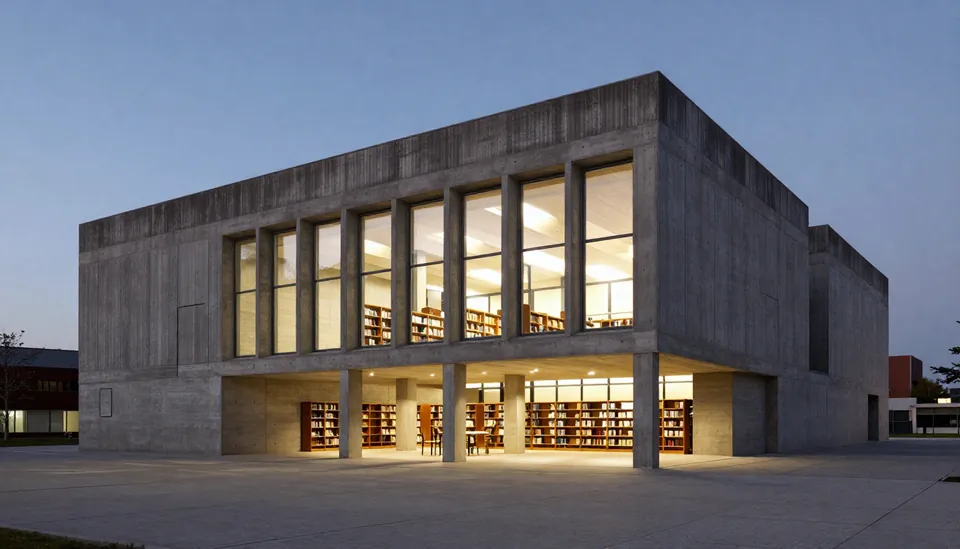
Brutalist library at dusk
Warm interior light against cool concrete is the contrast that makes this look read as architecture photography, and it's easy to reuse.
a brutalist public library at dusk, raw board-formed concrete, warm light glowing from tall windows, long exposure, wide-angle architectural photography, empty plaza --ar 16:9 --raw --no text, letters, watermark
Repeating ginkgo leaf pattern
The --tile parameter makes the result repeat without visible seams, which is the point of a pattern.
tileable pattern of ginkgo leaves in {{colours}} on cream, flat vector illustration, even spacing, no shadows --tile --ar 1:1 --no text, letters, watermarkCharacter reference sheet
Asking for three views on a plain background gives a usable design sheet, so you're not stuck with one dramatic pose.
character reference sheet of a fictional space courier, front view, side view and back view, neutral standing pose, plain light grey background, consistent costume details, orange jacket with reflective stripes --ar 3:2 --raw --no text, letters, watermark
Isometric cutaway of an attic studio
Words like 'cutaway' and 'clay-render' pin down both the viewpoint and the material look.
isometric cutaway of a cosy attic studio with tiny plants, a drafting table and a sleeping cat, soft clay-render look, pastel palette --ar 1:1 --s 250 --no text, letters, watermark
Market breakfast flat lay
Listing real objects and one light direction produces an editorial food shot.
overhead flat lay of a market breakfast: fresh figs, yoghurt in a ceramic bowl, honeycomb, a linen napkin, a small knife, natural window light from the left, soft shadows --ar 4:5 --raw --no text, letters, watermark
Library inside a whale skeleton
--weird and --chaos push toward odd, unexpected results, so use them only when you're after surprise.
a vast library inside the skeleton of a whale, books drifting through the water like plankton, shafts of soft blue light from above, dreamlike --ar 3:2 --weird 500 --chaos 25 --no text, letters, watermark
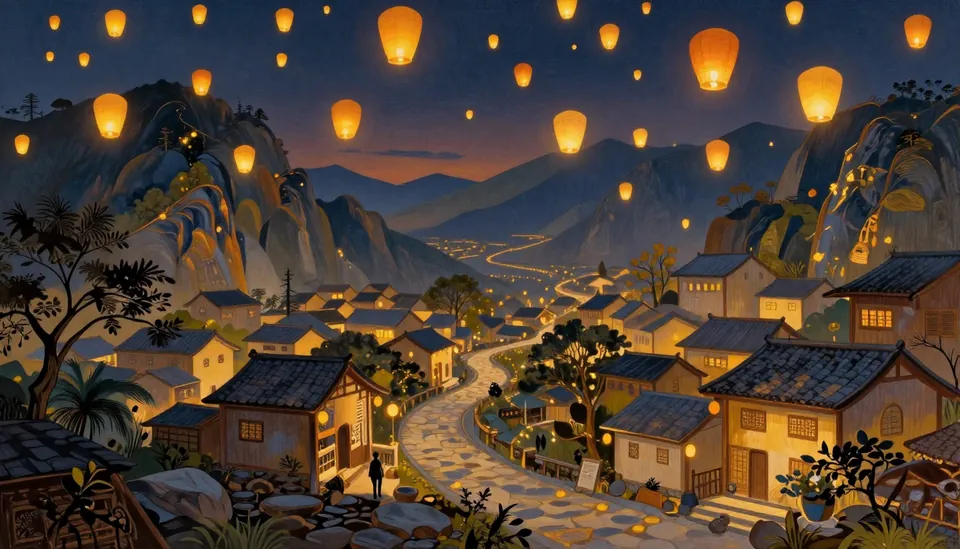
Painted fantasy valley with lanterns
A higher --s lets Midjourney lean into its own painterly taste.
painted fantasy valley at twilight with hundreds of floating paper lanterns, a winding stone path and a small village, golden-age book illustration style, rich textured brushwork --ar 16:9 --s 500 --no text, letters, watermark
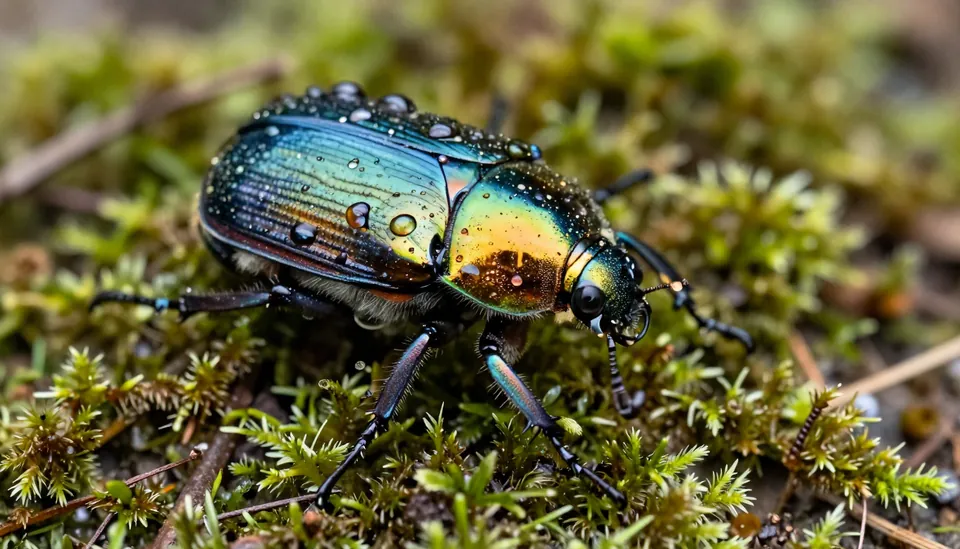
Macro of a jewel beetle on moss
Macro, a lens length and a single named surface give a convincing close-up.
macro photograph of a jewel beetle on green moss, iridescent shell catching the light, shallow depth of field, macro lens, dew drops --ar 3:2 --raw --no text, letters, watermark
Minimalist mountain hut poster
Limiting the palette to four colours is the simplest way to get a poster look, and --no text stops the garbled lettering you'd otherwise get.
minimalist travel poster of a mountain hut at dawn, flat shapes, limited palette of four colours, subtle grain texture, generous empty sky --ar 2:3 --s 200 --no text
Midjourney prompt examples by style
Midjourney prompt examples by style group the prompts into photo, painting, illustration, poster and pattern looks, so you can copy one and change only the subject. You don't have to touch the style words, and you shouldn't: they're what makes the look. Seven of the 12 cards sit here:
- Photo: the lone taxi at a rainy night intersection, with an anamorphic flare.
- Painting: the loose watercolour of foxgloves and ferns, and the painted fantasy valley with lanterns.
- Illustration: the isometric cutaway of an attic studio, and the library inside a whale skeleton.
- Poster: the minimalist mountain hut poster in flat colour.
- Pattern: the repeating ginkgo leaf tile.
Midjourney prompt examples by subject
Midjourney prompt examples by subject cover product, architecture, nature, character and food scenes, with no card repeated from the style groups. Product is the floating sneaker studio shot; architecture is the brutalist library at dusk; nature is the macro jewel beetle on moss; character is the reference sheet; food is the market breakfast flat lay. Here it's the style words you'll change and the subject that stays, the reverse of the style list.
None of the 12 fits your idea? The Midjourney prompt generator writes a custom one with the parameters set.
How do you write a Midjourney prompt?
To write a Midjourney prompt, describe the subject, setting, light, lens and mood as short phrases, then add parameters such as --ar and --raw at the end. That's the whole structure: subject, setting, light, lens, mood, then parameters, in one line. Midjourney doesn't need full sentences, and it won't reward praise words like "stunning"; it's the concrete nouns that change the picture.
- Start with the subject. One main thing, described concretely.
- Add setting, light, lens and mood as short phrases separated by commas.
- Add parameters at the end. They're settings, not words, so they go after the description.
- Run, then change one thing. Change a single phrase or parameter per round so you'll know what caused the difference.
Which Midjourney parameters matter most?
The Midjourney parameters that matter most are --ar, --raw, --stylize, --chaos and --no: aspect ratio, literal look, style strength, variety and exclusions, where --no names elements to leave out, such as text or people. They go at the end of the prompt, after the description, with a space before each double dash. Three more, --weird, --tile and --v, sit in the table for the jobs that need them. Values are from Midjourney's own Parameter List as of 10 November 2026, and V8.2 is listed as default there (default since 24 July 2026; verify the date on Midjourney docs when a new version ships). Parameters aren't words, so they don't go in the middle of the description, and they won't work without the space before each double dash.
| Parameter | What it does |
|---|---|
--ar 4:5 | Sets the aspect ratio (width:height). The default is 1:1. |
--raw | Turns off Midjourney's default styling for a more literal, photo-like result. (The older --style raw spelling isn't in the current parameter list, so the prompts here use --raw.) |
--stylize (--s) 0 to 1000 | Lower follows your words more closely; higher adds more of Midjourney's own look. The default is 100. |
--chaos (--c) 0 to 100 | Increases variety between the four results, and is 0 by default. |
--weird (--w) 0 to 3000 | Pushes toward unusual, experimental results, and is 0 by default. |
--no | Excludes things, such as --no text. List 2 or more with commas. |
--tile | Makes a single tile that repeats without visible edges. |
--v | Picks a model version. The default is V8.2, so you only need it to run a different version on purpose. |
For text work instead of images, the Claude prompt library collects ready prompts in the same copy-and-run format. Why phrase order and specific nouns change the result is explained across the prompt engineering guide pages.
Midjourney prompts FAQ
Still stuck? Build it in Prompt Studio. It'll score each part as you go.
Which Midjourney version are these prompts written for?
These prompts are written for the current default Midjourney model, so they carry no version flag. That's V8.2, the default since 24 July 2026, checked on 10 November 2026. Some parameters differ in older versions, so remove one first when a prompt won't run there.
Are these Midjourney prompts free to use?
Yes, these Midjourney prompts are free to use: the prompts on this page are free to copy, but running them needs a Midjourney plan.
Where do I check whether Midjourney has a free trial?
Check Midjourney's plans page for the current free access, since the offer changes over time and this page states no trial terms.
How do I build my own Midjourney prompt from scratch?
Build your own Midjourney prompt with the generator page, which asks for subject, style and ratio and writes the parameters for you. You can paste the result straight into Midjourney and change one phrase per round.