
Anatomy of a prompt: the parts that change the answer
Free prompt courseLesson 1 of 228 minVideoGo to the lesson
Guide
4 min
- Plain English
The short answer
A strong prompt has up to eight parts: a role, the task, context about who it's for, your inputs, limits, the output format, an example and a checklist the AI runs before replying. The task and the context matter most. The rest cut guessing, so you get the answer you wanted on the first try.
What are the 8 parts in the anatomy of a prompt?
The anatomy of a prompt has 8 parts: role, task, context, inputs, limits, output format, example and checklist. The table labels each part on the prompt we really ran for this lesson, a LinkedIn About section for a parent going back to work. You won't need all 8 every time, but you should know which ones you've left out.
| Part | What it tells the AI | In the tested prompt |
|---|---|---|
| Role | Whose standards to write to | A careers adviser for people returning to work |
| Task | The one thing to produce | A short LinkedIn About section |
| Context | The reader and the goal | Recruiters at UK primary schools; the goal is an interview |
| Inputs | Your facts, kept apart from the instructions | Five bullets about Amira, plus a rule to ask if anything is missing |
| Limits | Length, scope and what to leave out | 80 to 110 words, first person, no buzzwords, nothing invented |
| Output format | The shape of the reply | One paragraph, then a headline under 70 characters |
| Example | What good looks like | One opening line in the right tone |
| Checklist | What to check before replying | Four pass or fail checks |
Most common guides teach a four-element model instead, and it's the source behind the usual element lists: instruction, context, input data and output indicator. It's the same ground in fewer boxes. The instruction is our role and task, input data is our inputs, and the output indicator is our output format; limits, example and checklist are the three extras that make an answer easy to check.
Headings like ## Role aren't magic words. They make each part easy for you and the model to find. Claude reads Extensible Markup Language (XML) tags well, and plain headings suit ChatGPT and Gemini; the prompt format lesson covers both, plus a table or JavaScript Object Notation (JSON) as the reply shape.
Which parts of a prompt matter most?
The parts of a prompt that matter most are the task and the context, followed by your inputs. A clear task with no context makes the AI guess the reader and the goal, so the tone and the level of detail miss. The Prompt Studio prompt builder, the free AI prompt generator on our home page, lays out every part as its own box and caps the score at 55 when the context is empty, however tidy the rest looks.
Inputs come next. Leave your facts out and it'll fill the gaps with plausible ones. One line, if anything you need is missing, ask me before you write, does more to stop invented details than any amount of "be accurate". That's the ask-me rule, and the hallucinations lesson takes it further.
The example and the checklist are the parts people skip, and they're the cheapest wins. An example shows tone in one line. A checklist makes the model reread its work against your rules, and in our run it did: the paragraph came in at 100 words, inside the 80 to 110 limit, and the headline ran 55 characters, under the 70 limit.
Anatomy of a prompt before and after
The same request, asked two ways. Read the second one slowly. Each line does a job.
Write my LinkedIn about section. I want to go back to work as a teaching assistant.
## Role
You are a careers adviser who helps people returning to work after a long break.

## Task
Write a short LinkedIn About section for me.

## Context
Readers: recruiters at UK primary schools. Goal: a first interview for a teaching assistant job.

## Inputs
6 years at home raising two children; before that, 4 years as a nursery practitioner; weekly reading helper at my son's school; Level 3 Diploma in Childcare. Ask me if anything's missing.

## Limits
80 to 110 words, first person, no buzzwords, nothing invented.

## Output format
One paragraph, then a headline under 70 characters.
Why it works
The first version gives the AI a task and nothing else, so it invents a career, a tone and a length. The second names the reader, supplies the real facts and fixes the size and shape. Each added part removes one thing the AI would otherwise guess.
Anatomy of a prompt examples
The eight-part skeleton, ready to fill
Every part has a slot, so you can see at a glance what you've left blank.
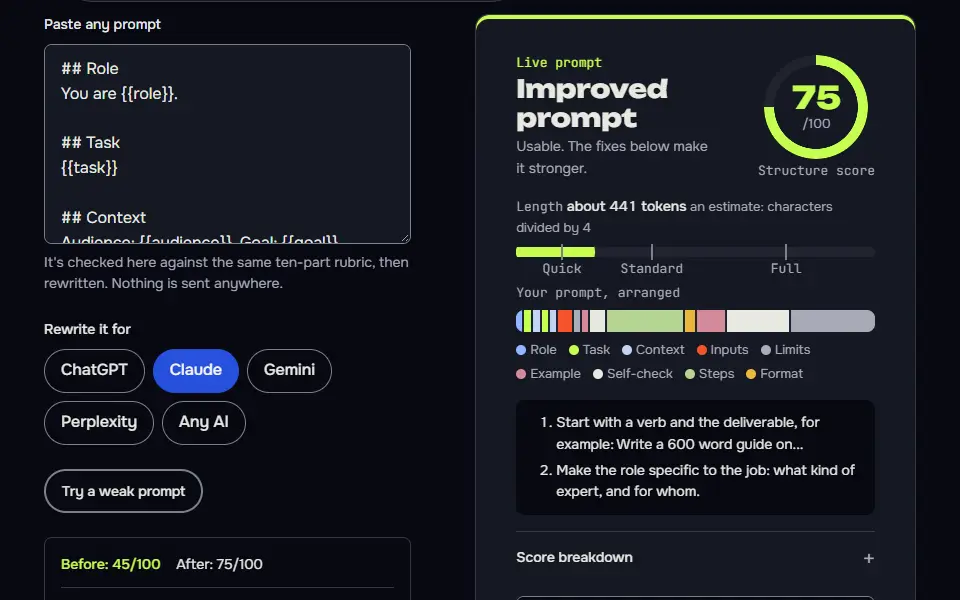
## Role
You are {{role}}.

## Task
{{task}}

## Context
Audience: {{audience}}. Goal: {{goal}}.

## Inputs
{{facts}}
If anything you need is missing, ask me before you start.

## Limits
{{limits}}. Don't invent facts, names or numbers.

## Output format
{{format}}

## Example
{{example}}

## Checklist
Before you reply, check:
- Every fact comes from Inputs.
- The limits are met.
- The format matches exactly.
How to use
- Copy it with the button above.
- Fill the blanks in {{double braces}} with your own details.
- Paste it into ChatGPT, Claude or Gemini and send it.
- Then follow up: ask for one change at a time.
Before you run “The eight-part skeleton, ready to fill” for the first time, the lesson on how to use AI prompts step by step walks through copying, filling and sending it.
Ask the AI to label the parts of your prompt
It turns the anatomy into a checklist the AI applies to your own prompt, without doing the job for you.
Below is a prompt I wrote. Label each line with the part it plays: role, task, context, inputs, limits, format, example or checklist. Then list which of those eight parts are missing, and for each missing part write one line I could add. Don't rewrite the whole prompt, and don't answer it.

My prompt:
"""
{{my_prompt}}
"""Lesson 1 of 22Basics8 min
Lesson: Anatomy of a prompt
A prompt is a short brief. Name the job, say who it's for, hand over your facts and fix the length and shape, and the AI stops guessing. This lesson labels all eight parts, including role, task, context, inputs, limits, format, example and checklist, on one prompt we really ran.
Use it when
- The job matters and you want it right first time.
- You'll reuse the prompt, so it's worth getting the parts right once.
- The last answer missed and you can't tell why: check which part is missing.
Skip it when
- The job is short and common, like a three-bullet summary.
- You're brainstorming and want the AI to surprise you.
## Role
You are a careers adviser who helps people returning to work after a long break.

## Task
Write a short LinkedIn "About" section for the person described below.

## Context
Audience: recruiters and hiring managers in UK primary schools.
The goal is to get a first interview for a teaching assistant job.

## Inputs
- Name: Amira
- 6 years at home raising two children
- Before that: 4 years as a nursery practitioner
- Volunteers weekly as a reading helper at her son's school
- Has a Level 3 Diploma in Childcare
If anything you need is missing, ask me before you write.

## Limits
Between 80 and 110 words. First person. No buzzwords such as passionate or dynamic. Don't invent jobs, dates or qualifications.

## Output format
One paragraph, then a one-line headline under 70 characters on its own line.

## Example
Opening line in the right tone: "I spent six years at home with my two children, and I'm ready to bring that patience back into a classroom."

## Checklist
Before you reply, check:
- Every fact comes from Inputs.
- 80 to 110 words.
- The career break is stated plainly, not hidden.
- The headline is under 70 characters.
I spent six years at home with my two children, and I'm ready to bring that patience back into a classroom. Before that, I worked for four years as a nursery practitioner, caring for and supporting young children. I hold a Level 3 Diploma in Childcare. Every week I volunteer as a reading helper at my son's school, helping children build confidence with their reading. I'm now looking for a teaching assistant role in a UK primary school, where I can support pupils and work closely with teachers. I would welcome the chance to talk about how I can help.

Aspiring Teaching Assistant | Level 3 Childcare Diploma
What to notice: We counted: the paragraph is 100 words and the headline is 55 characters, so the checklist held. Every fact comes from the five inputs, such as the 6 years at home and the nursery job. The model reused the example line word for word as the opening, which is worth knowing: an example can be copied, not just imitated.
Try it in Prompt StudioOpens the studio with this lesson's set-up already selected.
Quick check: 3 questions
Practice: write your own
Write a prompt for a real job of your own. Use at least five of the eight parts: role, task, context, inputs, limits, format, example and checklist. Headings help, but plain sentences work too.
Prompt Studio's rubric scores it right here. Nothing's sent anywhere.
Your progress is saved in this browser only. No sign-up.
When can you leave parts of a prompt out?
You can leave parts of a prompt out when the job is short and common, such as summarising an email in 3 bullets for your manager. That one line's already got a task, a reader, a limit and a format, and that's plenty. It's the zero-shot lesson in practice, and it's coming up soon in the course.
Add parts as the stakes rise or the first answer misses. A prompt you'll reuse every week earns all eight; a one-off question doesn't.
Which missing prompt part causes which bad answer?
Each missing prompt part causes its own bad answer: no role or example gives the wrong tone, no inputs gives invented facts and no format gives the wrong shape. Use it as a fix map:
- Wrong tone: add a role or a one-line example.
- Invented facts: add your inputs and the ask-me rule.
- Wrong shape: add an output format.
- A rule it ignored: add a checklist that repeats the rule.
The parts don't stop working in longer jobs. A prompt that splits the work into a plan, the work and a check is a plan-execute-verify prompt, and one prompt that runs the same parts over a list of items is the subject of batch prompts. You're on lesson 1 of the free prompt course, and once you've labelled a couple of your own prompts, you'll spot the missing part without thinking about it.
Anatomy of a prompt FAQ
Still stuck? Build it in Prompt Studio. It'll score each part as you go.
What are the elements of a prompt in most guides?
The elements of a prompt in most guides are instruction, context, input data and output indicator, and this lesson splits them into eight parts. The extra parts (limits, an example and a checklist) don't change the job; they make the answer more reliable and easier to check.
Does every prompt need all eight parts of the anatomy?
No, a prompt doesn't need all eight parts every time; a quick summary needs a task and maybe a limit. Add parts when the job matters, when you'll reuse the prompt, or after a first answer that missed. Each part you add removes one thing the AI would otherwise guess.
What order should the parts of a prompt go in?
The parts of a prompt go in this order: role, task and context, then inputs, limits, format, example and checklist. It puts the job first, so the details don't arrive without a frame. The order matters less than keeping each part separate and easy to find, and headings or tags do that well.