
Self consistency prompting: run it often, keep the best
Guide
4 min
- Plain English
The short answer
Self-consistency prompting runs the same reasoning prompt more than once, collects the final answer from each run and keeps the one that appears most often. It helps when a question has a single checkable answer and the model sometimes slips. It multiplies the token cost by the number of runs, and it isn't useful for open-ended writing.
What is self-consistency prompting?
Self-consistency prompting is a method that runs the same reasoning prompt more than once and keeps the final answer that appears most often. It comes from Self-Consistency Improves Chain of Thought Reasoning in Language Models (Wang et al., 2022, arXiv 2203.11171), so this guide calls it the self-consistency paper.
The method sits on top of chain of thought. You still ask for a step-by-step reasoning path, but you sample several paths and take a majority vote on the final answer. A hard problem often has more than one valid path to the right result, while wrong results tend to scatter. So the answer most runs reach is more likely right than one reached once, and a split vote tells you the model isn't sure.
It has 3 settings worth naming: the number of runs (5 is a common start), the majority vote that picks the winner, and the token cost, which grows with every run.
What is a self-consistency prompting example?
A self-consistency prompting example is one maths question run in 5 fresh chats, where the answer given 4 times wins the vote. Take this question: "Pens cost 2 dollars for a pack of 3. How much do 18 pens cost?" The right working is 18 divided by 3, which is 6 packs, times 2 dollars, so 12 dollars.
Suppose 4 of the 5 chats end with "Final answer: 12 dollars" and one slips and writes 6 dollars, having stopped at the pack count. The tally reads 12 dollars 4 times and 6 dollars once, so 12 dollars wins. That one stray run is exactly the slip the vote is there to catch. A 3 to 2 split would've been a warning sign, and you'd check the working by hand.
How do you run self-consistency prompting in a chat app?
To run self-consistency prompting in a chat app, run the same prompt in fresh chats, pull out each final answer and keep the one that wins the vote. A clear prompt gives cleaner runs, so tidy yours first with the prompt rewriter, a prompt optimizer that can rewrite a loose question for clarity. Then follow 3 steps:
- Run it in fresh chats. Paste the same prompt into 5 new chats, or press regenerate. Fresh runs are more independent than 5 answers in one reply.
- Pull out the final answers. Ask every run to end with a marked line, such as "Final answer: ...", so they're easy to compare.
- Vote. Count them, and the most common answer wins.
There's no code involved. Chat apps don't let you set temperature, so variety comes from regenerating; through an Application Programming Interface (API) you'd sample at a temperature above zero instead. The worked prompts include a single-prompt shortcut that asks for 3 independent attempts in one reply, and a tally prompt that counts the answers you've pasted in. The method won't fix a question the model can't answer, only random slips.
How does step-back prompting relate to self-consistency prompting?
Step-back prompting relates to self-consistency prompting as a cheaper partner: it asks a broader question first, then answers the specific one with the principle it found. It comes from Take a Step Back: Evoking Reasoning via Abstraction in Large Language Models (Zheng et al., 2023).
Example: before a physics problem, ask "Which principle governs this situation?", then solve it with that principle. Step-back improves each single run by putting the broad question first, and self-consistency checks several runs against each other. You can put a step-back line at the top of the prompt you're voting on, and it doesn't add any runs.
Does self-consistency prompting still help with reasoning models?
Yes, self-consistency prompting still helps with reasoning models on checkable answers, though the gain is smaller than with older models. Reasoning models already do extra thinking of their own, and OpenAI's guidance calls explicit step-by-step prompting unnecessary for them (OpenAI).
A vote still adds reliability on 4 kinds of answers: maths results, labels, extracted values and yes or no decisions. The cost is the catch, since each run on a reasoning model is longer and pricier. Check whether one run already gets your test cases right, and skip the extra runs if it does. It's a reliability tool, not a smarts tool.
Self consistency prompting before and after
The same request, asked two ways. Read the second one slowly. Each line does a job.
A train leaves at 14:20 and the journey takes 2 hours 55 minutes. A bus leaves at 15:05 and takes 2 hours 10 minutes. Which arrives first? (one try)
Solve the same problem five separate times in fresh chats, each time asking for step-by-step working and a final line "Final answer: train" or "Final answer: bus". Tally the five final lines. Keep the majority.
Why it works
A single slip gets outvoted. A 3 to 2 split means the question is uncertain and worth checking by hand.
Self consistency prompting examples
Several independent attempts in one prompt
A fast approximation for when you can't run five chats; independent attempts are less independent but still catch random slips.
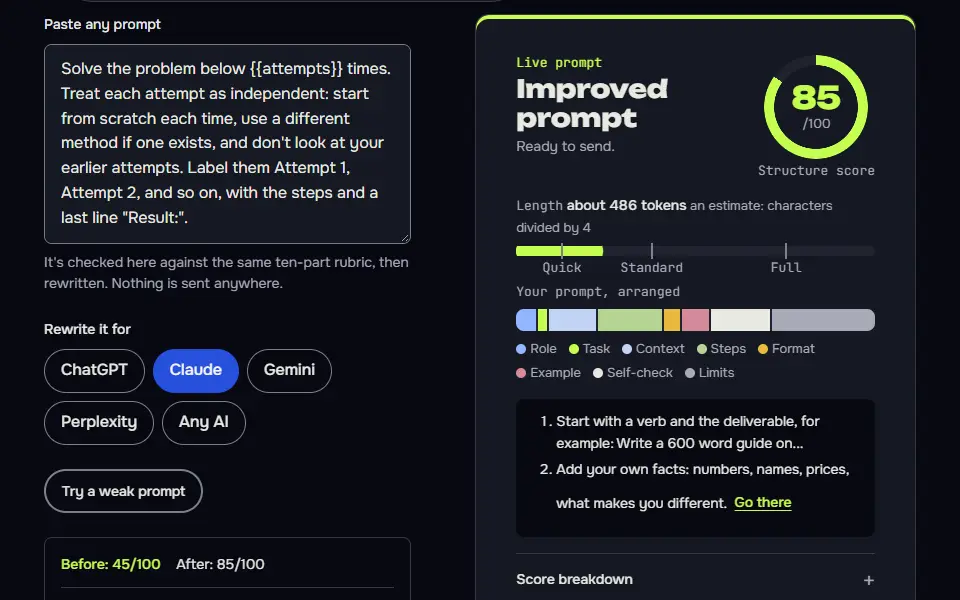
Solve the problem below {{attempts}} times. Treat each attempt as independent: start from scratch each time, use a different method if one exists, and don't look at your earlier attempts. Label them Attempt 1, Attempt 2, and so on, with the steps and a last line "Result:".

Then add a tally: list each distinct result and how many attempts reached it. State the majority result as the answer. If there's no majority, say the answer is uncertain and explain which attempts differ and why.

Problem: {{problem}}
How to use
- Copy it with the button above.
- Fill the blanks in {{double braces}} with your own details.
- Paste it into ChatGPT, Claude or Gemini and send it.
- Then follow up: ask for one change at a time.
Before you run “Several independent attempts in one prompt” for the first time, the lesson on how to use AI prompts step by step walks through copying, filling and sending it.
Vote across answers you collected
Separating the counting from the solving stops the model re-solving and overriding the votes.
I ran the same question {{runs}} times and collected the final answers below. The question was: {{question}}

{{answers}}

Count the distinct final answers, treating answers that mean the same thing as one (for example "2.5 hours" and "2 hours 30 minutes"). Give a table of answer and count. State the majority answer. If the top answer has fewer than {{threshold}} votes, say the question is uncertain, and list what I should check by hand. Don't solve the problem yourself.
Step-back prompt: principle first, then the problem
Asking for the governing principle first keeps the model from jumping straight to a plausible-looking detail.
Before answering, take a step back. Step 1: state in two sentences the general principle or concept that governs this kind of question. Step 2: apply that principle to the specific question and show your working. Step 3: give the result on a last line starting "Result:".

Question: {{question}}When is self-consistency worth the extra runs?
Self-consistency is worth the extra runs for questions with one checkable answer, such as maths, classification and extraction, plus yes or no decisions where an error would cost you.
Don't use it for essays, brainstorming or anything with no single right answer: there's nothing to vote on, and you'd just collect 5 separate drafts. For exploring options instead of agreeing on one, compare it with this tree of thought prompting example, which branches and prunes. Runs agree more often when the format is pinned down, and a few-shot prompt with one solved sample does that. Each technique sits next to its neighbours in the types of prompting hub.
Self consistency prompting FAQ
Still stuck? Build it in Prompt Studio. It'll score each part as you go.
What is the meaning of self-consistency in AI prompting?
Self-consistency in AI prompting means an answer is trusted when separate reasoning runs arrive at it independently. Agreement across runs counts as evidence, and disagreement is a sign to check the working yourself.
What is a limitation of self-consistency prompting?
A limitation of self-consistency prompting is cost: 5 runs use about 5 times the tokens, and it doesn't help open-ended writing. And it can't rescue a question the model gets wrong every time, since a wrong answer can win the vote too.
Can self-consistency work in one ChatGPT prompt?
Yes, self-consistency can work in one ChatGPT prompt as an approximation that asks for 3 independent solutions and a final vote. Those 3 attempts share one context, so they're less independent than fresh chats, but it's a quick check when you don't want to open new windows.