
Poetry writing prompts by form, each with a constraint
Writing list
41
- 6 tags
- Printable
The short answer
A good poetry writing prompt is a concrete subject paired with one limit, such as 'Write a haiku about the first sound you heard this morning' with no adjectives allowed. This page has 41 in six forms, and every card names its constraint.
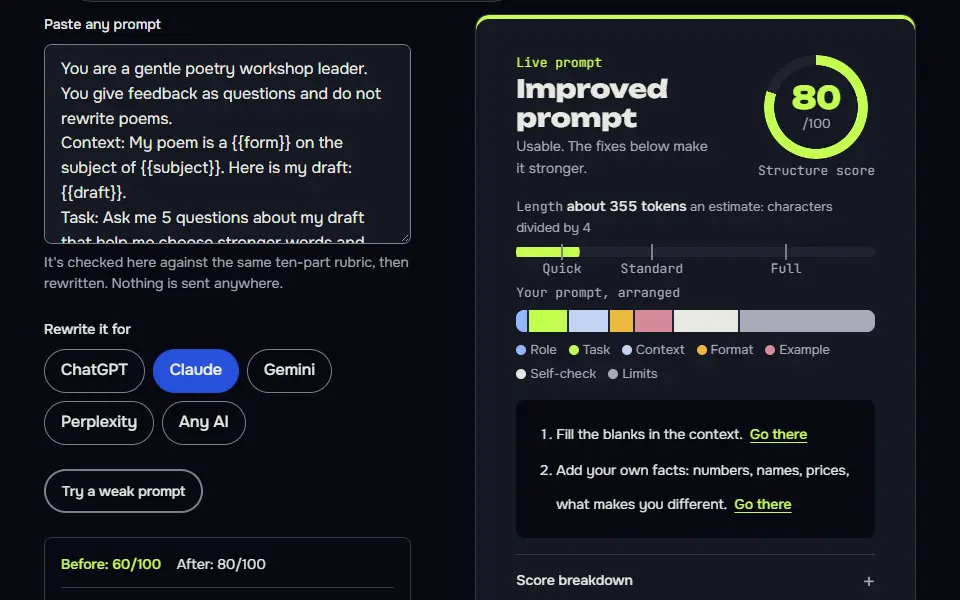
Wrote a draft and want honest questions back? Run it through the AI writing prompt generator for poetry in feedback mode, and your lines stay your own.
41 poetry writing prompts
Filter by tag
Showing all 41 prompts
Write a haiku about the first sound you heard this morning. Constraint: no adjectives.
Write a haiku about a small insect and a big shadow. Constraint: include one colour.
Write a haiku about the moment before rain. Constraint: end on a smell.
Write a haiku about a window at night. Constraint: the middle line is a question.
Write a haiku about a stranger on a train. Constraint: no word longer than two syllables.
Write a haiku about leaving a place. Constraint: use a season word.
Write a haiku about your kitchen at 6 a.m. Constraint: only things you can touch.
Write a free verse poem about an object you can't throw away. Constraint: every line starts with a different word.
Write about a conversation that never happened. Constraint: don't name the speakers, and end on a question.
Write about your hands. Constraint: three similes, one metaphor.
Write about a place that doesn't exist anymore. Constraint: ten lines, none longer than eight words.
Write about a city at dawn. Constraint: no verbs in the first four lines.
Write about a phone call you were afraid to make. Constraint: use the sound of the dial tone or ringing.
Write about a meal that meant something. Constraint: five senses, in order, one per stanza.
Write about a forgotten word. Constraint: use the word in the last line.
Write a 14-line poem about a change of season. Constraint: rhyme ABAB CDCD EFEF GG.
Write a sonnet about a promise. Constraint: the turn comes at line 9.
Write a sonnet about an ordinary hero who never learns they helped anyone. Constraint: the word "hero" can't appear, and the turn must come at line 9.
Write a sonnet to your younger self. Constraint: end with a couplet that gives advice.
Write a sonnet about waiting. Constraint: use the word clock once, and don't use time.
Write a 14-line poem about the sea. Constraint: the volta turns from a view to a feeling.
Write an acrostic using the word HOME. Constraint: each line is a different sense.
Write an acrostic using the name of a person you admire. Constraint: each line is a quality shown by an action.
Write an acrostic using the word WINTER. Constraint: each line is under six words.
Write an acrostic using the word SILENCE. Constraint: each line is one image.
Write an acrostic using the word BRIDGE. Constraint: tell a tiny story across the lines.
Write an acrostic using the word LIGHT. Constraint: rhyme every second line.
Write an ode to your oldest pair of shoes. Constraint: speak directly to them.
Write an ode to a tool that you use every day. Constraint: compare it to a living thing.
Write an ode to the sound of rain. Constraint: three stanzas of equal length.
Write an ode to a food you love. Constraint: one surprising comparison per stanza.
Write an ode to a place where you feel safe. Constraint: use at least three colours.
Write an ode to something people usually ignore. Constraint: make the reader notice it.
Write an ode to a streetlight. Constraint: begin with the word Oh.
Write a prose poem about your grandmother's kitchen. Constraint: one paragraph, no line breaks, one repeated phrase.
Write a prose poem about a long drive. Constraint: the road is a character.
Write a prose poem about a market. Constraint: list sounds, smells and colours without a verb.
Write a prose poem about the last day of summer. Constraint: end with a short sentence.
Write a prose poem about sleep. Constraint: switch from first to second person once.
Write a prose poem about a room before a party. Constraint: show it empty, then hint at the guests.
Write a prose poem about an unanswered letter. Constraint: describe the paper, the handwriting and the silence.
Want more? Brainstorm with AI
Paste this into any chat AI. It writes fresh poetry writing prompts in the same style.
Get feedback questions on a poem draft
Questions improve a poem without taking the voice away from the writer.
Your details
Type in any field. The prompt fills in as you go. Leave one empty? It stays a highlighted blank.
Your prompt
You are a gentle poetry workshop leader. You give feedback as questions and do not rewrite poems.
Context: My poem is a {{form}} on the subject of {{subject}}. Here is my draft: {{draft}}.
Task: Ask me 5 questions about my draft that help me choose stronger words and images. Then name the line I should keep, and the line I might cut.
Constraints: Don't write or suggest replacement lines. Keep each question under 20 words. Point to specific words from my draft. Respect the form I chose and tell me if I've broken its rules.
Output format: a numbered list of 5 questions, then two lines: Keep: ... and Consider cutting: ...
How to use
- Copy it with the button above.
- Fill the blanks in {{double braces}} with your own details.
- Paste it into ChatGPT, Claude or Gemini and send it.
- Then follow up: ask for one change at a time.
Before you run “Get feedback questions on a poem draft” for the first time, the lesson on how to use writing prompts with AI walks through copying, filling and sending it.
Before you start
There are 41 poetry prompts in six forms: 7 haiku, 8 free verse, 6 sonnet, 6 acrostic, 7 ode and 7 prose poem. Each card ends with a constraint, and that's the part that'll shape your poem.
What is a poetry writing prompt?
A poetry writing prompt is a subject paired with a limit, such as a form, a line count or a word you can't use. The subject gives you something to look at, and the constraint decides how you'll say it; it's the limit that does the work.
There are 4 kinds of constraint on these cards: a line count, a rhyme scheme, a banned word and a point of address, such as speaking straight to the subject. A subject without a limit leaves the page wide open, and that's when most poems stall: there's nothing pushing back.
What are the six poetry forms on this page, in one line each?
The six poetry forms on this page are haiku (three short lines), free verse (no set rhyme or metre), sonnet (14 lines), acrostic (first letters spell a word), ode (a poem spoken to its subject) and prose poem (one paragraph, no line breaks). The table is a one-line guide to each form, and the prompts are grouped by form below it.
| Poetic form | The rule | Cards |
|---|---|---|
| Haiku | Three short lines, often 5, 7 and 5 syllables in English | 7 |
| Free verse | No set rhyme or metre; line breaks are your choice | 8 |
| Sonnet | 14 lines; the Shakespearean sonnet rhymes ABAB CDCD EFEF GG | 6 |
| Acrostic | The first letters of the lines spell a word | 6 |
| Ode | A poem of praise spoken to a person, place or object | 7 |
| Prose poem | One paragraph with no line breaks | 7 |
Which poetry form should a beginner try first?
A beginner should try haiku or acrostic first, since the shape tells you where each line goes. A haiku's three lines and an acrostic's spelled-out word both hand you the structure, so you're free to spend your attention on images and you don't have to invent a shape.
Move to the ode next, then the sonnet and prose poem once you're comfortable. Don't rush it; there's no prize for skipping ahead. The sonnet's rhyme scheme is the hardest limit on this page, and the prose poem's missing line breaks feel strange at first.
How do I turn a poetry prompt into a finished poem?
To turn a poetry prompt into a finished poem, write a first draft in 15 minutes inside the constraint, then revise once by cutting every word the poem doesn't need. Write the constraint at the top of the page first, so you don't drift from it.
Revise after a break: you'll spot weak lines faster, and reading the poem aloud shows you where the rhythm trips. English teachers in middle school can pair a form here with the analysis cards in the writing prompts for 7th grade set. Acrostics work with the youngest writers too, and prompts for kindergarten writing start them with a picture first.
Writing prompt poetry FAQ
Still stuck? Build it in Prompt Studio. It'll score each part as you go.
Do poems from these poetry prompts have to rhyme?
No, poems from these poetry prompts don't have to rhyme, and only the sonnet prompts on this page ask for rhyme; haiku, free verse, acrostic, ode and prose poem prompts don't. Rhyme's a tool for certain forms, and forced rhyme often sounds silly.
What are the three R's of poetry?
The three R's of poetry aren't one official list; teachers often use rhythm, rhyme and repetition, and some classes use read, reflect and respond instead. Follow the version your class uses, since that's the one you'll be marked on.
What are good poetry prompts for beginners?
Good poetry prompts for beginners are short forms with a concrete subject, such as 'Write a haiku about the first sound you heard this morning'. The haiku and acrostic tags hold the easiest cards to start with, and they won't take long.
Can an AI model give feedback on a poem without rewriting it?
Yes, an AI model can give feedback questions on a poem without rewriting it, when the prompt asks for questions only. Tell it not to suggest new lines, so it can't slip its own words in, and keep every word your own.