
Writing prompts for 7th grade: argument, story, analysis
Writing list
42
- 3 tags
- Printable
The short answer
Good writing prompts for 7th grade are tasks that ask a student to argue a position, tell a story or analyse a text, then back it with evidence in three to five paragraphs. The 42 prompts here are tagged argument, narrative or analysis (14 each), and they share one four-part self-check rubric.
Want a model to coach the draft instead of a red pen? Paste any prompt here into the AI writing prompt generator for 7th grade and pick rubric feedback as the output.
42 7th grade writing prompts
Filter by tag
Showing all 42 prompts
Should schools teach financial literacy before high school? Use two pieces of evidence and one counterclaim.
Should students be graded on effort as well as results? Choose a side and defend it.
Should students be allowed to eat lunch outside the cafeteria? Explain your position with two reasons.
Should school laptops be allowed for personal projects after class? Argue one side and answer a counterclaim.
Should all students learn basic coding before high school? Support your claim.
Should communities spend more on parks or on libraries? Argue for one.
Should students be allowed to retake tests? Give reasons and a counterpoint.
Should older students be paid to tutor younger classmates? Explain why or why not.
Should all students learn a second language from age 11? Defend your position.
Do video games help or harm learning? Use evidence from your own experience and one outside source.
Should recycling be mandatory in every school? Explain what you'd do to make it work.
Should students vote on one school rule each year? Argue your side.
Is it better to learn about history from textbooks or from stories? Defend one.
Should junk food be sold in school cafeterias? Argue your position and note what the other side would say.
Write about a time you changed your mind. Show the moment with dialogue and one sensory detail you couldn't have invented.
Write a story that begins with a character receiving a package they didn't order, and doesn't open it yet.
Write about a day when your plan fell apart. How'd you adapt?
Write about a moment when you had to choose between two friends.
Tell the story of a promise that was hard to keep.
Write a scene set during a storm in which two strangers shelter in the same place.
Write a story from the point of view of an object left behind in a school.
Write about a time you weren't the one who won, and were proud anyway.
Describe the first day at a new school using flashback to a memory of your old one.
Write a story about someone who finds out they have a skill they didn't know they had.
Write a story that ends with a door closing and a new one opening.
Write about a tradition in your family and why it matters.
Tell a story about a mistake that taught you something about trust.
Write a short story in which the setting isn't just a backdrop but acts like a character.
Choose a character from a book you've read. Analyse how one choice reveals their personality, with two quotes.
Explain how the setting in a story you've read shapes the mood. Use two details.
Compare two characters from the same text and show how they respond differently to a challenge.
Choose a poem. Explain how one image or comparison supports its main idea.
Explain a theme from a book or film you've studied. Use two examples as evidence.
Analyse how an author uses a plot twist to change how you see a character.
Explain how a news headline or an ad uses word choice to persuade you.
Describe how the tone of a text changes from the beginning to the end and why.
Choose a scene that you think matters most in a story. Explain why it can't be cut, using the text.
Explain why an author would choose a first-person narrator. What do we gain and lose?
Analyse the opening paragraph of a book you like. What choices make it work?
Compare how a book and its movie or show treat the same event, if you've seen both.
Explain how a speech you've heard uses repetition, questions or examples to make its point.
Pick a symbol from a text and explain what it represents, with two pieces of evidence.
Want more? Brainstorm with AI
Paste this into any chat AI. It writes fresh 7th grade writing prompts in the same style.
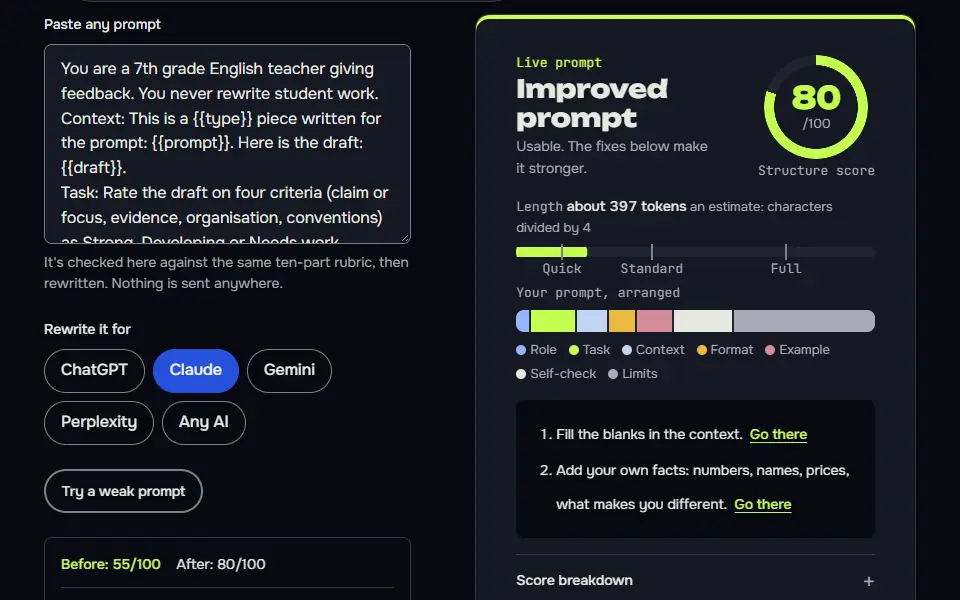
Check a draft against the four-part rubric
A rubric-based critique stays on the writing, and it never takes over the student's words.
Your details
Type in any field. The prompt fills in as you go. Leave one empty? It stays a highlighted blank.
Your prompt
You are a 7th grade English teacher giving feedback. You never rewrite student work.
Context: This is a {{type}} piece written for the prompt: {{prompt}}. Here is the draft: {{draft}}.
Task: Rate the draft on four criteria (claim or focus, evidence, organisation, conventions) as Strong, Developing or Needs work. Explain each in one sentence and give one next step for each.
Constraints: Don't rewrite any sentence and don't give the student replacement wording. Quote the student's own words when you point to a problem. Keep the tone kind and specific. Keep it appropriate for school. Don't comment on the student's identity or opinions, only on the writing.
Output format: a table with Criterion, Rating, Why and Next step, then one praise line naming the strongest sentence.
How to use
- Copy it with the button above.
- Fill the blanks in {{double braces}} with your own details.
- Paste it into ChatGPT, Claude or Gemini and send it.
- Then follow up: ask for one change at a time.
Before you run “Check a draft against the four-part rubric” for the first time, the lesson on how to use writing prompts with AI walks through copying, filling and sending it.
Before you start
Seventh graders can write multi-paragraph pieces with a clear focus, and they're ready to be asked for evidence. Each prompt fits one class period or one homework night, and they're all safe for school, so you don't have to screen them first.
Which 7th grade writing prompts build an argument?
The 7th grade writing prompts that build an argument are the prompts tagged Argument, which ask for one claim, two reasons with evidence and one counterclaim answered in a closing paragraph. There are 14 of them, such as whether schools should teach financial literacy before high school.
The counterclaim is the grade 7 step up. A student who's named the other side and answered it has written an argumentative essay, and that isn't the same as an opinion piece. Ask for the claim in the first sentence, so it's clear from the start and the reader won't have to hunt for it.
Which 7th grade prompts work for narrative writing?
The 7th grade prompts that work for narrative writing are the 14 Narrative prompts, each built around one turning point told from one point of view. Keep the story to three to five paragraphs so the sequence of events stays tight.
A good grade 7 narrative uses a few lines of dialogue to move the scene, not to fill space. Ask students to pick the point of view before they write, and don't let them switch halfway; it's the slip graders notice first.
How do 7th grade analysis prompts use text evidence?
7th grade analysis prompts use text evidence by asking the student to quote one line, explain what it shows and connect it to the theme in the same paragraph. That's the literary analysis move most grade 7 lists skip.
The 14 Analysis prompts cover character choices, setting and mood, a poem's image, a symbol, an author's narrator and even the word choice in an ad. Quote, explain, connect: if a paragraph's missing one of the three, it isn't analysis yet.
What rubric can a 7th grader use to self-check a draft?
A 7th grader can self-check a draft with a four-part rubric: claim or focus, evidence, organisation and conventions, each answered with one yes or no question.
| Part | Strong work | Yes or no check |
|---|---|---|
| Claim or focus | One clear main idea or story purpose | Can I state it in one sentence? |
| Evidence | Specific facts, quotes, examples or details | Did I back up each point? |
| Organisation | Intro, body, ending and transitions | Does each paragraph have one job? |
| Conventions | Spelling, punctuation and sentence variety | Did I read it aloud and fix mistakes? |
Your school's rubric may differ, and that's fine. This writing rubric is a starting point; it doesn't replace yours.
How do I plan 7th grade writing prompts across a unit?
To plan 7th grade writing prompts across a unit, rotate argument in week 1, narrative in week 2 and analysis in week 3, and give two prompt choices per piece. Set one length for every piece, such as three to five paragraphs, so students aren't guessing.
Ask for a three-line outline first. It's the step students want to skip, but a plan beats a blank page. Homeschool families can run the same three weeks with one piece a week, and they'll still cover every mode.
Teachers who cover the whole school can find picture-and-sentence starters on the free kindergarten writing prompts list. Students who finish early can stretch with the longer counterclaim tasks on the 8th grade writing prompts page.
Writing prompt for 7th grade FAQ
Still stuck? Build it in Prompt Studio. It'll score each part as you go.
How long should a 7th grade writing piece be?
A 7th grade writing piece should be three to five paragraphs (about 300 to 500 words) for one class period or one homework night. Your school may set its own targets, and evidence counts more than length, so don't pad it.
What are good argument topics for 7th graders?
Good argument topics for 7th graders are school-life questions a student can back with evidence, such as phone rules, homework limits and later start times. Each one has two fair sides, so there's a real counterclaim to answer.
How do I help a 7th grader who says they have nothing to write?
Help a 7th grader who has nothing to write by asking for a two-minute spoken answer first, then having the student write down what they just said. It's rarely that they've got nothing to say; the task just felt too big.
Can an AI model score a 7th grade draft without rewriting it?
Yes, an AI model can score a 7th grade draft against the four-part rubric without rewriting it, when the prompt tells it to return comments only. The student still makes every change, and that's what you'd want.