
Opinion writing prompts with a claim, reason and example
Writing list
42
- 7 tags
- Printable
The short answer
A writing prompt for opinion is a question with two fair sides that a student answers with a claim, a reason and a real example. Each of the 42 prompts here carries a cue for all three parts, so kids plan before they write and aren't left guessing.
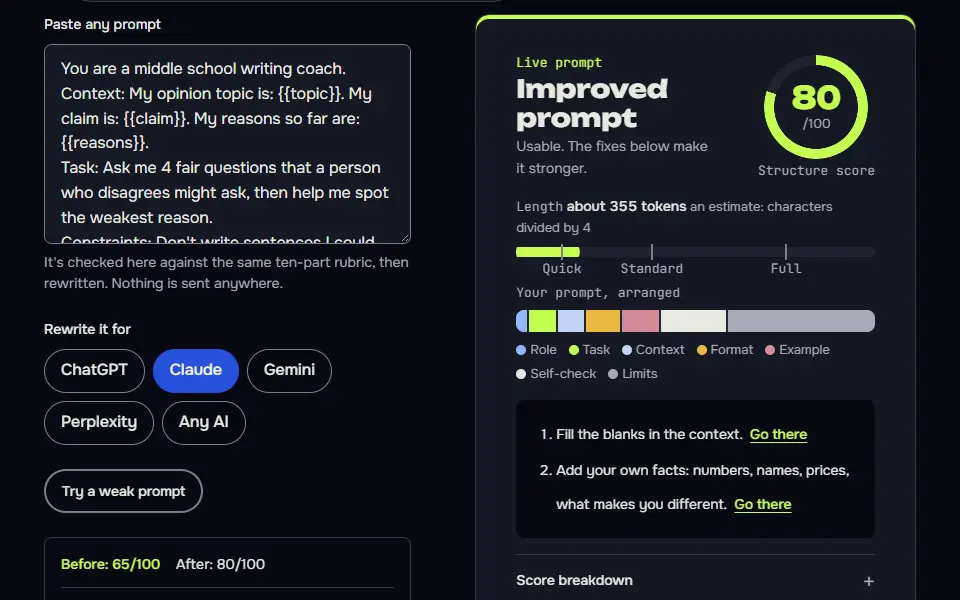
Want your reasons tested before a debate? Paste your claim into the AI writing prompt generator for opinion writing, and it'll come back with a counterpoint for each reason.
42 opinion writing prompts
Filter by tag
Showing all 42 prompts
Should schools have a longer lunch break? Claim: I think lunch should be ___ minutes. Reason cue: energy and food. Example cue: a day you felt rushed.
Should students choose some of their own class topics? Claim: Yes or no, and how many. Reason cue: interest and effort. Example cue: a time you worked harder because you liked the topic.
Is homework helpful? Claim: Homework helps or doesn't help me. Reason cue: practice or stress. Example cue: one night of homework you remember.
Should school uniforms be required? Claim: Uniforms are good or not for school. Reason cue: cost, comfort and fairness. Example cue: something you saw on a non-uniform day.
Should every school have a garden? Claim: Gardens belong in school or they don't. Reason cue: learning and teamwork. Example cue: a plant you grew.
Is a four-day week good for students? Claim: A short week helps or hurts. Reason cue: rest and learning time. Example cue: a long weekend that went well or badly.
Should recess be longer? Claim: Recess should stay the same or grow. Reason cue: exercise and focus. Example cue: after recess versus after a long lesson.
Should every student learn a musical instrument? Claim: Music class should be required or optional. Reason cue: skill and choice. Example cue: someone you know who plays.
Is breakfast the best meal of the day? Claim: My favourite meal is ___. Reason cue: energy and taste. Example cue: a meal you remember.
Should school lunches have more choices? Claim: More choice would help. Reason cue: tastes and waste. Example cue: a lunch you didn't eat.
Is pizza a healthy food? Claim: Pizza can or can't be healthy. Reason cue: what's on it. Example cue: a pizza you made or ate.
Which is better, cooking at home or eating out? Claim: Home cooking is better or eating out is. Reason cue: cost and fun. Example cue: a family meal.
Should kids learn to cook in school? Claim: Cooking class is a good idea or not. Reason cue: life skills and safety. Example cue: something you made.
Should zoos exist? Claim: Zoos should stay or change. Reason cue: animal care and learning. Example cue: an animal you saw or read about.
Are dogs better pets than cats? Claim: I prefer ___. Reason cue: care and personality. Example cue: a pet you know.
Should classrooms have pets? Claim: Classroom pets are a good idea or not. Reason cue: responsibility and allergies. Example cue: a pet in a class you've seen.
Should people be allowed to keep wild animals as pets? Claim: Yes or no. Reason cue: safety and animals' needs. Example cue: a news story or book.
Which animal would make the best friend? Claim: The best friend is a ___. Reason cue: loyalty and fun. Example cue: a moment with that animal.
Should kids have their own tablets? Claim: Kids should have one at age ___ or not at all. Reason cue: learning and screen time. Example cue: something you learned on a screen.
Is it better to read on paper or on a screen? Claim: I prefer ___. Reason cue: focus and comfort. Example cue: a book you read both ways.
Should video games count as a sport? Claim: Games are or aren't a sport. Reason cue: skill and teamwork. Example cue: a game you've played with others.
Should robots help with household chores? Claim: Robots would help or not. Reason cue: time and trust. Example cue: a chore you dislike.
Should schools allow phones in class for learning? Claim: Phones help or distract. Reason cue: focus and tools. Example cue: a time a phone was useful or a problem.
Should everyone have to take turns, even if they are slower? Claim: Turn-taking is always fair or not. Reason cue: respect and time. Example cue: a game where turns mattered.
Is it fair for older kids to get later bedtimes? Claim: Yes or no. Reason cue: age and sleep. Example cue: a bedtime rule at your home.
Should people who break something always pay to fix it? Claim: Yes, no or it depends. Reason cue: responsibility and accidents. Example cue: a time something was broken.
Should the team captain be picked by vote? Claim: Votes are the best way or not. Reason cue: fairness and skill. Example cue: a vote you remember.
Is it ever okay to break a promise? Claim: Always keep it or sometimes not. Reason cue: trust and safety. Example cue: a promise you kept.
Should every town have a free library? Claim: Libraries are important or not. Reason cue: access and learning. Example cue: a book you found there.
Should neighbours share tools? Claim: Sharing tools is a good idea or not. Reason cue: cost and trust. Example cue: something you borrowed.
Should there be a car-free day in every city? Claim: A car-free day is a good idea or not. Reason cue: air and safety. Example cue: a quiet street you know.
Should volunteering be part of school? Claim: Required or voluntary. Reason cue: skills and choice. Example cue: a time you helped.
Should parks stay open late in summer? Claim: Longer hours help or hurt. Reason cue: safety and fun. Example cue: an evening at a park.
Is a rainy day better than a sunny day? Claim: I choose rain or sun. Reason cue: what you can do. Example cue: your best weather day.
Which is the best hobby for a weekend? Claim: My pick is ___. Reason cue: fun and skill. Example cue: a weekend you remember.
Should kids have a say in family holidays? Claim: Kids should or shouldn't choose. Reason cue: fairness and cost. Example cue: a trip you wish had been different.
Are board games better than video games? Claim: I prefer ___. Reason cue: people and skill. Example cue: a game night.
Is it better to have one close friend or many friends? Claim: I prefer ___. Reason cue: trust and fun. Example cue: a time a friend helped you.
Should birthdays be celebrated with a party or a quiet day? Claim: Party or quiet day. Reason cue: fun and comfort. Example cue: your last birthday.
Should every family have a weekly game night? Claim: Game night is a good habit or not. Reason cue: time together. Example cue: a night that went well.
Should schools teach first aid to every student? Claim: Everyone should learn it or not. Reason cue: safety and confidence. Example cue: a time someone needed help.
Which is the best season for a birthday? Claim: The best season is ___. Reason cue: weather and activities. Example cue: your favourite birthday.
Want more? Brainstorm with AI
Paste this into any chat AI. It writes fresh opinion writing prompts in the same style.
Test my opinion with fair questions
Hearing the other side's questions helps you strengthen your reasons without giving you the words.
Your details
Type in any field. The prompt fills in as you go. Leave one empty? It stays a highlighted blank.
Your prompt
You are a middle school writing coach.
Context: My opinion topic is: {{topic}}. My claim is: {{claim}}. My reasons so far are: {{reasons}}.
Task: Ask me 4 fair questions that a person who disagrees might ask, then help me spot the weakest reason.
Constraints: Don't write sentences I could copy into my piece and don't take a side yourself. Keep each question under 20 words. Keep it respectful and appropriate for school. If my reasons are facts I haven't checked, tell me to check them.
Output format: a numbered list of 4 questions, then one line naming the weakest reason and one idea for an example that would strengthen it.
How to use
- Copy it with the button above.
- Fill the blanks in {{double braces}} with your own details.
- Paste it into ChatGPT, Claude or Gemini and send it.
- Then follow up: ask for one change at a time.
Before you run “Test my opinion with fair questions” for the first time, the lesson on how to use writing prompts with AI walks through copying, filling and sending it.
Before you start
These 42 opinion writing prompts sit under seven topic tags: school, food, animals, technology, fairness, community and free time. Pick a topic you've got a real view on, since it's easier to find reasons for something you care about, and a weak view is still fine for practice.
What is the claim, reason, example scaffold for opinion writing?
The claim, reason, example scaffold for opinion writing is a claim that says what you think, a reason that says why and an example from a real moment that proves it. Every prompt on this page carries a cue for each part, so you won't start from nothing.
| Part | Question to answer | Starter |
|---|---|---|
| Claim | What do I think? | I believe that... |
| Reason | Why do I think it? | The reason is... |
| Example | When did I see or feel it? | For example, when... |
Here's one school card filled in, and it's the kind of answer you're aiming for. Claim: lunch should be 40 minutes. Reason: students can't eat and rest in 20. Example: on Tuesday I left half my sandwich to make it to class. Three sentences like that turn into three paragraphs once each one gets a detail or two. That's a full opinion piece, and it didn't need a blank page.
How do I start an opinion writing piece?
To start an opinion writing piece, state your claim in the first sentence and name your strongest reason in the second. Don't open with a question: the reader should know your side before the first full stop.
A finished opinion piece has three parts: an opening with the claim, two or three reasons that each get their own example, and a closing that says the claim again in new words. Put the strongest reason first, so it isn't buried at the end. You'll lose a reader who's waiting for the good part.
Which opinion writing topics fit which grade?
The opinion writing topics that fit younger grades are food, animals and free time, and the ones that fit older grades are technology, fairness and community. School topics work at every grade level, since every student has lived them.
Elementary writers in grades 3 to 5 do best with one claim and one reason they can see, such as a longer recess, and they don't need a counterpoint yet. Middle school writers can handle a reason with a counterpoint they've answered, such as phone rules or community service hours. For a February lesson, students can argue for or against a holiday with the Valentine's Day writing prompts cards. Teachers who want these on paper can cut out the opinion cards from the writing prompt cards page.
Writing prompt opinion FAQ
Still stuck? Build it in Prompt Studio. It'll score each part as you go.
What are some examples of opinion writing for students?
Some examples of opinion writing for students are a book review, a letter to a principal asking for a change and a speech for a class vote. Each one states a view and backs it with a reason, so it doesn't stop at 'I like it'.
How many reasons should an opinion piece have?
An opinion piece should have two or three reasons, each with its own example. One reason reads thin, and four or more crowd a short piece, so most students write a paragraph per reason. That's easy to plan, and it's easy to mark.
Can an AI model argue against my opinion to test it?
Yes, an AI model can argue against your opinion to test it, and it gives a counterpoint to each of your reasons when the prompt asks it to challenge, not to write. You'll answer each counterpoint in your own words, and that's what makes the piece stronger.