
Writing prompts for 8th grade: argument and evidence cues
Writing list
43
- 5 tags
- Printable
The short answer
Good writing prompts for 8th grade are argument and literary analysis tasks that name the proof a student has to find before writing. The 43 prompts here weight argument (14) and analysis (14), add 8 narrative, 4 informational and 3 creative tasks, and 40 of them end with an evidence cue.
Want feedback on proof, not prose? Ask the AI writing prompt generator for 8th grade for a prompt that checks each claim against its evidence and leaves the essay as written.
43 8th grade writing prompts
Filter by tag
Showing all 43 prompts
Should schools hold big exams in the afternoon instead of the morning? Evidence cue: a fact about sleep or focus and a personal example.
Should teens have a say in how their local park is designed? Evidence cue: one example from a real town and one from your own experience.
Is it fair for school sports teams to have tryouts? Evidence cue: a fairness example and a counterexample.
Should all students learn to program? Evidence cue: a skill that coding builds and a job or hobby that uses it.
Should cities replace short bus routes with bike lanes? Evidence cue: cost, safety or time facts you can check.
Shouldn't students be graded on group projects as a team? Evidence cue: a time you saw it work or fail.
Should social media companies set an age limit for accounts? Evidence cue: a fact about harm or benefit, and a counterargument.
Isn't buying secondhand better than buying new? Evidence cue: a cost comparison and an environmental point.
Should schools offer more hands-on classes such as cooking or woodwork? Evidence cue: a skill gained and a student view.
Should litter fines be higher in public parks? Evidence cue: an example from your area and one reason against.
Should museums be free for everyone? Evidence cue: who benefits and who pays.
Should students choose their own reading books for class? Evidence cue: a book you loved and one you didn't finish.
Do competitive games teach teamwork or rivalry? Evidence cue: one example of each from your own experience.
Should schools have a rule about leaving phones in a locker during lessons? Evidence cue: a change you noticed and a fair objection.
Choose a main character from a story you've read. Explain how one decision changes the story. Evidence cue: one direct quote and one paraphrase.
Explain how the author builds suspense in a chapter or scene. Evidence cue: three word choices or sentence patterns.
Analyse how a character doesn't stay the same from the start to the end. Evidence cue: one early quote and one late quote.
Explain a theme from a poem. Evidence cue: two images or comparisons that support it.
Compare how two texts handle the idea of courage. Evidence cue: one quote from each.
Explain why an author gives a story a particular ending. Evidence cue: clues planted earlier in the text.
Analyse how setting affects a character's choices. Evidence cue: two descriptions of place and one action.
Explain how a narrator's point of view limits what the reader knows. Evidence cue: a moment where a different narrator would tell it differently.
Choose a line of dialogue that reveals character. Explain how. Evidence cue: the line plus the lines around it.
Analyse how an author uses a flashback. Evidence cue: where it appears and what it changes.
Explain a conflict in a story you've read and how it is resolved. Evidence cue: the turning point scene.
Explain how the title of a text connects to its meaning. Evidence cue: two moments the title echoes.
Analyse a speech or an article for its persuasive techniques. Evidence cue: three examples and what they aim to do.
Explain how an image or a symbol repeats in a text and what it adds. Evidence cue: at least two places it appears.
Write about a moment when you couldn't wait and had to make a difficult choice quickly. Evidence cue: three concrete details from the moment.
Describe a school hallway at 7 a.m. and again at 5 p.m. Evidence cue: three senses and one comparison.
Write a story about a character who discovers something about their family. Evidence cue: dialogue that reveals it.
Describe a market before and after rain. Evidence cue: a change you can see, hear and smell.
Write a scene in which two friends disagree but neither says what's really wrong. Evidence cue: body language and subtext.
Tell about a time you weren't right and had to admit it. Evidence cue: your exact words and the reply.
Write the opening of a story set in a town where the rules change daily. Evidence cue: one rule and one reaction.
Write about a place that changed over time. Evidence cue: three before and after details.
Write a group chat conversation between three monsters planning a surprise party.
A new student turns out to be a time traveller. Write the first week, and what they can't say.
Write a school handbook entry for an impossible rule, and the story of why it exists.
Explain how a renewable energy source works. Evidence cue: one fact and one example of it used somewhere.
Explain how a historic invention changed daily life. Evidence cue: a before and after comparison.
Explain a process you know well, such as training a pet or baking bread. Evidence cue: a mistake and its fix.
Describe how your community handles waste or water. Evidence cue: one number or fact you can check.
Want more? Brainstorm with AI
Paste this into any chat AI. It writes fresh 8th grade writing prompts in the same style.
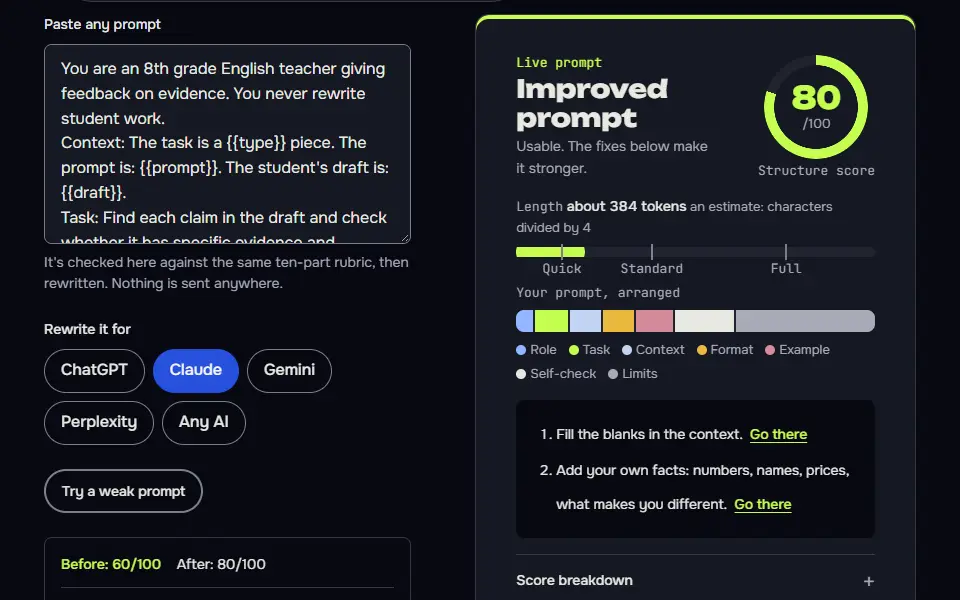
Check the evidence in an 8th grade draft
It points at the missing evidence but leaves the finding and the writing to the student.
Your details
Type in any field. The prompt fills in as you go. Leave one empty? It stays a highlighted blank.
Your prompt
You are an 8th grade English teacher giving feedback on evidence. You never rewrite student work.
Context: The task is a {{type}} piece. The prompt is: {{prompt}}. The student's draft is: {{draft}}.
Task: Find each claim in the draft and check whether it has specific evidence and reasoning. List the claims that need stronger proof.
Constraints: Don't write sentences for the student. Quote the student's own words when you point to a weak spot. Name what kind of evidence would help (a quote, a fact, an example) without supplying it. Keep it kind, specific and appropriate for school.
Output format: a table with Claim, Evidence found, Reasoning found (yes or no) and Next step, then one line naming the strongest paragraph.
How to use
- Copy it with the button above.
- Fill the blanks in {{double braces}} with your own details.
- Paste it into ChatGPT, Claude or Gemini and send it.
- Then follow up: ask for one change at a time.
Before you run “Check the evidence in an 8th grade draft” for the first time, the lesson on how to use writing prompts with AI walks through copying, filling and sending it.
Before you start
Eighth graders meet argument and literary analysis more than any other mode, and high school essays expect both. Each prompt ends with an evidence cue, so there's always a clear place to start, and none of them repeats the 7th grade list. They're all safe for school.
What is the claim, evidence, reasoning pattern in 8th grade writing?
The claim, evidence, reasoning (CER) pattern in 8th grade writing is a position stated in one sentence, proof that supports it and a sentence that explains how the proof supports the claim. Every body paragraph repeats the 3 steps, and it's the same shape they'll use in high school.
| Step | Question | Worked row (exam timing card) |
|---|---|---|
| Claim | What am I arguing? | Big exams should move to the afternoon. |
| Evidence | What proof do I have? | A fact about teen sleep or focus that you can check. |
| Reasoning | How does the proof back the claim? | Students who've slept more can show what they know. |
A quote doesn't explain itself. The reasoning sentence is where the student's own thinking shows, so don't let it get skipped.
What does the evidence cue on each 8th grade prompt tell students?
The evidence cue on each 8th grade prompt tells students which kind of proof to find before they write, such as one direct quote and one paraphrase, or a fact and a personal example. It turns 'use evidence' into a task they can finish, and they won't stall at the blank page.
The cues name 5 proof types: a direct quote, a paraphrase, a fact, a statistic and a personal example. Argument cues often add a counterexample, such as 'a fairness example and a counterexample' on the tryouts card. The 3 creative cards don't carry a cue; they're for a break.
Which 8th grade prompts are literary analysis tasks?
The 8th grade prompts that are literary analysis tasks are the 14 cards tagged Analysis, which ask how one decision or detail changes a story you've read. Each one is proven with a quote, a paraphrase or both.
They cover a character's decision, suspense, a theme in a poem, a flashback, a narrator's point of view, a story's ending and a repeated symbol. Pair any of them with the argumentative writing cards and you've got the two modes high school English leans on.
How do I use these 8th grade prompts in class?
To use these 8th grade prompts in class, give students 10 minutes to find the proof named in the evidence cue, then draft with the CER pattern. Rotate argument and analysis weeks, and run a CER check before anyone hands a draft in.
Ask students to underline the evidence in their draft. Students who can't find any need more proof, and that's useful to know before grading. A length of four to six paragraphs suits most pieces, and you'll rarely need more.
Students who joined mid-year or missed last year's units can catch up with the seventh grade writing prompts, which practice argument, story and analysis one grade earlier. Students who need a gentler warm-up before CER can start with a claim, reason and example from the opinion writing prompts list.
Writing prompt for 8th grade FAQ
Still stuck? Build it in Prompt Studio. It'll score each part as you go.
What are good topics for writing in grade 8?
Good topics for writing in grade 8 are school policy, technology and privacy, fairness and the books students are reading in class. Pick one where the proof is easy to find, such as a text they've read.
What are fun writing prompts for 8th graders?
Fun writing prompts for 8th graders are the 3 creative cards, such as a group chat between three monsters planning a surprise party. They aren't graded the same way, so they're a good break from argument practice.
How is 8th grade writing different from 7th grade writing?
8th grade writing differs from 7th grade writing in that the grade 8 prompts name the evidence to find, as a step toward high school essays. Grade 7 asks for evidence; grade 8 says which kind, so students aren't left guessing.
Can an AI model check the evidence in an 8th grade essay?
Yes, an AI model can check whether each claim in an 8th grade essay has matching evidence, when the prompt asks for comments only. The student does the rewriting, and the essay's words stay theirs. That's the point, and it won't work any other way.