
Picture writing prompts with 42 photo scenes
Writing list
42
- 7 tags
- Printable
The short answer
A writing prompt photo is a scene described in words plus one task, so you can write from it with or without a real image. The 42 picture prompts here are tagged descriptive (18) or narrative (24) and by setting, and they're written for teen and adult writers. You won't need to hunt for a picture first.
Want a scene nobody else in your workshop has used? Our AI writing prompt generator for picture prompts writes a new photo scene and a matching task in one go.
42 picture writing prompts
Filter by tag
Showing all 42 prompts
Picture: a foggy lake at dawn with a single rowboat tied to a dock. Describe the scene so well the reader can hear the water.
Picture: a rain-wet street at night, neon signs doubled in the puddles. Describe it using only sound and colour.
Picture: a suitcase left alone on a train platform. Write the last hour of its owner's day.
Picture: a lit window in a row of dark houses. Who is awake, and why?
Picture: a kitchen table covered in flour, with two mugs and no people. Describe what just happened here.
Picture: a fox standing in an empty car park at sunrise. Write what the fox is looking for.
Picture: a field of tall grass bending in strong wind under a bruised sky. Describe the feeling in the air before the storm.
Picture: a bicycle chained to a lamppost with a handwritten note taped to the seat. Write the note and what happens next.
Picture: a crowded market stall selling spices in a dozen colours. Describe the smells in order, strongest first.
Picture: a staircase that ends at a plain wall. Write the story of who built it.
Picture: an attic trunk open on the floor, a faded red scarf on top. Write what the finder discovers underneath.
Picture: a frozen waterfall, blue at its core. Describe it as if explaining it to someone who has never seen ice.
Picture: a lone traveller's shadow stretching along a desert road at sunset. Write the next mile.
Picture: a messy desk lit by a single lamp, with an unfinished letter. Describe the person who owns it, without showing them.
Picture: a pair of muddy boots by the front door, still wet. Write the visitor who isn't there.
Picture: a street musician playing to an empty subway platform. Write what one passing stranger does.
Picture: a small harbour with fishing boats at low tide. Describe the sound of the place in ten sentences.
Picture: a hawk circling over a quiet farm. Write the scene from the point of view of the smallest creature below.
Picture: a birthday cake with three candles blown out and four guests' coats still on the chairs. Write what interrupted the party.
Picture: a rooftop garden among tall buildings at dusk. Describe the contrast between the two worlds.
Picture: a ferry leaving a dock as one passenger runs along the pier. Write why they can't miss it.
Picture: an old forest path covered in orange leaves. Describe the walk, step by step, without using the word walk.
Picture: a mirror in an empty room reflecting a doorway that isn't in the room. Write what comes through.
Picture: a laundromat at 2 a.m. with two strangers and one running machine. Write their conversation.
Picture: sunlight through a kitchen window onto a bowl of lemons. Describe the quiet using only things you can see.
Picture: a lighthouse with its lamp dark in the middle of a storm. Write the keeper's decision.
Picture: a night train window with rain streaks and distant town lights. Describe what a tired traveller notices.
Picture: a shoebox of old photographs spilled across a rug. Write the story behind one picture you can't see.
Picture: a bookshop door left open at midnight, light spilling out. Write who goes in.
Picture: a beach after a high tide, covered in shells and driftwood. Describe three objects in detail and what each might have been.
Picture: a child's red balloon caught in the branches of a city tree. Write what it sets in motion for a stranger below.
Picture: a bus stop in the early morning with steam rising from paper cups. Describe the mood in a hundred words.
Picture: a map pinned to a wall with one route circled in pencil. Write who drew it and where it leads.
Picture: two paths splitting in a misty wood. Write the first step down the one nobody takes.
Picture: an empty swing moving slightly in a backyard. Describe the silence, then hint at who just left.
Picture: a locked door with a small light under it. Write what you do next.
Picture: a mountain village at sunrise with smoke rising from three chimneys. Describe the morning from a hillside.
Picture: a streetlamp flickering above a closed bakery. Write what the baker sees when they arrive.
Picture: a cluster of mushrooms on a mossy log after rain. Describe the tiny world as if it were a city.
Picture: a handwritten recipe card stained with oil and one corner burned. Write the family story behind it.
Picture: a passport on a cafe table with the photo page missing. Write what happened to it.
Picture: a library reading room, empty, with every lamp lit. Describe it as if the books were listening.
Want more? Brainstorm with AI
Paste this into any chat AI. It writes fresh picture writing prompts in the same style.
Make an original photo to write about
Paste it into an image AI to get a unique picture with no copyright worry, then write about what it makes you wonder.
Your details
Type in any field. The prompt fills in as you go. Leave one empty? It stays a highlighted blank.
Your prompt
Any model
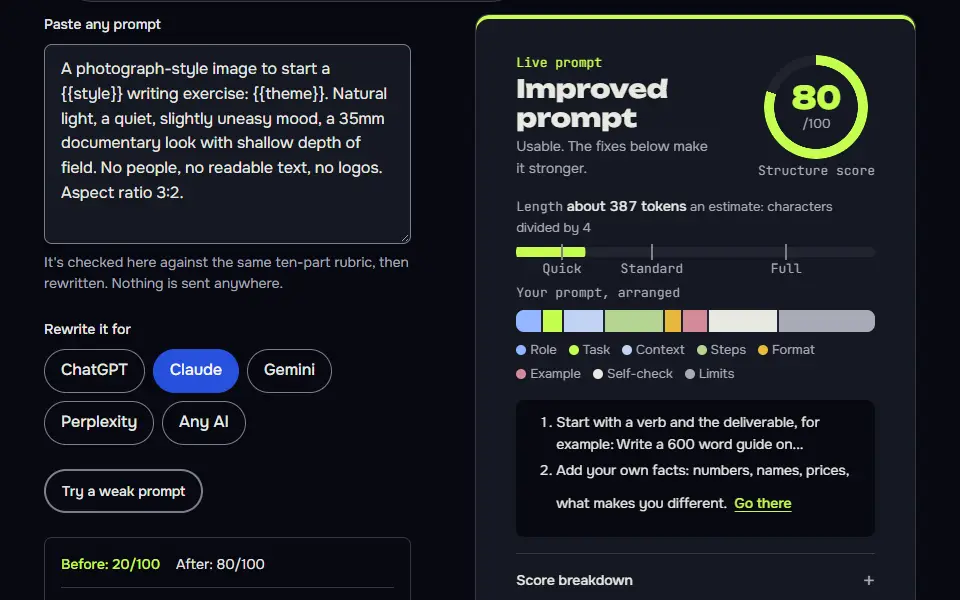
A photograph-style image to start a {{style}} writing exercise: {{theme}}. Natural light, a quiet, slightly uneasy mood, a 35mm documentary look with shallow depth of field. No people, no readable text, no logos. Aspect ratio 3:2.
ChatGPT
Create a photograph-style image, 3:2 landscape: {{theme}}. Natural light, 35mm lens, shallow depth of field, quiet mood, no text or logos and no recognisable people.Gemini
Generate a realistic photo in a 3:2 frame of {{theme}}. Soft natural light, a 35mm look, and a quiet mood suited to a {{style}} writing exercise. No readable text and no recognisable faces.
Midjourney
{{theme}}, documentary photograph, 35mm lens, soft natural light, quiet mood, no text --ar 3:2 --rawHow to use
- Copy it with the button above.
- Fill the blanks in {{double braces}} with your own details.
- Paste it into your image AI and generate.
- Then ask for one change at a time, not a new prompt.
Before you run “Make an original photo to write about” for the first time, the lesson on how to use AI image prompts walks through copying, filling and sending it.
Before you start
Every prompt here pairs a scene with a task, and the scene's written in words, so there's nothing to download. You don't need our photos or a camera: use your own camera roll, a library book, or picture it in your head. Younger writers have a separate picture prompts for kids list, sorted by grade, and it doesn't share any scenes with this one.
How do I write from a photo writing prompt?
To write from a photo writing prompt, look at the scene, list what you see, hear and smell, then write what happened before or what happens next. It works with any image, real or described, and it doesn't take long.
- Look for 60 seconds. Don't write yet, and don't rush it. Notice the corners, the background and what's missing: that's where the story's hiding.
- List five details across different senses, even the ones a photo can't show, such as sound and smell.
- Choose before or after: the minute before the photo, or the minute after it. Don't try both.
- Write for ten minutes and open with your best detail. You'll trim the rest later.
How do descriptive and narrative picture prompts differ?
Descriptive and narrative picture prompts differ in the task: a descriptive prompt asks you to show the scene in detail, and a narrative prompt asks you to tell what happens in it.
| Type | Prompts | Your task | Example |
|---|---|---|---|
| Descriptive writing | 18 | Show the place through the five senses | A foggy lake at dawn: make the reader hear the water. |
| Narrative writing | 24 | Tell what happened before, after or to a character | A suitcase left on a platform: write its owner's last hour. |
Descriptive prompts suit warm-ups and exam practice, since they train detail you'd otherwise skip. Narrative prompts suit fiction, since they ask for a character and a change that's yours to invent. Filter by one type, since you won't want both at once. It's quicker, and you'll stay on one task.
Which picture prompts fit nature, city, home and travel scenes?
The picture prompts that fit nature, city, home and travel scenes are the nature, city, home and travel sets: 10, 10, 8 and 7 prompts, with 7 mystery scenes for a darker story. Each setting tag's set alongside the descriptive or narrative tag, so two filters find the exact kind of scene you need.
Nature scenes suit description, since light and weather do the work and there's no plot to manage. City and travel scenes suit stories with strangers you'll never see again. Home scenes suit memory and quiet tension, and mystery scenes suit anything with a secret that's not been told. A favourite photo from the week makes a good entry for the gratitude journal prompts for adults list too. Teachers who grade descriptive pieces can move students on to argument with the AI prompts for essay writing list and its thesis starters.
Writing prompt photo FAQ
Still stuck? Build it in Prompt Studio. It'll score each part as you go.
What is a good prompt for a photo you took yourself?
A good prompt for a photo you took yourself is 'Write what happened in the five minutes before you pressed the shutter', which turns any camera roll image into a story. You were there, so you've already got the details.
What are some good AI prompts for photos to write about?
Good AI prompts for photos to write about are scene descriptions with one place, one light condition and one odd detail, pasted into ChatGPT, Gemini or Midjourney. The AI helper on this page has a version for each one, and it makes an original image, so nothing's copied.
Do photo writing prompts work for adults?
Yes, photo writing prompts work for adults, and the narrative and mystery scenes on this page are written for teen and adult writers. They work in writing groups and workshops as ten-minute starters.
Where are the picture writing prompts for younger children?
The picture writing prompts for younger children are on the separate picture prompts for kids page, sorted by grade band from kindergarten (K) to grade 6. That page uses its own scenes, so none of these 42 repeat there.