
Flipped interaction pattern: a prompt that interviews you
Free prompt courseLesson 15 of 226 minVideoGo to the lesson
Guide
3 min
- Plain English
The short answer
The flipped interaction pattern turns a prompt around: instead of you writing every detail, you ask the AI to interview you first. Give it 3 rules: ask up to 5 questions, put the most important first and wait for your answers. It's best when the job depends on details only you know.
What is the flipped interaction pattern in prompting?
The flipped interaction pattern is a prompt where the AI asks you questions first and does the job only after you answer. Normally you're the one asking; here it's the AI that asks, and you're the one who answers. The name comes from a 2023 prompt pattern catalogue by Jules White and colleagues at Vanderbilt University, which describes asking the model to question you until it has enough to reach a goal.
It works since a model knows what a job usually needs, even when you haven't thought about it yet. Your details are the part it can't guess, so letting it ask for them is quicker than writing a long brief from scratch. You'll find it most useful for plans, letters and anything personal.
How do you write an interview-first prompt?
To write an interview-first prompt, name the job, cap the questions at 5, ask for the most important first, ask for them all at once and tell the AI to wait. For a prompt you'll reuse as standing instructions (Gemini Gems, Claude Projects and Custom GPTs all take them), paste the interview rules into the generator for custom GPT instructions, and every new chat opens with the questions.
- Job line. Name the job in one line, so it won't ask about the wrong thing.
- Question cap. Write "up to 5". Without a cap of 5 questions, you'll sometimes get twelve.
- Priority order. Ask for "the questions that would change the answer most, most important first".
- All at once or one at a time. All at once, numbered, suits most jobs, since you'll answer in one message.
- Wait line. Write "don't start the work until I reply". It's the line models skip most often, and leaving it out is the usual reason the pattern fails.
One extra is worth adding: a why-it-matters line, "say in a few words why each question matters". You'll learn what the AI thinks drives the result, and you can skip a question that doesn't apply.
What did the tested flipped interaction run ask?
The tested flipped interaction run asked five ranked questions, most important first, then waited for the answers before writing. We asked a personal trainer role for a 4 week home workout plan. The questions covered the goal, the equipment at home, the days a week and minutes per session, the current fitness level and any injuries, each with a short reason. Then it stopped, and it didn't write any of the plan. The injury question carried the line to check with a doctor or physio, which we'd asked for in the prompt. Answer each in one line: "3 days a week, 30 minutes each" tells the AI far more than "when I can".
Flipped interaction pattern before and after
The same request, asked two ways. Read the second one slowly. Each line does a job.
Write me a 4 week home workout plan.
I want a 4 week home workout plan. Before you write anything, ask me up to 5 questions that would change the plan the most, numbered, most important first, in one message. Say in a few words why each one matters. Then wait for my answers. Don't write any part of the plan until I reply.
Why it works
The first version gets a generic plan built on guesses about your goal, your kit and your fitness. The second makes the AI find out first, so the plan fits you, and the stop line keeps it from writing before you've answered.
Flipped interaction pattern examples
Interview me first, for any job
The pattern stays reliable with 3 parts: the cap, the order and the stop line.
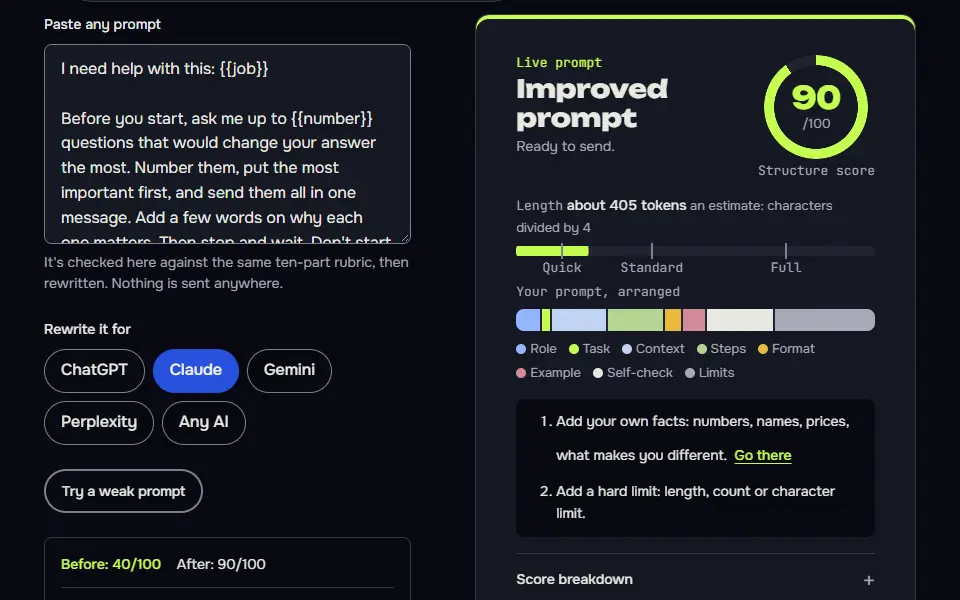
I need help with this: {{job}}

Before you start, ask me up to {{number}} questions that would change your answer the most. Number them, put the most important first, and send them all in one message. Add a few words on why each one matters. Then stop and wait. Don't start the work until I've replied.
How to use
- Copy it with the button above.
- Fill the blanks in {{double braces}} with your own details.
- Paste it into ChatGPT, Claude or Gemini and send it.
- Then follow up: ask for one change at a time.
Before you run “Interview me first, for any job” for the first time, the lesson on how to use AI prompts step by step walks through copying, filling and sending it.
One question at a time, for a longer brief
Slower than one batch of questions, but each question can build on your last answer.
Help me write a brief for {{project}}. Interview me one question at a time. After each answer, ask the next most useful question, and tell me how many are left in your view. Stop when you have enough, or after 8 questions, whichever comes first. Then write the brief in under 250 words, using only what I told you, and list anything you had to assume.Lesson 15 of 22Techniques6 min
Lesson: Flipped interaction: the AI interviews you
Ask the AI to question you before it works. Cap the number of questions, ask for the most important first and tell it to wait. You'll get an answer built on your details instead of its guesses.
Use it when
- The answer depends on details only you know: your goals, budget or situation.
- You're not sure what information the job needs.
- You'd otherwise go back and forth fixing a generic first draft.
Skip it when
- You already know every detail: write them into the prompt instead.
- It's a quick, common job where a decent default answer is fine.
## Role
You are a personal trainer who writes beginner home workout plans.

## Task
I want a 4 week home workout plan. Before you write anything, interview me.

## How to work
Ask me up to 5 questions that would change the plan the most, numbered, most important first, all in one message. Say in a few words why each question matters. Then stop and wait for my answers. Don't write any part of the plan until I reply.

## Limits
Keep the questions short and plain. Don't give medical advice; if a question touches on health, tell me to check with a doctor or physio first.
1. **What's your main goal?** (lose fat, build strength, get fitter, or more energy) This sets the exercise mix and intensity.

2. **What equipment do you have at home?** (none, dumbbells, bands, a pull-up bar, a mat) This decides which exercises I can use.

3. **How many days a week can you train, and for how long each session?** This sets the plan's structure and volume.

4. **How active are you now, and have you trained before?** This sets the starting level so the plan is challenging but not too much.

5. **Any injuries, pain, or health conditions I should know about?** This may mean swapping exercises. I can't give medical advice, so please check with a doctor or physio first if something is a concern.
What to notice: It asked exactly five questions, such as goal, equipment and days a week, each with its reason, then stopped without writing any of the plan. The health question carries the doctor or physio line the prompt asked for. Your answers to these five are what a good plan would need anyway.
Try it in Prompt StudioOpens the studio with the Interview first technique already selected.
Quick check: 3 questions
Practice: write your own
Write an interview-first prompt for a job where your own details matter: a trip, a budget, a plan or a piece of writing. Cap the questions, ask for priority and include a stop line.
Prompt Studio's rubric scores it right here. Nothing's sent anywhere.
Your progress is saved in this browser only. No sign-up.
When does the flipped interaction pattern go wrong?
The flipped interaction pattern goes wrong when the model asks one question and writes the whole job anyway, or when the answers are "whatever you think". The first failure mode comes from a missing or weak wait line, and a clear stop sentence fixes most of it. The second is lazy answers: they'd hand the guessing back to the AI and lose the point of the interview. Short, specific answers are what it's after.
Skip the interview when you've already got the details: writing them straight into the prompt is quicker. The eight parts of a prompt show where each detail goes, so you'll know what to include without being asked. For a longer job that needs a written plan and a check at the end, the plan and solve prompt is the next tool to try. Both lessons sit in the free prompt course.
Don't feel you have to answer every question. Say so when one doesn't apply, and the AI will move on.
Flipped interaction pattern FAQ
Still stuck? Build it in Prompt Studio. It'll score each part as you go.
What is a flipped interaction prompt?
A flipped interaction prompt is a prompt that asks the AI to question you before it does the job, with a set number of questions and a line telling it to wait. You say what you want, it'll ask about the details that matter most, and it'll work from your answers, not guesses.
Who came up with the flipped interaction pattern?
Jules White and colleagues at Vanderbilt University named the flipped interaction pattern in a 2023 paper on prompt patterns for ChatGPT. Asking clarifying questions first is an older habit, but that paper gave it the name most people use today.
How should a flipped interaction prompt ask its questions, one at a time or all at once?
A flipped interaction prompt should ask its questions all at once for most jobs and one at a time for long briefs, with the total capped either way. All at once is faster, since you'll answer in one message. One at a time lets each question build on your last answer, so it's worth the extra turns on a big job.