
Horror writing prompts for stories, by subgenre and fear
Writing list
47
- 8 tags
- Printable
The short answer
Good prompts for horror stories take something ordinary and make it wrong, then name a fear source, a setting and a limit on the character. This page has 47 for adult and young adult readers, including fear source and setting lists to mix. You don't need a full plot yet, just one wrong detail.
Have a fear source and a setting picked? Drop them into the AI writing prompt generator for horror stories for a dread plan and scene-by-scene questions, with no story written for you.
47 horror writing prompts
Filter by tag
Showing all 47 prompts
Every night at 3:12 the baby monitor picks up a second voice, and your partner swears the room is empty.
You begin to notice that your reflection arrives half a second late.
A new colleague knows details about your childhood you've never told anyone at work.
You wake up in your own bed, but the house has been reorganised by someone who loves you very much.
A therapist's notes describe sessions you can't remember attending.
Your diary entries start appearing in handwriting that is almost yours.
You buy a house and the previous owner's rules are written in pencil inside every cupboard.
A lift stops on a floor that isn't on the panel, and the doors open to your childhood bedroom.
Your late neighbour keeps leaving his porch light on, and a new family has moved in who never go out.
A second-hand piano plays one note at night, and the note changes when you get close.
At a village inn, every guest is given the same key, and every room is the same room.
You find a photograph taken in your house in 1920, and you are in it.
A village keeps a tradition of leaving one empty chair at the harvest table. This year you sit in it.
The scarecrow has been moved again. This time it's holding a lantern.
The forest path has a new rule: do not whistle after dusk. You've just whistled.
A newcomer discovers that the local festival has a role nobody volunteers for, but someone always fills.
A well in the village square gives back answers, and every answer costs a memory.
The bells ring a day before a funeral. No one has died yet.
A telescope on a mountain picks up a signal that is clearly addressed to a person by name, and it's yours.
You discover that the stars have been moving, but only when you're not looking.
A deep-sea crew finds a door on the ocean floor that opens inward.
A mathematician proves a theorem that the universe immediately starts to correct.
A small town forgets the sky. It's just white, and no one remembers it was ever blue.
Something is eating the livestock on the farm, but the tracks stop at the barn door.
You find a nest in the attic, built from household objects you thought you'd lost.
A lake monster in a holiday town turns out to be a very polite regular at the cafe.
The fog that rolls in each evening is made of something that listens.
A zoo guard hears a new cry at night from an enclosure with no animal in it.
A fishing boat catches something that looks back.
Your smart speaker begins answering questions you haven't asked, and it's always right.
A dashcam video shows your car on a road you've never driven, with someone in the back seat.
An old video game character begins to appear in your real-life reflection.
A voice assistant refuses to turn off the lights, and has a reason.
Your phone keeps receiving photos of your house, taken from outside, each one closer than the last.
You find a livestream of an empty room that slowly begins to look like your own.
A voice that sounds exactly like a loved one, asking you to open a door.
A pattern that repeats in everything you see, getting larger each day.
A stranger who is always one step behind you in photographs.
A rule that must never be broken, whose punishment isn't described.
A tradition whose original purpose has been forgotten but whose cost is still paid.
In your grandmother's cottage, a porcelain doll on the shelf is a little closer every time you look away, and the storm means you can't leave tonight. Write the night.
A road-side motel at the edge of a salt flat, one night only.
A school building after the last bell, when the corridors are quiet.
A lighthouse during a long winter.
A small-town library after closing time.
A hospital wing that has been closed for repairs for ten years.
A night ferry crossing in thick fog.
Want more? Brainstorm with AI
Paste this into any chat AI. It writes fresh horror writing prompts in the same style.
Plan the dread in a horror story
Planning escalation beat by beat keeps dread building, and the writing stays yours.
Your details
Type in any field. The prompt fills in as you go. Leave one empty? It stays a highlighted blank.
Your prompt
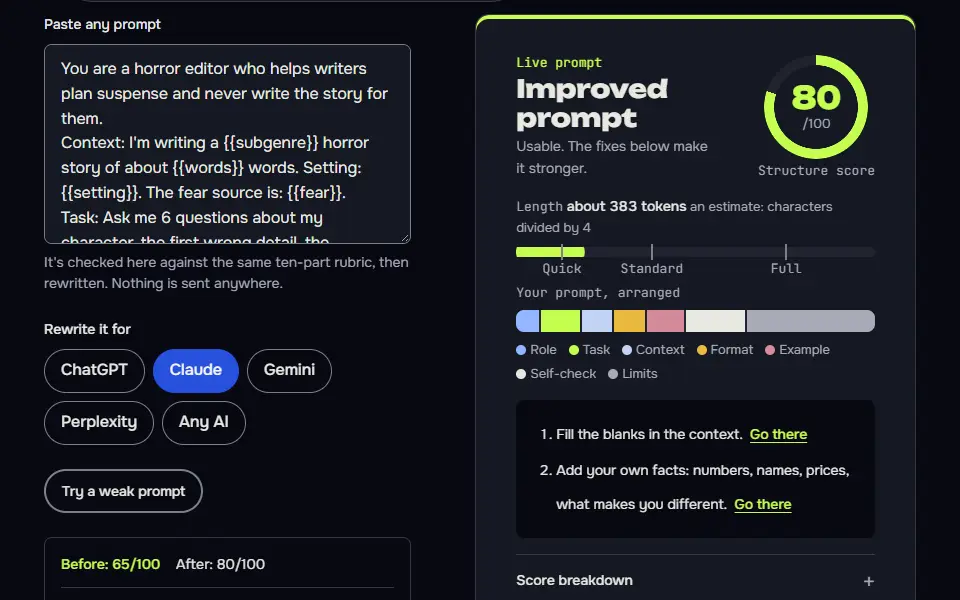
You are a horror editor who helps writers plan suspense and never write the story for them.
Context: I'm writing a {{subgenre}} horror story of about {{words}} words. Setting: {{setting}}. The fear source is: {{fear}}.
Task: Ask me 6 questions about my character, the first wrong detail, the escalation and the ending. Then outline 5 beats that build dread with no jump scares.
Constraints: Don't write any story text. Keep each question under 25 words. Avoid graphic violence, real-world tragedies and cliches such as it was all a dream. Show the effect before the cause in the outline.
Output format: 6 numbered questions, then a 5-beat outline with one line each, then one idea for a final image that stays with the reader.
How to use
- Copy it with the button above.
- Fill the blanks in {{double braces}} with your own details.
- Paste it into ChatGPT, Claude or Gemini and send it.
- Then follow up: ask for one change at a time.
Before you run “Plan the dread in a horror story” for the first time, the lesson on how to use writing prompts with AI walks through copying, filling and sending it.
Before you start
These 47 horror prompts are written for adult and young adult readers. They cover psychological, supernatural, folk, cosmic, creature and technological horror, and they don't rely on gore. Content note: the prompts steer clear of graphic violence and real-world tragedies, and you'll want to add your own content warning if you share what you write.
What makes a good horror writing prompt?
A good horror writing prompt sets up something ordinary and makes it wrong, naming a fear source, a setting and a limit on what the character can do. "Every night at 3:12 the baby monitor picks up a second voice" works: the fear source is the voice, the setting is a nursery, and the limit is a partner who won't believe it.
A prompt that explains everything leaves you nothing to write, and readers won't feel a thing. Leave the cause open, and let the character's routine be the thing that's under threat.
Which horror subgenre fits your story idea?
The horror subgenre that fits your story idea is psychological for a mind you can't trust, supernatural for a rule-bound ghost, folk for a tradition, cosmic for something too big to grasp, creature for a hunter and technological for a device that turns. Each tag on the list holds 6 cards, except cosmic, which has 5.
| Subgenre | The fear | Cards |
|---|---|---|
| Psychological | Your own mind or memory isn't reliable | 6 |
| Supernatural | A ghost or presence that follows rules | 6 |
| Folk | A village custom nobody questions | 6 |
| Cosmic | Something vast that doesn't notice you | 5 |
| Creature | A hunter you can't see clearly | 6 |
| Technological | A device that listens or acts on its own | 6 |
How do I build dread in a horror story instead of shock?
To build dread in a horror story, show a normal scene, add one wrong detail, deny the easy explanation, narrow what the character can do and hold the reveal until late. Shock lasts one line, while dread builds across the whole story and doesn't let go. The method has five steps, and it takes the place of jump-scare advice.
- Show a normal scene. Give the routine and what the character cares about; that's what you'll threaten.
- Add one wrong detail that others ignore: a sound, a smell, a rule.
- Deny the easy explanation. The draught isn't a draught, and the neighbour isn't home.
- Narrow the limit. Each attempt to ignore it costs more, and the exits close.
- Hold the reveal until late, then end with a choice or a change, not a lecture.
For length, 1,000 to 2,000 words is plenty for a first draft, so don't worry if it isn't long.
How do I mix the horror fear source and setting lists?
To mix the horror fear source and setting lists, pick one card from each list, put the fear in the place and add one thing the character can't do. Each list has 6 cards, so two dice rolls give you 36 pairs you haven't tried yet.
Then ask three questions: who's there, what do they want, and what won't they believe? A twist usually comes from that last answer: a reveal that the safe place was the threat, or a reversal where the hunter's the one being watched. Horror fans who like a good argument can debate whether scary stories belong in school with the writing prompts for opinion pieces cards. Gothic writers often need a love thread, and the trope cards behind love writing prompts give you one in a line.
Prompts for horror stories FAQ
Still stuck? Build it in Prompt Studio. It'll score each part as you go.
What are some good horror story ideas with a twist?
Some good horror story ideas with a twist are prompts where the safe place is the threat, such as a house whose previous owner left rules in every cupboard. The twist lands when the reader learns who the rules were protecting.
What are good prompts to ask ChatGPT for horror stories?
Good prompts to ask ChatGPT for horror stories name the subgenre, setting, point of view, length and the one rule the threat follows. Ask for a plan or a scene outline first, then write the story yourself, so it's your voice the reader hears.
Are these horror writing prompts suitable for kids?
No, these horror prompts are written for adult and young adult readers. The Halloween writing prompts on this site hold the milder, age-banded starters for children.