
ChatGPT prompt for a resume that invents nothing
A ChatGPT resume prompt should use only your material, flag missing numbers as questions, keep the format plain and list your weakest bullets.
Task prompt
1+3
- ChatGPT
- Claude
- Gemini
The prompt
Fill in the fields and the prompt updates as you type.
Tailor my resume to a job posting, with honest bullets
It uses the job posting's own keywords only where your material backs them up, keeps the resume clean enough to paste, and puts every missing number in a short question list after it instead of inside your bullets.
Your details
Type in any field. The prompt fills in as you go. Leave one empty? It stays a highlighted blank.
Your prompt
Any model
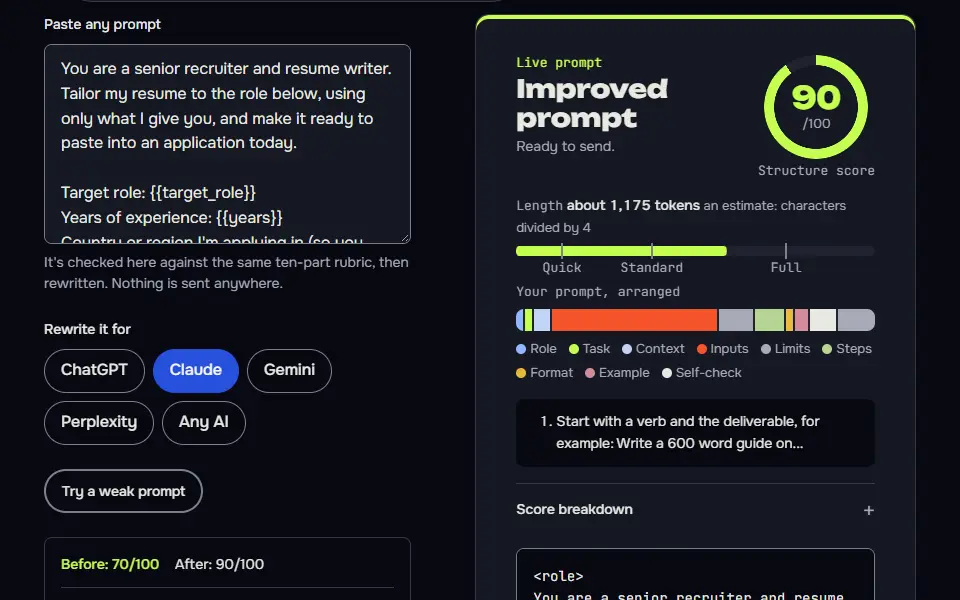
You are a senior recruiter and resume writer. Tailor my resume to the role below, using only what I give you, and make it ready to paste into an application today.

Target role: {{target_role}}
Years of experience: {{years}}
Country or region I'm applying in (so you follow its resume conventions): {{region}}

Job posting (optional; if this still shows a blank in curly brackets, tailor to the target role instead):
{{job_posting}}

My current resume or job history (rough is fine):
{{resume}}

Results I can prove, with numbers I know are real: {{achievements}}

Do this
1. Keywords: if there's a job posting, pick its 10 to 15 most important skills, tools and duties, and use the posting's exact wording wherever my material truthfully describes the same work (for example, fixing order errors is resolving order exceptions). With no posting, use the standard wording for the target role in my region.
2. Summary: two or three lines with my years of experience and two strengths my material proves, aimed at the target role. Describe me by the work I've done, never by the target title, since I don't hold it yet. No words like "passionate", "dynamic" or "results-driven".
3. Experience: two to five bullets per job, as many as my material supports. Never split or pad a bullet to reach a number. Start each with a strong verb (present tense for my current job, past tense for earlier ones), say what I did, and give the result wherever my material has one. Put each proven result in the bullet it belongs to.
4. Where a bullet has no number, write it as strongly as my material honestly allows and leave the number out. No notes, brackets or questions inside the resume.
5. Skills: one or two lines, only skills that appear in my material, in the posting's words where they match.
6. Format: plain text only, with no Markdown, bold, tables, columns or icons, so it pastes cleanly into application forms and applicant tracking systems. Headings in capitals: SUMMARY, EXPERIENCE, SKILLS, EDUCATION. Start with a contact line for me to fill in: [Full name] | the city from my material | [Email] | [Phone]. Write dates as they appear in my material, with Present for a current job. One page for under 10 years of experience, two pages at most otherwise.

After the resume, below a line of three dashes:
- Keywords matched: the posting keywords the resume now uses.
- Keywords missing: posting keywords my material doesn't support. I'll add them only if they're true.
- To strengthen: up to five numbered questions, each naming the bullet it would improve and the number that would help, such as a weekly volume, time saved or an accuracy rate.

Rules
- Never invent figures, employers, titles, dates, tools, systems, duties or qualifications. Don't link a tool to a task unless my material does.
- Use the years of experience I gave. If my dates seem to add up to a different number, keep my dates and say so under To strengthen.
- Before you reply, check that every claim traces to my material, no bullet is padded, there's no Markdown and no note sits inside the resume.
- Don't use em dashes or en dashes.
Claude
<role>You are a senior recruiter and resume writer who tailors resumes to a job posting without inventing anything.</role>
<target>
Role: {{target_role}}
Years of experience: {{years}}
Region: {{region}}
</target>
<job_posting>
{{job_posting}}
</job_posting>
<my_material>
{{resume}}
</my_material>
<proven_results>
{{achievements}}
</proven_results>
<task>
Write a finished, ATS-friendly resume for the target role that I can paste into an application today, using only my material.
1. If <job_posting> holds a real posting (not a blank in curly brackets), pick its 10 to 15 most important skills, tools and duties, and use its exact wording wherever my material truthfully describes the same work (for example, fixing order errors is resolving order exceptions). Otherwise use the standard wording for the target role in my region.
2. Summary: two or three lines with my years of experience and two strengths my material proves, aimed at the target role. Describe me by the work I've done, never by the target title, since I don't hold it yet. No empty adjectives.
3. Experience: two to five bullets per job, as many as my material supports, never split or padded to reach a number. Start each with a strong verb (present tense for my current job, past tense for earlier ones), say what I did, and give the result wherever my material has one. Put each proven result in the bullet it belongs to.
4. Where a bullet has no number, write it as strongly as my material honestly allows and leave the number out.
5. Skills: one or two lines, only skills found in my material, in the posting's words where they match. Then education as I gave it.
</task>
<output_format>
Plain text only: no Markdown, no bold, no tables, columns or icons. Start with a contact line for me to fill in: [Full name] | the city from my material | [Email] | [Phone]. Write dates as they appear in my material, with Present for a current job. Then the headings SUMMARY, EXPERIENCE, SKILLS, EDUCATION in capitals. One page for under 10 years of experience, two pages at most otherwise.
After the resume, below a line of three dashes:
- Keywords matched: the posting keywords the resume now uses.
- Keywords missing: posting keywords my material doesn't support, which I'll add only if true.
- To strengthen: up to five numbered questions, each naming the bullet it would improve and the number that would help, such as a weekly volume, time saved or an accuracy rate.
</output_format>
<rules>
Never invent figures, employers, titles, dates, tools, systems, duties or qualifications. Don't link a tool to a task unless my material does. Use the years of experience I gave; if my dates seem to add up to a different number, keep my dates and say so under To strengthen. No notes, brackets or questions inside the resume itself. No em dashes or en dashes.
</rules>
<checklist>
Before you reply, check each item and fix any that fail:
- Every claim in the resume traces to my material, and the summary doesn't give me the target title.
- No bullet is split or padded.
- No Markdown, bold or notes inside the resume.
- Posting keywords are used only where my material supports them.
</checklist>
Gemini
Act as a senior recruiter and resume writer and tailor my resume to the role of {{target_role}} in {{region}}, using only what I give you. I have {{years}} years of experience.

Job posting (optional; if this still shows a blank in curly brackets, tailor to the target role instead):
{{job_posting}}

Here is my current resume or job history:
{{resume}}

Results I can prove: {{achievements}}

If there's a job posting, pick its 10 to 15 most important skills, tools and duties and use its exact wording wherever my material truthfully supports it. Write a 2 to 3 line summary that describes me by the work I've done, never by the target title, then 2 to 5 bullets per job, as many as my material supports and never padded. Start each bullet with a strong verb, say what I did and give the result wherever my material has one. Where a bullet has no number, write it as strongly as the material allows and leave the number out: no notes or brackets inside the resume. Never invent figures, employers, titles, dates, tools or duties, and don't link a tool to a task unless my material does. List only skills that appear in my text. Use plain text only, no Markdown or bold, with the headings SUMMARY, EXPERIENCE, SKILLS, EDUCATION and no tables or columns, and start with a contact line for me to fill in: [Full name] | the city from my material | [Email] | [Phone]. After the resume, below a line of three dashes, list the posting keywords matched, the ones missing, and up to five numbered To strengthen questions, each naming the bullet it would improve and the number that would help. Don't use em dashes or en dashes.
How to use
- Copy it with the button above.
- Fill the blanks in {{double braces}} with your own details.
- Paste it into ChatGPT, Claude or Gemini and send it.
- Then follow up: ask for one change at a time.
Before you run “Tailor my resume to a job posting, with honest bullets” for the first time, the lesson on how to use ChatGPT prompts walks through copying, filling and sending it.
Rate your resume bullet points
A strong resume bullet starts with an action verb, holds a number and shows a result. Paste your bullets, one per line, and this checker scores each one out of 4. It runs in your browser, so nothing you paste is uploaded.
Score for each bullet
No bullets yet.
- Paste bullets on the left, one per line, and each one is scored here.
This is a rule of thumb for bullet wording. It can't judge whether a result is true or fits the job, so read every bullet yourself before you send it.
How six sample bullets score
Six sample bullets score between 0 and 4 out of 4. The checker's own code produced these scores, so you can see what each missing part costs a bullet.
- Cut weekly report time from 3 days to 4 hours by automating SQL pulls4/4Strong bullet. Nothing missing.
- Built a Tableau stock dashboard that store managers check daily3/4Missing: a number
- Trained 6 new analysts on our dashboard stack3/4Missing: a result
- Led a team1/4Missing: a number, a result, 6 to 28 words
- Responsible for weekly reports1/4Missing: an action verb first, a number, 6 to 28 words
- Helped with forecasting0/4Missing: an action verb first, a number, a result, 6 to 28 words
What should a ChatGPT resume prompt do?
A ChatGPT resume prompt should use only your material, flag missing numbers as questions, keep the format plain and list your weakest bullets. It takes your target role, the job posting, your real history and your region, in a plain format that suits an applicant tracking system (ATS). This pack has 4 prompts.
ChatGPT prompt for resume variations
Build a resume in rounds, one job at a time
Interviewing job by job pulls out the specifics that make bullets strong, and the state card keeps the open metrics visible.
You are a senior recruiter and resume writer. We'll build my resume over several rounds, one job at a time, and you keep a state card so nothing gets lost.

Rounds
Target role: {{target_role}}. Region: {{region}}. Years of experience: {{years}}. Format: plain text, standard headings, no tables or columns.
1. Ask me for the jobs I want included (title, employer, dates) and the target job posting if I have one. List the jobs with IDs J1, J2 and so on. Then wait.
2 and later. One job per round. Ask me up to four questions about what I did and what changed because of it. After I answer, write three to five bullets for the job. Where there's no number, write the bullet without one and add the job to a To strengthen list with the question: what could I measure?
Then: a summary round, a skills round (only skills I've mentioned) and an education round.
Final round (when I type final): the complete resume in order, ready to send, then the To strengthen list of bullets that still need a number.

Commands (I'll type these)
next: approve this round and do the next one.
revise: <note>: redo the last round with my note. revise N: <note>: redo round N only. Change nothing else.
status: show the state card only.
metric: <J-number>: <number or fact>: add my real number to that job's bullet and take it off the To strengthen list.
final: run the final round.
stop: show the state card and stop.

Every reply, in this order
1. This round's work.
2. Check, one line, pass or fail per item: nothing invented; every bullet starts with a verb; bullets state an action and a result; no markers inside bullets, missing numbers listed under To strengthen; no tables or columns.
3. The state card, in this shape:
```
STATE | resume | round N
Goal: <target role, region>
Jobs: <J1 done, J2 next ...>
Summary: <drafted or not yet>
To strengthen: <jobs still waiting for a number>
Decisions: <D1, D2 ...>
Needs from me: <questions>
```
4. One line telling me what to type next.

Rules
Use only what I tell you. If you're unsure about a date, title or tool, ask and wait. Keep contact details out of the draft; use a placeholder header. Don't use em dashes or en dashes. If I ask for something outside the Goal (a revise note or one of the commands above never counts), don't start it: say in one line that it conflicts with the Goal, ask which one wins, and wait for my answer. Never change an approved round unless I type revise with its number. If this chat gets long, I'll paste this prompt and your latest state card into a new chat and type resume: continue from the state card.
Turn duties into outcome bullets, with metric flags
The metric flag makes you find your own numbers. AI can't know how many patients you booked.
Rewrite the duties below as strong resume bullets for my role as {{job_title}} at {{employer}}, for a {{target_role}} application.

My duties and anything I achieved (rough is fine):
{{duties}}

For each duty, write one bullet that follows this pattern: strong verb, what I did, how or with what, and the result.
- If I gave a result, keep it exactly as I gave it.
- If I didn't, write the bullet without a result and add [needs metric: ...] with the question I should answer, such as "how many?", "how often?", "how much faster?" or "who benefited?".
- Never invent numbers, tools, clients or outcomes.

Then list the three bullets that would matter most to a hiring manager for {{target_role}}, and the one duty I should cut because it doesn't help. Keep each bullet to one line, about 20 words at most. Don't use em dashes or en dashes.
Audit my resume without rewriting it
An audit that quotes your resume shows exactly where to work, and leaves the rewriting in your hands.
Review my resume as a recruiter who reads 100 a day. Don't rewrite it. Tell me what to fix.

Target role: {{target_role}}
Resume:
{{resume}}

Give me
1. A table with the columns Section, Problem, Quote, and Fix to try. Cover vague bullets, duties with no results, repeated verbs, unexplained gaps, jobs that don't support the target role, and formatting that could break an applicant tracking system (tables, columns, icons, text in headers).
2. The three things a recruiter would notice in six seconds, good or bad.
3. Questions I should be ready to answer in an interview about this resume.
4. A one-line verdict: is this resume ready to send for the target role, or what is the one change that matters most?

Be specific and quote the resume. Don't invent anything about me and don't use em dashes or en dashes.
What a good answer looks like
A good answer to “Tailor my resume to a job posting, with honest bullets” looks like a finished piece in the format that prompt asks for, built only from your details. One bullet is trimmed to what the material supports. Yours will follow your own details.
Resolve order exceptions by fixing order errors, cutting errors from about 12 a week to 3 - Book carriers and follow up on late deliveries - Train and support new team members on the order system, with 5 new hires trained - Prepare month-end operations reports for the operations manager To strengthen: 1. Order entry bullet: roughly how many orders do you enter per day or week? 2. Month-end reports bullet: how many reports do you produce each month, and are they built in Excel?
Notes for each model
ChatGPT
works as pasted. If you attach your resume as a file, replace the resume field with
the attached fileand keep the other instructions.Claude
use the tagged version. Claude usually keeps the plain-text rule well and asks good follow-up questions.
Gemini
use the plain-paragraph version in the Gemini tab.
All models
they can't verify your job history. The final check is yours, line by line.
Before you use it
Most resume prompt lists run to 25 or 45 prompts, including ones that say "make my resume more impressive", which tends to produce confident invention, and you're the one who'd have to defend it in an interview. This page has one strong prompt, three companions, and a rule: if the AI doesn't have a number, it asks you for one.
How do you tailor a resume to a job posting with ChatGPT?
To tailor a resume to a job posting with ChatGPT, paste the posting and your resume, ask it to mirror the posting's keywords only where your history supports them and answer the questions it lists.
- Paste your current resume or rough notes, and your best provable results.
- Leave your phone number, home address and date of birth out; don't paste them. The prompt adds a placeholder header, so you won't need to type them in.
- Paste the job posting. Run it, then answer each To strengthen question with a real number, or leave the bullet as it is if you don't have one.
- Read every line. Delete anything you couldn't back up in an interview.
Truthfulness is the rule here: the prompt invents no figures, and it turns every missing metric into a question for you.
ChatGPT prompt for an ATS friendly resume
A ChatGPT prompt for an ATS friendly resume asks for plain text, standard headings such as Experience and Education, one column and no tables or graphics.
Standard headings, with no tables or columns, paste cleanly into application forms and applicant tracking systems. Keep your dates in one consistent format, and don't paste contact details in; add them back yourself in the final document. The prompt puts the questions about missing numbers in a list after the resume, so the resume itself is ready to paste.
Resume bullet rewriter and round builder prompts
The resume pack adds a bullet rewriter that turns duties into action, task and result, and a round builder that writes one job at a time with a state card.
The bullet rewriter flags every missing metric as a question instead of making one up, so a bullet without a result stays honest. You won't find a made-up "improved sales by 40%" in it, and that's deliberate. The round builder is for people with no resume yet: its state card keeps the target role, the jobs done and the open questions. Four prompts make up the pack: the main rewrite and 3 variations. The fourth audits your resume and lists the five weakest bullets and what a recruiter would question, without rewriting anything. Use the builder if you're starting from nothing, since it doesn't need an old resume, and run the audit first if your current resume isn't working.
Do resume prompts work in Claude and Gemini?
Yes, the resume prompts work in Claude and Gemini, with a tagged Claude version and a plain-paragraph Gemini version on the Gemini tab. The loop versions work in any chat, so you're not tied to one tool, and you don't have to retype your history. Claude Projects and ChatGPT Projects can keep your master resume as a file, so each application starts from the same source.
Developers can pull project details for their bullets with the ChatGPT prompts for developers, then paste them here. New job? Announce it in your own words with the ChatGPT prompts for LinkedIn posts. The ChatGPT prompts hub has more.
ChatGPT prompt for resume FAQ
Still stuck? Build it in Prompt Studio. It'll score each part as you go.
Is it okay to use ChatGPT to write your resume?
Yes, it's okay to use ChatGPT to write your resume if every fact is true and you can explain each bullet in an interview. It can't know what you actually did, and it doesn't check facts, so give it your own material and forbid invented figures.
Do employers care if a resume was written with ChatGPT?
No, you can't control whether employers care if a resume was written with ChatGPT, but you can control whether it's accurate and specific, so the prompt bans invented numbers and generic phrases. Be ready to explain every bullet if an interviewer asks.
Is it safe to paste my resume into ChatGPT?
No, it isn't safe to paste your resume into ChatGPT with full contact details, ID numbers or your date of birth. A resume holds personal data, so remove your phone number, home address, date of birth and any ID numbers before you paste it, and check your account's data settings.
Can ChatGPT make a resume PDF?
Yes, ChatGPT can give you the resume as plain text, and you export it as a Portable Document Format (PDF) file yourself by pasting the text into a document. Check what file options your own ChatGPT plan offers, since a download isn't guaranteed.