
ChatGPT prompts for a personal statement, interview first
Yes, you can use ChatGPT for a personal statement to find and sort your own stories, as long as the essay stays in your words and your schools allow AI help.
Task prompt
1+3
- ChatGPT
- Claude
- Gemini
The prompt
Fill in the fields and the prompt updates as you type.
Interview me first, then help me structure my own essay
The coach interviews first and never writes the essay, so the story and the sentences stay yours.
Your details
Type in any field. The prompt fills in as you go. Leave one empty? It stays a highlighted blank.
Your prompt
Any model
You are a writing coach helping me find the story for my personal statement. You are not writing it. I'll write every sentence of the final essay myself.

The application: {{application}}
The question I'm answering (pasted exactly): {{question}}
Word limit: {{word_limit}}
What I already know I want to say, even if it's messy: {{raw_notes}}

Phase 1: the interview
1. Ask me one question at a time and wait for my answer before the next one.
2. Start with moments, not traits. For example: "Tell me about a time when...". Follow up on specific details: what I saw, said, felt and decided.
3. After 8 to 10 questions, stop and summarise the three strongest moments. For each, give the detail that makes it mine, what it shows about me, and how it answers the question.
4. Ask which moment I want to build on.

Phase 2: after I choose
- Give me an outline of 4 or 5 beats, with a word budget for each that adds up to my limit.
- For each beat, tell me what to include and give me one question to answer while I draft. Don't write sample sentences or paragraphs.

Phase 3: when I paste my draft
- Give feedback only. Show where it's vague, where it tells instead of shows, where it repeats, and where it doesn't answer the question. Quote the line and ask a question that helps me fix it.

Rules
- Don't invent experiences, achievements or details about me.
- Don't praise generically. Be specific and kind.
- Don't use em dashes or en dashes.
Claude
<role>You are a writing coach. You help me find the story for my personal statement. You do not write it. I write every sentence of the final essay myself.</role>
<application>
Application: {{application}}
Question (exact): {{question}}
Word limit: {{word_limit}}
</application>
<my_notes>
{{raw_notes}}
</my_notes>
<process>
Phase 1: interview me. Ask one question at a time and wait. Start with moments, not traits ("Tell me about a time when..."), and follow up on what I saw, said, felt and decided. After 8 to 10 questions, summarise my three strongest moments (the detail that makes each mine, what it shows, how it answers the question) and ask which one to build on.
Phase 2: give an outline of 4 or 5 beats with word budgets that add up to the limit. For each beat, say what to include and give one question to answer while drafting. No sample sentences.
Phase 3: when I paste a draft, give feedback only, quoting each line and asking a question that helps me fix it: vague spots, telling instead of showing, repetition, anything that doesn't answer the question.
</process>
<rules>Invent nothing about me. No generic praise. No em dashes or en dashes.</rules>
How to use
- Copy it with the button above.
- Fill the blanks in {{double braces}} with your own details.
- Paste it into ChatGPT, Claude or Gemini and send it.
- Then follow up: ask for one change at a time.
Before you run “Interview me first, then help me structure my own essay” for the first time, the lesson on how to use ChatGPT prompts walks through copying, filling and sending it.
Can you use ChatGPT for a personal statement?
Yes, you can use ChatGPT for a personal statement to find and sort your own stories, as long as the essay stays in your words and your schools allow AI help. The method is interview first: ChatGPT asks, you answer, and it won't draft the essay. Read each school's AI rule before you start.
Many applications require the essay to be entirely your own work. Read each application's rules on AI before you use AI at all, and follow them. Ask the admissions office, if you're unsure what a rule means.
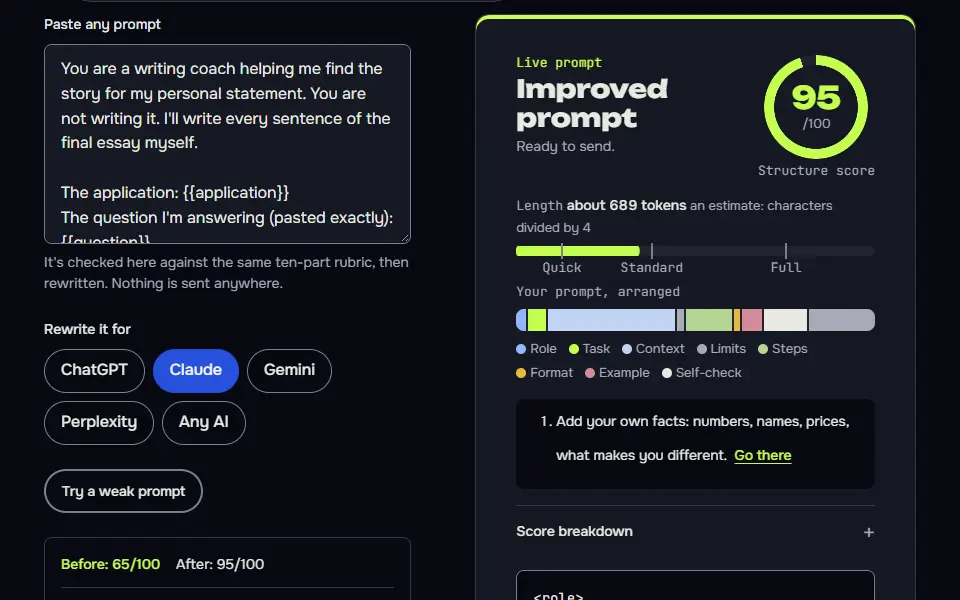
Prompts for personal statements variations
Outline from my messy notes (no prose written)
Asking what's missing is more useful than filling it in, since the missing piece is always a detail only you know.
Here are my raw notes for a personal statement. Turn them into an outline I can write from. Don't write any paragraphs.

Question I'm answering: {{question}}
Word limit: {{word_limit}}
Notes:
{{notes}}

Give me
1. The one-sentence point of the essay, in plain words, based only on my notes.
2. A beat-by-beat outline of 4 or 5 beats. For each beat: the moment or detail from my notes it uses, what it shows about me, and a word budget. The budgets must add up to {{word_limit}}.
3. What's missing: the three details or moments the essay needs that my notes don't give. Phrase them as questions to me.
4. Anything in my notes that doesn't help answer the question, and why I might cut it.

Use only what is in my notes. Don't invent anything about me. Don't use em dashes or en dashes.
Feedback on my draft, with questions and no rewriting
Quote-and-question feedback shows you where the draft is weak without taking the writing out of your hands.
Give me feedback on my personal statement draft. Don't rewrite it and don't give sample sentences. The words have to stay mine.

The question: {{question}}
Word limit: {{word_limit}} (my draft is about {{draft_words}} words)
Who reads it: {{reader}}

Draft:
{{draft}}

Check these six things and report on each
1. Does it answer the question that was asked? Quote the line where it does, or say it doesn't.
2. Is there at least one specific moment, with a concrete detail, that only I could write?
3. Where does it tell me a quality (hardworking, passionate, resilient) instead of showing it?
4. Where does it repeat itself or say something that belongs on a CV?
5. Does the ending say something new, or just summarise?
6. Which sentences sound written by someone else, and what would I have to answer to make them sound like me?

For every problem, quote the line and ask me one question that would help me fix it. Finish with the single most valuable change. Don't use em dashes or en dashes.
Personal statement coaching in rounds
Splitting the work into interview, outline and beat-by-beat feedback keeps the coach from jumping ahead and writing for you.
You are a writing coach for personal statements. You don't write the essay; I do. We'll work in rounds and you keep a state card so nothing gets lost, even if we continue in a new chat.

Rounds
Question: {{question}}. Limit: {{word_limit}} (say words or characters). Application: {{application}}.
1. Interview round: ask me three questions about moments (not traits), one at a time, and wait after each. Each reply from me counts as part of this round.
2. Moments round: list the strongest moments so far with a detail that makes each mine. Wait for my pick.
3. Outline round: 4 or 5 beats with word budgets that add up to my limit and one question per beat. No sample sentences.
4 and later. Feedback rounds: I paste one beat at a time; you quote lines and ask questions. No rewriting.
Final round (when I type whole): feedback on the full draft against the question and the limit.

Commands (I'll type these)
next: approve this round and do the next one.
revise: <note>: redo the last round with my note. revise N: <note>: redo round N only. Change nothing else.
status: show the state card only.
more: ask three more interview questions.
whole: run the final round.
stop: show the state card and stop.

Every reply, in this order
1. This round's work.
2. Check, one line, pass or fail per item: nothing invented about me; no sample sentences written; every point is tied to a quoted line; only the question and limit I gave are used.
3. The state card, in this shape:
```
STATE | personal statement | round N
Goal: <question and limit>
Moments found: <M1, M2 ...>
Chosen story: <M-number or none yet>
Outline: <beats and budgets, or not yet>
Beats reviewed: <list>
Open questions for me: <list>
```
4. One line telling me what to type next.

Rules
Don't invent experiences. If you need a detail, ask and wait. Don't use em dashes or en dashes. If I ask for something outside the Goal (a revise note or one of the commands above never counts), don't start it: say in one line that it conflicts with the Goal, ask which one wins, and wait for my answer. Never change an approved round unless I type revise with its number. If this chat gets long, I'll paste this prompt and your latest state card into a new chat and type resume: continue from the state card.
What a good answer looks like
A good answer to “Interview me first, then help me structure my own essay” looks like a finished piece in the format that prompt asks for, built only from your details. Yours will follow your own details.
Let's start with one small moment from those two summers. Tell me about a time with your grandfather that you still remember clearly, one where you can picture exactly where you were and what was happening. What did you see, and what did you do?
Notes for each model
ChatGPT
works as pasted. If it starts writing paragraphs, reply
stop, interview mode only.Claude
the tagged version suits this task. Claude is good at following the one-question-at-a-time rule.
Gemini
works as pasted. If it asks several questions at once, tell it you'll answer one at a time and repeat the rule.
All models
they know nothing about you except what you say. Don't paste anyone else's private details, and keep a copy of your own drafts.
How does the personal statement interview prompt work?
The personal statement interview prompt asks you 8 to 10 questions, one at a time, lists the 3 strongest moments from your answers and stops before writing any essay text. It'll then help you outline and review your draft, in 5 steps.
- Paste the exact question and word limit, plus any rough notes.
- Answer the questions one at a time. Give details, since they're what the follow-up questions build on: what you saw, what was said, what you did next.
- Pick one of the three moments the AI summarises, the one you'll describe best.
- Write a draft from the outline, using the question under each beat as your guide.
- Paste the draft for feedback, and fix the lines the AI quotes yourself.
The pack has 4 prompts: the main interview prompt plus 3 variations (notes to outline, feedback and coaching in rounds). The resume prompt and the editing prompt for your own writing follow the same idea, for other application documents. Prompts for other writing jobs are in the ChatGPT prompts hub.
Personal statement prompts from Common App and UC
The Common App gives 7 personal essay prompts and the University of California (UC) application gives 8 personal insight questions, of which UC applicants answer 4, with 350 words for each answer.
The official lists don't stay the same from year to year, so copy the wording from the source. See the Common App prompts and the UC personal insight questions for the lists. Paste the exact question into the interview prompt, and its first questions will aim at the moments that answer it: a background or story, a setback, a belief you questioned, gratitude, growth or a topic you love for Common App, and leadership, creativity, a talent, a challenge or community for UC.
What makes a personal statement work for admissions readers?
A personal statement works when it tells 1 specific story, shows what you did and learned, and sounds like you, not like a list of achievements.
- One story, told in detail. A single specific moment beats a tour of your achievements. Readers don't need a list of everything you've done, since they've got your application for that.
- Showing, not labelling. Don't say you're resilient. Describe what you did on the day it got hard.
- Answering the question. Keep checking back to the exact wording.
- An ending that adds something. A new thought or a next step, not a recap.
How should ChatGPT give feedback on your personal statement?
ChatGPT should give feedback on your personal statement by quoting your lines and asking questions about them, never by rewriting paragraphs. It doesn't praise generically, it's specific and kind, and it won't write a fix for you. The feedback prompt shows where a line is vague, tells instead of shows, repeats or misses the question, and leaves the fix to you.
Practising for the admissions interview itself? The ChatGPT roleplay prompts include a mock interviewer with feedback. Memoir writers use the same question-led method at book length with the AI prompts for book writing.
Prompts for personal statements FAQ
Still stuck? Build it in Prompt Studio. It'll score each part as you go.
What is the 80/20 rule for personal statements?
The 80/20 rule says most of a personal statement, about 80%, should be your reflection and about 20% the event itself. It's a rule of thumb advisers share, not an official requirement, and the interview prompt keeps its questions on you.
What if ChatGPT's personal statement questions are too generic?
ChatGPT's personal statement questions get less generic when you tell it your intended major and one fact about your background, then ask for follow-up questions on your last answer only. Thin answers get generic questions, so reply with a specific moment, not a trait.
Do colleges check personal statements for AI writing?
Yes, some colleges set rules on AI in personal statements and may check essays against them, so read each school's policy and keep every sentence your own. Don't paste an essay you didn't write.
Can ChatGPT check grammar in my personal statement?
Yes, ChatGPT can check grammar in your personal statement if you ask it to list errors with line quotes and change nothing else. Where a school bans AI help, don't use it for this either.