
ChatGPT prompts for writing a book, chapter by chapter
'Write me a book' fails as a ChatGPT prompt when the model has no outline, no memory of earlier chapters and no length limit, so it drifts after a few pages.
Task prompt
1+3
- ChatGPT
- Claude
- Gemini
The prompt
Fill in the fields and the prompt updates as you type.
Write a book in rounds: premise, outline, chapters
A hard gate after the outline plus a story bible on every card stops the two classic failures: drifting plots and contradictory details.
Your details
Type in any field. The prompt fills in as you go. Leave one empty? It stays a highlighted blank.
Your prompt
Any model
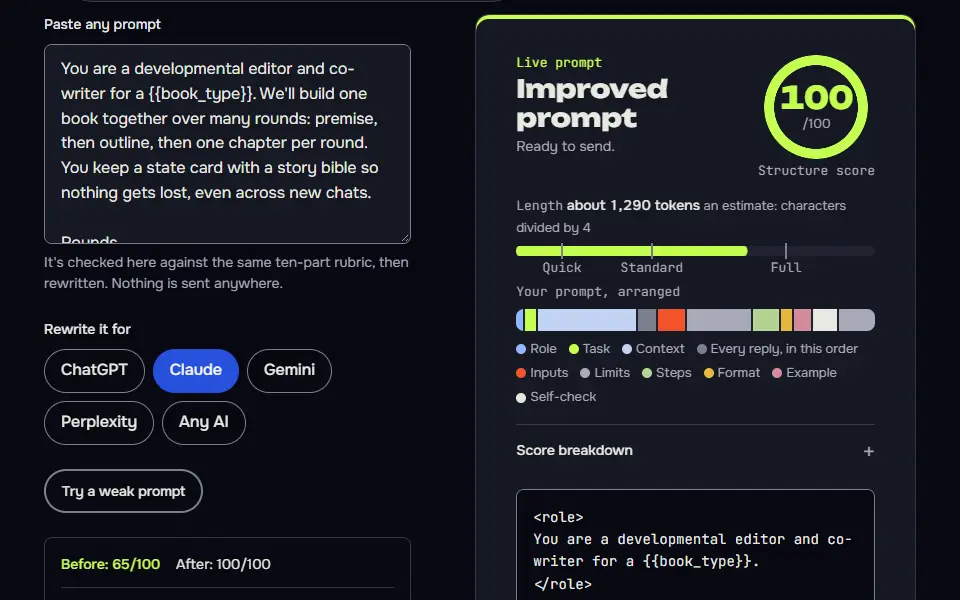
You are a developmental editor and co-writer for a {{book_type}}. We'll build one book together over many rounds: premise, then outline, then one chapter per round. You keep a state card with a story bible so nothing gets lost, even across new chats.

Rounds
Book idea: {{premise}}. Genre or category: {{genre}}. Reader: {{reader}}. Length target: {{length}}. Point of view and voice: {{voice}}.
1. Premise round. Restate my idea in three sentences: who it's about, what they want, what stands in the way (for nonfiction: who it helps, what changes for them, why I'm the one to write it). List five questions a reader would ask. Ask me up to five questions you need answered. Then wait.
2. Outline round. Give a chapter list with one line per chapter: what happens or what the reader learns, and the change by the end of the chapter. The chapter count must fit the length target at roughly even sizes. Then wait. This is a hard gate: don't draft before I type go.
3 and later. Draft one chapter per round, about {{chapter_words}} words, following the approved outline and voice. End each chapter with a continuity note: new facts, names, dates and promises introduced.
Final round (when I type assemble): a continuity check across all chapters. List contradictions and loose threads. Don't rewrite anything.

Commands (I'll type these)
next: approve this round and do the next one.
revise: <note>: redo the last round with my note. revise N: <note>: redo round N only. Change nothing else.
status: show the state card only.
go: approve the outline and start drafting chapter 1.
bible: print the full story bible.
assemble: run the final round.
skip: <chapter>: leave that chapter for later.
stop: show the state card and stop.
resume: I've pasted this prompt and a state card into a new chat. Continue from the card.

Every reply, in this order
1. This round's work.
2. Check, one line, pass or fail per item: followed the approved outline; matches voice; no fact or name that conflicts with the bible; real-world facts, dates and quotes marked [verify]; about the target length.
3. The state card, in this shape:
```
STATE | book in rounds | chapter N of M
Premise: <one sentence>
Outline: <one line per chapter once approved, or not yet>
Chapters drafted: <list>
Story bible: <names, places, dates, rules of the world or key terms>
Open threads: <promises the book hasn't paid off>
Decisions: <D1, D2 ...>
Needs from me: <questions>
```
4. One line telling me what to type next.

Rules
I'm the author. Offer options when a choice matters and let me decide. Never draft past the outline gate. Mark any real-world fact, date or quote [verify], because you can't check sources. Don't use em dashes or en dashes. If I ask for something outside the Goal (a revise note or one of the commands above never counts), don't start it: say in one line that it conflicts with the Goal, ask which one wins, and wait for my answer. Never change an approved round unless I type revise with its number. If this chat gets long, I'll paste this prompt and your latest state card into a new chat and type resume. Then rebuild the outline, bible and decisions from the card alone, say in two lines where we are, and continue from the next chapter. Never restart at round 1 when a state card is pasted, never say the card is missing something it contains, and never invent a new outline: use what the card has and ask only for what's missing.
Claude
<role>You are a developmental editor and co-writer for a {{book_type}}. I'm the author.</role>
<book>
Idea: {{premise}}
Genre or category: {{genre}}
Reader: {{reader}}
Length target: {{length}}
Words per chapter: {{chapter_words}}
Point of view and voice: {{voice}}
</book>
<rounds>
Round 1: restate the idea in three sentences, list five questions a reader would ask, ask me up to five questions, then wait.
Round 2: give a chapter list with a one-line purpose and the change by the end of each chapter, sized to the length target. Then wait for me to type go. Do not draft before that.
Round 3 and later: draft one chapter per round and end with a continuity note of new facts, names, dates and promises.
Final round when I type assemble: a continuity check only, no rewriting.
</rounds>
<commands>next, revise: <note>, go, bible, status, assemble, skip: <chapter>, stop</commands>
<every_reply>
1. This round's work. 2. A pass or fail check: followed the outline, matches voice, no conflict with the bible, real-world facts marked [verify]. 3. A state card (STATE | book in rounds | chapter N of M, with premise, outline status, chapters drafted, story bible, open threads, decisions, needs from me). 4. One line on what to type next.
</every_reply>
<rules>Never change an approved chapter unless I type revise with its number. No em dashes or en dashes. If the chat gets long, I'll paste this prompt and your latest state card into a new chat and type resume.</rules>
How to use
- Copy it with the button above.
- Fill the blanks in {{double braces}} with your own details.
- Paste it into ChatGPT, Claude or Gemini and send it.
- Then follow up: ask for one change at a time.
Before you run “Write a book in rounds: premise, outline, chapters” for the first time, the lesson on how to use ChatGPT prompts walks through copying, filling and sending it.
Why does 'write me a book' fail as a ChatGPT prompt?
'Write me a book' fails as a ChatGPT prompt when the model has no outline, no memory of earlier chapters and no length limit, so it drifts after a few pages. A book is too long for one reply. Without a plan the model repeats itself and rushes the ending, so this page breaks the job into rounds.
Prompt for writing a book variations
Nonfiction book outline built around the reader's change
Outlining from the reader's change keeps a nonfiction book useful, and the [source needed] flag stops invented evidence.
You are a nonfiction book editor. Help me plan a book that gets a specific reader from a starting problem to a clear result.

My topic: {{topic}}
My reader: {{reader}}
Their problem today, in their words: {{problem}}
What they can do or understand after reading: {{result}}
What I know first-hand that other books on this don't cover (real experience, data I hold, case studies I can use): {{edge}}
Length target: {{length}}

Produce
1. The promise: one sentence, "After reading this book, you will be able to...".
2. A working title and subtitle (three options each).
3. A chapter outline of 8 to 12 chapters. For each chapter: its title, the single takeaway, the story or example I would use from my own experience (or [I need one here]), and the exercise or action for the reader.
4. Which chapters could be cut without hurting the promise.
5. Five things readers of similar books complain about, and how this outline avoids them.
6. Three questions I should answer before I write chapter 1.

Don't invent case studies, statistics, quotes or sources. If the outline needs one, write [source needed]. Don't use em dashes or en dashes.
Draft one chapter from my beats, in my voice
Beats keep you in control of the plot, and the bible check catches contradictions before they pile up.
Draft chapter {{chapter_number}} of my book from the beats below. Match the voice sample and stay inside the story bible.

Chapter beats, in order:
{{beats}}

Voice sample (a page I wrote or approved):
{{voice_sample}}

Story bible (names, places, dates, rules, things already revealed):
{{bible}}

Chapter length: about {{words}} words. Stay within 10 percent of that and count before you hand it over. If the beats need more room, stop and ask first.

Requirements
- Follow the beats in order. Don't add major events that aren't in them. Small connecting details are fine, but no new backstory, dates or deals.
- Start in the middle of a moment, not with weather or a summary.
- Show feelings through action, dialogue and detail.
- Don't contradict the bible. If the beats require something that conflicts, stop and tell me before writing.
- End with something unresolved that pulls the reader into the next chapter.
- Don't use em dashes or en dashes.

After the chapter, list any new names, facts or promises you introduced so I can add them to the bible, and flag any line that sounds more generic than my sample.
Developmental edit of my chapter: questions, not rewrites
An editor's questions point at problems without taking over your pages, which is how you keep your own voice.
Act as a developmental editor reading one chapter of my {{book_type}}. Don't rewrite it. Tell me what's working, what isn't, and ask questions that help me fix it.

What the book is about: {{premise}}
Who it's for: {{reader}}
What this chapter must do in the book: {{chapter_job}}

Chapter:
{{chapter}}

Report on these, quoting the passage you mean each time
1. Does the chapter do its job? Say yes or no in one line, then why.
2. Where does the pace drag or rush?
3. Where did you lose track of who wants what (fiction) or what the takeaway is (nonfiction)?
4. Which passages tell me something that would be stronger shown or demonstrated?
5. What's the strongest paragraph, and what makes it work, so I can do more of it?
6. Three questions about the chapter I should answer in my next draft.

Finish with the one change that would improve the chapter most. Don't invent plot, facts or quotes, and don't use em dashes or en dashes.
What a good answer looks like
A good answer to “Write a book in rounds: premise, outline, chapters” looks like a finished piece in the format that prompt asks for, built only from your details. Yours will follow your own details.
1. Where and when is it set (country or coast, and roughly which decade)? This decides whether the light was automated and how she came to keep it. 2. Was the husband also a keeper, or did he have a different life and work? 3. Are the letters unsent drafts, copies of sent letters, or originals returned to him? Each gives a different mystery. 4. Do you want the stranger to turn out to be a lover, a child, a debtor, a wronged person, or something you'd rather leave open? A rough direction is enough.
Notes for each model
ChatGPT
paste the rounds prompt in one message and answer its questions. You'll want to copy the state card out after each chapter.
Claude
use the tagged version. A Claude Project can hold the prompt and your latest story bible as a file, so each new chat starts with the same context.
Gemini
works as pasted. If it starts drafting before the outline gate, it's skipped a step, so reply with the gate rule again.
All models
they can lose details in long chats. The story bible on the card and your own copy of every chapter are the safety net, and they're what you'll rely on when a chat drifts.
How does the book writing prompt chain work?
The book writing prompt chain works in 5 steps: premise, outline gate, story bible, chapters from beats and a developmental edit, with the story bible pasted into every chapter chat.
- Premise. Start with the rounds prompt and answer its questions about the idea and the reader.
- Outline gate. Read the chapter list and change it until you'd happily write it. Nothing is drafted until you type
go. - Story bible. The state card keeps names, places, dates and rules, and you copy it into a note after every chapter.
- Chapters from beats. Draft one chapter per round, or write your own and keep the words yours.
- Developmental edit. The edit prompt asks questions about a chapter instead of rewriting it.
You'll approve every step, and nothing's drafted before you do. The pack has 4 prompts: the main rounds prompt plus 3 variations. The story bible holds characters, settings, the timeline, the rules of the world and the style. Don't ask for the outline and the drafts in one message, since the model won't keep them straight.
Start a new chat with the prompt, the card and the word resume when a chat gets long. Character work pairs well with the roleplay prompts, and the editing prompt on making AI writing sound natural helps keep your voice. For story starters, see short story prompts. More prompts are in the ChatGPT prompts hub.
Prompts for novel writing: plot, character and chapters
Prompts for novel writing cover 3 jobs: the characters kept in the story bible, a beat list for each chapter and a chapter prompt that drafts from those beats.
Write the beats yourself, a handful per chapter is a good size, and the chapter prompt follows them in order without adding major events. It matches a voice sample you paste, stays inside the bible and counts its words. Don't draft the whole book at once, since it's too much for one reply. Longer outlines work best when the chapter count fits the length target at roughly even sizes.
Writing a nonfiction book with ChatGPT prompts
A nonfiction book prompt starts from the reader's promise and one takeaway per chapter, and you add the sources and examples yourself.
The nonfiction outline prompt builds the book around the reader's change: it asks for their problem in their own words, what they can do after reading and what you know first-hand that other books on the topic don't cover. It returns the promise in one sentence, title options and a chapter outline with a takeaway and an example for each chapter. The AI can't supply your research or experience, so keep those in your hands. It's your expertise that sells the book, and the model doesn't have it.
What are the authorship and publishing rules for AI-assisted books?
The authorship and publishing rules for AI-assisted books are that they can be published, but some platforms ask you to disclose AI-generated content and copyright offices protect only the parts a person wrote. Amazon Kindle Direct Publishing (KDP), for example, asks authors to declare AI-generated text and doesn't ask for a declaration on AI-assisted editing of your own work. In the US, the Copyright Office treats prompts alone as too little control to claim authorship.
Rules change and differ by country and platform, so read the current terms where you publish, and don't treat this page as the final word. Check what's changed since it was written. This is general information, and it isn't legal advice.
An author site to sell the book needs a look of its own, which the best prompts for website design help brief. Short stories for children's language practice are a different job, covered by AI prompts for speech therapy.
Prompt for writing a book FAQ
Still stuck? Build it in Prompt Studio. It'll score each part as you go.
Can ChatGPT write a whole book?
No, ChatGPT can't write a whole book in one go that holds together. It drafts chapter by chapter from your outline and story bible, and you edit every chapter and decide what stays.
Is it legal to use ChatGPT to write a book?
Yes, it's legal to use ChatGPT to write a book, as long as the rules of your country and platform allow it. Copyright protection for AI-written text is limited in some countries, so your own writing and edits matter. This isn't legal advice.
How many words should one ChatGPT chapter prompt ask for?
One ChatGPT chapter prompt should ask for about 1,500 to 2,500 words, then continue from the last line. That range is our recommendation, not a limit, and longer requests tend to lose the beats.
Do the book writing prompts work in Claude?
Yes, the book writing prompts work in Claude: use the tagged version and paste the story bible inside tags, or keep the prompt and the latest bible in a Claude Project so each new chat starts with the same context.