
ChatGPT prompts for speech therapists
Yes, ChatGPT can help speech therapists with planning.
Prompt library
29
- ChatGPT
- Claude
- Gemini
29 speech therapy prompts
Session planning7 prompts
Plan a single session around your goal
It gives the AI your goal so it plans around it instead of choosing one.
Plan a {{minutes}}-minute speech therapy session for a client aged {{age}} working on {{target}}. The goal I've set is: {{goal}}. Include a 3-minute warm-up, two main activities with step-by-step instructions, a quick way to check how it went and a closing routine. List the materials, and keep them cheap and easy to find. I choose the goals, so don't suggest a diagnosis or change my target.
How to use
- Copy it with the button above.
- Fill the blanks in {{double braces}} with your own details.
- Paste it into ChatGPT, Claude or Gemini and send it.
- Then follow up: ask for one change at a time.
Before you run “Plan a single session around your goal” for the first time, the lesson on how to use ChatGPT prompts walks through copying, filling and sending it.
Plan a group session with different targets
A shared activity with per-student tweaks saves planning time.
Plan a {{minutes}}-minute group session for {{group_size}} students aged {{age_range}} who have different targets: {{targets}}. Give me one shared activity with a small tweak for each student's target, a way to rotate turns so nobody waits long, and a simple tally sheet for correct trials per student. I'll set the goals; you plan the activity.
Build a themed session without losing the target
Asking for a harder and easier version of each activity builds in flexibility.
Build a {{theme}} themed session for a client aged {{age}} working on {{target}}: three activities, each tied to the target, with example things I can say aloud and a way to make each activity easier or harder. Keep the theme from taking over, so the target is practised in every activity.
Plan a teletherapy session that uses household items
A word-for-word opening and a fallback plan cover the usual video-call problems.
I run speech sessions over video call with a client aged {{age}} working on {{target}}. Plan a {{minutes}}-minute session that works with a shared screen and a few things found at home. Write the first 5 minutes word for word, then the activities, then what to do if the connection drops or the client leaves the screen.
Outline four weeks of sessions
It asks for an outline you can edit, and bans made-up benchmarks.
Create a 4-week plan outline for a client working on {{target}} with {{sessions_per_week}} sessions a week. For each week give a focus, two activity ideas and one thing to review. I'll check it against my assessment and progress data, so don't invent progress benchmarks or expected timelines.
Make an activity easier and harder
Starting from an activity you trust keeps the result practical.
Here's an activity I already use: {{activity}}. Show me three ways to make it easier and three ways to make it harder for a client working on {{target}}, as a table with the change and what it changes about the demand on the client.
Draft plain wording for each cue level
It supplies wording only, and leaves the clinical choice with you.
Write plain-language wording I can say at each of these cue levels: {{cue_levels}}, for when a client misses a target word during {{activity}}. Give one short line for each level. I decide which cue to use and when, so don't rank them or tell me which is best.
Therapy materials6 prompts
Make a word list for a target sound or pattern
Asking it to flag rare words and your own check catches the common errors.
Make a list of {{count}} words with {{target_pattern}} in the {{position}} position, suitable for a client aged {{age}}. Group them by number of syllables and mark any that are rare or hard to picture. Remind me to check the list against a pronunciation source, since you can make mistakes with sounds.
Write short practice sentences
Stating level and topics keeps the sentences usable on the day.
Write {{count}} short sentences, each with at least one word containing {{target_pattern}}, at a {{level}} level. Keep the topics ordinary: {{topics}}. Don't use names of real people or brands.
Write a short script for a social situation
Two possible replies per turn make it feel like a real exchange.
Write a short script a client aged {{age}} can practise for this situation: {{situation}}. Write two separate scripts of {{turns}} turns each: one where the other person says yes and one where they say no. In each turn, give two ways the speaker might reply, and make every line fit what came before. Keep the language at a {{level}} level and the tone friendly.
Set up a barrier game
Describing pictures in words means you control what's actually printed.
Create a barrier game for a client aged {{age}} working on {{language_target}}. Give me the instructions for me to read out, a description of two matching picture sets in words (I'll find or draw the pictures) and 8 prompts for the client to give or follow.
Write a story for retelling practice
Ordering questions from easy to hard lets you stop at the right level.
Write a 6-sentence story about {{topic}} for a client aged {{age}}, with clear characters, a problem and an ending. Then give 8 questions, ordered from simple recall to "why" questions, and a list of 6 pictures I could draw to match the story.
Write the text for a visual schedule
A word limit per step keeps it readable at a glance.
Write the text for a visual schedule for a {{minutes}}-minute session using these steps in this order: {{steps}}. Use {{words}} words or fewer per step, and suggest a simple icon idea for each step.
Home practice5 prompts
Write a one-page home practice sheet
You set the practice length, so the AI doesn't recommend one.
Write a one-page home practice sheet for the family of a client aged {{age}}. Target: {{target}}. Include a two-sentence plain-language explanation, three short activities using things found at home, and what to say when the client gets one wrong. Practice length is {{minutes}} minutes, as I've set. Warm tone, no jargon.
Find ways to practise during daily routines
Under a minute and no materials makes it realistic for busy families.
Give me 8 ways to practise {{target}} during everyday routines such as {{routines}}. Each should take under a minute, need no materials and include the exact words the adult can say.
Use a picture book for practice
The check-any-title line guards against made-up book names.
Suggest how a parent can use a picture book on the theme of {{theme}} to practise {{target}}, in 5 steps. Include 6 questions to ask while reading and what to say when the answer isn't right yet. Don't name specific books unless they're well-known classics, and tell me to check any title.
Design a simple weekly practice log
A questions space turns the log into a conversation starter.
Design a simple weekly practice log for a client aged {{age}} that a family can fill in. Columns I want: {{columns}}. Add a friendly line at the top explaining what to write, and a space for questions to bring to the next session.
List no-prep games for home
A tweak for a tired client makes the games usable on bad days.
List 6 no-prep games for practising {{target}} at home. For each, explain how to play in two sentences, how to keep score without adding pressure, and one tweak for a tired or frustrated client.Family and team communication6 prompts
Write a short update to a parent
It uses only the facts you give and bans promises.
Write a short, warm message to a parent after today's session. What we worked on: {{worked_on}}. What went well: {{wins}}. What to try at home: {{homework}}. Keep it under 120 words, lead with the positive, avoid jargon and don't promise any outcome.
Prepare for a conversation with a worried parent
Questions to hear the parent's view keep it a two-way conversation.
Help me prepare for a conversation with a parent who is worried that {{concern}}. Give me 3 ways to open, a plain-language way to explain {{point}}, 4 questions to hear their view and a few phrases to avoid. I'll cover anything clinical myself.
Write a note to the classroom teacher
A 'what to leave out' line is often the most useful part for a teacher.
Write a note to the classroom teacher of a student working on {{target}}. Include 3 ways to support it in class that need no extra prep, one thing to avoid (such as correcting in front of peers) and when to contact me. Keep it under 150 words.Draft a policy email to families
Limiting it to your facts stops the email from inventing policy.
Draft a polite email to families about {{policy}}. Use only these facts: {{facts}}. Tone: {{tone}}. End with one line inviting questions. Don't add policy details I haven't given you.
Write a handoff summary for a colleague
A fixed four-part layout makes the handoff quick to read.
Write a handoff summary for a colleague who will cover my caseload next week, using only these details: {{details}}. Organise it as: who, what we're working on, what to watch for, and who to call. Don't add anything that isn't in my details.Rewrite a message in plain English for a multilingual family
It prepares the message for a human translator instead of replacing one.
Rewrite this message at a {{grade}} reading level for a family whose first language is {{language}}, using simple English and short sentences: {{message}}. Then list any words a translator should check, so I can have it properly translated. Don't translate it yourself.
Notes and admin5 prompts
Turn shorthand into a clear session note
'Not provided' keeps the AI from filling gaps with guesses.
Turn my shorthand into a clear session note, using only my facts. Shorthand: {{shorthand}}. Format: what we worked on, client responses in my words, plan for the next session. If something is missing, write "not provided" and don't fill it in. Use initials only, never full names.Make a draft goal measurable
Leaving the criterion blank prevents invented targets.
Rewrite this draft goal so it's measurable: {{draft_goal}}. Give three versions using this structure: {{structure}}. I'll pick one and adjust it to my assessment results, so leave the criterion blank wherever I haven't given a number.
Draft a progress paragraph from your data
The 'flag anything unclear' line turns the AI into a proofreader of your numbers.
Draft a plain-language progress paragraph for a report, using only this data: {{data}}. Don't add percentages, norms or conclusions that I haven't given you. Flag anything that looks unclear or inconsistent so I can fix it.Turn a session list into a weekly schedule
Highlighting back-to-back sessions surfaces the clashes early.
Turn this list of sessions into a one-week schedule table with time, client initials, target and materials needed: {{sessions}}. Highlight any back-to-back sessions that need a room change or a materials swap.Make a session prep checklist
Ordering the checklist by when you'd do each step makes it usable.
Make a 10-item prep checklist for a speech therapy session in {{setting}}, covering materials, data sheets, room set-up and family messages. Put the items in the order I'd do them.Can ChatGPT help speech therapists with planning?
Yes, ChatGPT can help speech therapists with planning: session plans, word lists, home practice sheets and parent emails, while every clinical decision stays with the speech-language pathologist (SLP). This page has 29 copy-paste prompts in 5 groups: sessions, materials, home practice, notes and admin, and family communication. None of them asks the AI to diagnose, set criteria or invent data.
These prompts help with planning and admin. They're not medical or clinical advice, and the AI's output is not medical advice either: you check it, and you make every clinical decision. Keep client names and identifying details out of the chat.
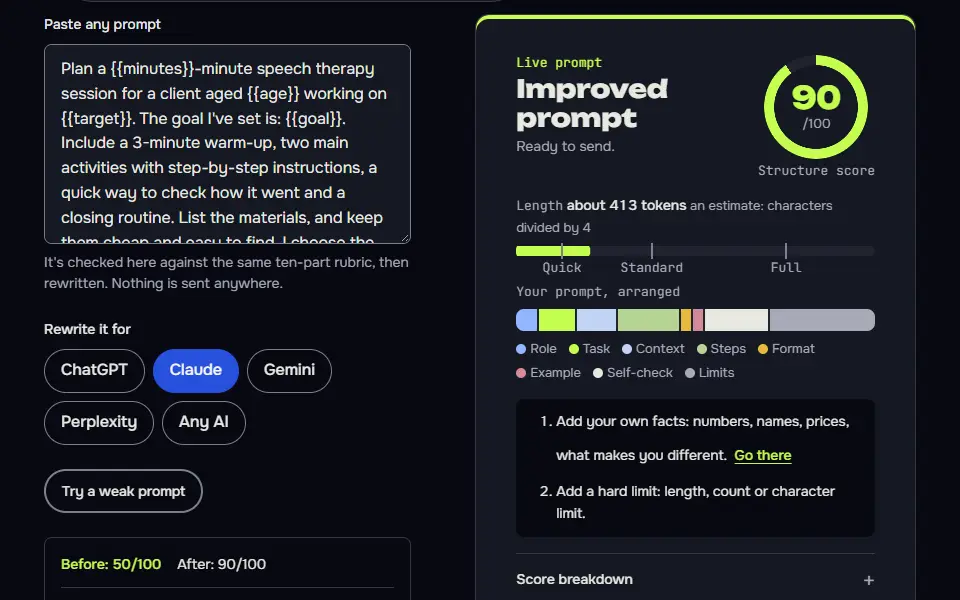
Speech therapy session plan prompts
A speech therapy session plan prompt gives ChatGPT the age, the target you chose, the setting and the length, then asks for warm-up, practice and wrap-up activities.
The session planning group has 7 prompts: a single-session plan, a group session where each student has a different target, a themed session that stays tied to the target, a teletherapy session built from household items, a four-week outline, a way to make an activity easier or harder, and plain wording for each cue level. The single-session prompt asks for a 3-minute warm-up, two main activities with steps and a quick way to check progress. You don't need to write the structure yourself. You fill the fields (age, target sound or skill, setting, format) and review every line before it reaches a client.
Speech therapy prompts for materials and home practice
Speech therapy prompts for materials ask for word lists by sound and position, short stories with target words and one-page home practice sheets in plain language for families.
The therapy materials group has 6 prompts, including word lists grouped by syllables, practice sentences, a barrier game and a story for retelling practice. The home practice group has 5, such as a one-page sheet for the family, 8 ways to practise during daily routines and a weekly practice log. Ask for a list like "10 words with /s/ at the start, for a 6-year-old" and check the sounds with your own ear, since it doesn't hear a client's speech and can't judge a sound.
What should speech therapists keep out of ChatGPT?
Speech therapists should keep client names, dates of birth, schools, recordings and any detail that identifies a person out of ChatGPT. Use an age and a target instead, such as "a 6-year-old working on /s/".
Use initials or a made-up label if a prompt needs one, and follow your employer's or school's rules on AI tools and client information. If you aren't sure what's allowed, ask before you paste. The note and admin prompts here work with your own shorthand, so they never need identifying details, and you won't have to strip anything out afterwards.
Is the PROMPT speech therapy method the same as an AI prompt?
No, the PROMPT speech therapy method isn't the same as an AI prompt: it's a hands-on, tactile approach to speech therapy that therapists train in (see prompt.org), and this page covers the instructions you type into ChatGPT.
You might've searched "prompt for speech therapy" and landed on PROMPT. In everyday therapy talk, a "prompt" can mean a cue a clinician gives to help a client respond. One prompt on this page drafts plain wording for the cue levels you choose, but it doesn't tell you which cue to use, and it can't judge whether a cue fits. You're the one who knows the client.
How do you get better results from these prompts?
To get better results from these prompts, fill every field, ask for one thing at a time, check the output and ask for revisions.
- Fill every field. Age, target and level change the output more than anything else.
- Ask for one thing at a time. A plan, then the materials, then the home sheet.
- Check what it gives you. Word lists and sound patterns need your ear, and you'll want to look up any book or resource title.
- Ask for a revision. "Make it shorter", "make it easier" or "use fewer words per step" usually works in one reply.
- Keep your own bank. Save the versions that worked for your caseload.
A short practice bio for your own clinic profile can come from the About me prompt for ChatGPT. Clinics that share tips online can draft captions with the AI prompt for an Instagram post, keeping client details out.
For message tone, see the prompts that make AI writing sound natural. The full set is in the ChatGPT prompts hub.
ChatGPT prompts for speech therapists FAQ
Still stuck? Build it in Prompt Studio. It'll score each part as you go.
What are examples of ChatGPT prompts for speech therapy?
Examples of ChatGPT prompts for speech therapy are a 30-minute session plan for a target sound, a word list for the /s/ sound in final position and a home practice sheet for parents. Each one is a fill-in prompt with fields for age, target and setting, and the 29 on this page cover plans, materials, home practice, notes and family messages.
Is it safe to put speech therapy client details into ChatGPT?
No, it isn't safe to put speech therapy client details into ChatGPT, unless you remove anything that identifies the client. Follow your employer's and your country's privacy rules and use de-identified facts only, such as an age and a target. It isn't worth the risk. Ask your manager or privacy officer if you're unsure what's allowed.
Can ChatGPT write speech therapy goals?
No, these prompts don't ask ChatGPT to write goals or criteria. The SLP sets goals, and the prompts produce materials and plans around them. One prompt only restructures a draft goal you've written and leaves the criterion blank until you add your assessment numbers.
Do the speech therapy prompts work for adult clients?
Yes, the speech therapy prompts work for adult clients when you set the age field to an adult and pick adult topics for word lists and stories.