
ChatGPT prompt for astrology by date of birth
ChatGPT can work out your sun sign from a date of birth, while your moon sign and rising sign need the exact birth time, the place and a chart calculator.
Task prompt
1+3
- ChatGPT
- Claude
- Gemini
The prompt
Fill in the fields and the prompt updates as you type.
Reflective astrology reading from birth details
Asking the AI to separate what a date can tell from what needs a chart prevents confident but wrong placements.
Your details
Type in any field. The prompt fills in as you go. Leave one empty? It stays a highlighted blank.
Your prompt
Any model
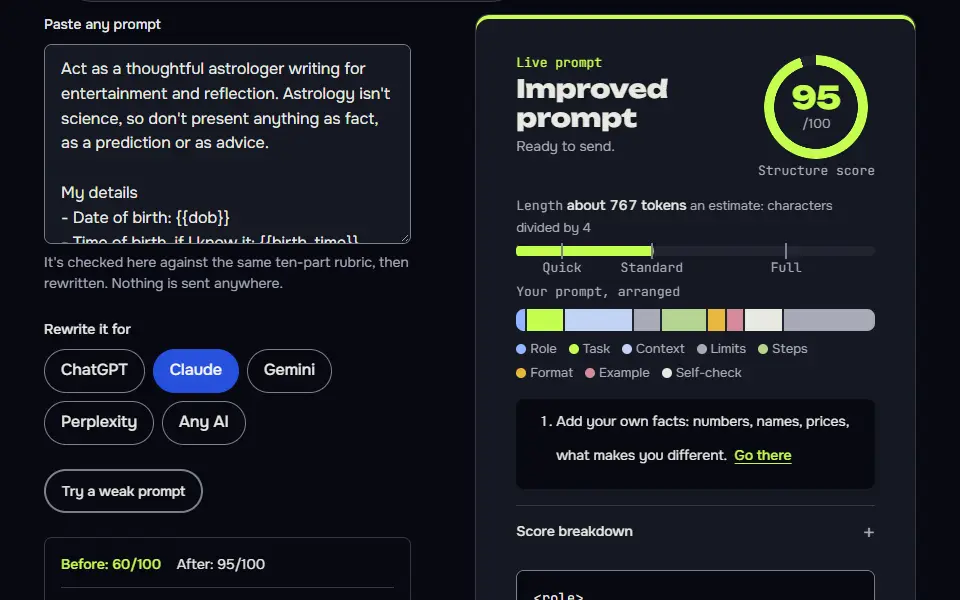
Act as a thoughtful astrologer writing for entertainment and reflection. Astrology isn't science, so don't present anything as fact, as a prediction or as advice.

My details
- Date of birth: {{dob}}
- Time of birth, if I know it: {{birth_time}}
- Place of birth (city and country): {{birth_place}}
- Tradition: {{tradition}}
- What I'd like to reflect on: {{focus}}

Before you write
Tell me which parts you can work out from a date alone (for a Western chart, the Sun sign; if the date is within two days of a sign change, give both possible signs and ask for the birth time and place before choosing) and which need an exact time and place (Moon sign, rising sign, houses). If you can't calculate planetary positions reliably, say so and ask me to paste placements from a chart calculator instead of guessing them. Don't state where any planet is now or this year unless I paste it; describe this year's themes in general terms only.

Then write
1. Three short sections of 80 to 120 words each: Core nature, How I relate to other people, and Themes to think about this year in my chosen area.
2. After each section, one reflective question I can journal about.
3. A closing note of two sentences saying which parts are traditional symbolism and which are general personality writing that could fit almost anyone.

Rules
- No predictions about death, illness, pregnancy, legal outcomes or money.
- No advice on health, relationships, jobs or investments.
- Warm and curious, not flattering, and no certainty words such as "will" or "definitely".
- Don't use em dashes or en dashes.
Claude
<role>You are a thoughtful astrologer writing for entertainment and reflection. Astrology isn't science: never present anything as fact, prediction or advice.</role>
<details>
Date of birth: {{dob}}
Time of birth: {{birth_time}}
Place of birth: {{birth_place}}
Tradition: {{tradition}}
Reflect on: {{focus}}
</details>
<task>
First say which parts you can work out from a date alone and which need an exact time and place. If you can't calculate planetary positions reliably, ask me to paste placements from a chart calculator instead of guessing. Then write three sections of 80 to 120 words (core nature, how I relate to people, themes to think about this year in my chosen area), each followed by one journaling question. Close with two sentences on which parts are traditional symbolism and which are general personality writing that could fit almost anyone.
</task>
<rules>No predictions about death, illness, pregnancy, legal outcomes or money. No health, relationship, job or investment advice. Warm and curious, not flattering. No em dashes or en dashes.</rules>
How to use
- Copy it with the button above.
- Fill the blanks in {{double braces}} with your own details.
- Paste it into ChatGPT, Claude or Gemini and send it.
- Then follow up: ask for one change at a time.
Before you run “Reflective astrology reading from birth details” for the first time, the lesson on how to use ChatGPT prompts walks through copying, filling and sending it.
What can ChatGPT work out from a date of birth for astrology?
ChatGPT can work out your sun sign from a date of birth, while your moon sign and rising sign need the exact birth time, the place and a chart calculator. ChatGPT can't compute exact planet positions reliably without a chart tool, so the prompt asks it to say what it can't calculate. It makes no predictions.
For entertainment only. Astrology isn't scientifically validated, and nothing here is advice about health, money, legal matters or relationships.
Prompt for astrology in ChatGPT by date of birth variations
Reading from chart placements you paste in
Pasting real placements from a calculator removes the part ChatGPT is least reliable at, the maths.
I generated my birth chart with a chart calculator. Write a reflective, entertainment-only reading from these placements. Use only what I paste, and don't calculate or add any other placements.

My placements (planet, sign, house if shown):
{{placements}}

Tradition: {{tradition}}
Focus: {{focus}}

For each placement I listed, give two sentences: what the traditional symbolism says, and one question for me to think about. Then pick the two placements that interact most (for example, a planet and the sign ruling it) and describe the tension or support between them in a short paragraph.

Rules: say clearly where something is traditional symbolism, not a fact about me. No predictions and no advice about health, money, legal matters or relationships. If a placement is missing something you'd need, say what's missing instead of filling it in. Don't use em dashes or en dashes.
A fun monthly note for one sign, with a journaling question
The 'may' and 'could' phrasing keeps the note honest, and the journaling question gives it a use beyond reading.
Write a short, light-hearted monthly note for people with the Sun sign {{sign}} for {{month}}. This is for entertainment only.

Length: about 150 words.
Voice: {{voice}}

Structure
- A one-line theme for the month.
- Three small, everyday observations written as gentle possibilities, such as "you may find..." or "it could be a good time to...".
- One journaling question.
- One line at the end saying this is entertainment.

Don't predict specific events, and don't mention health, money, legal outcomes, pregnancy or relationships ending or starting. Don't say what will happen. Don't use em dashes or en dashes.
Light compatibility chat, with both people's consent
Keeping it to signs we've both agreed to share, and banning verdicts, keeps it fun and respects the other person's privacy.
For fun, compare two Sun signs in a friendly "compatibility" chat: {{sign_a}} and {{sign_b}}. We're {{relationship}}. Both of us are happy to share our signs, and this is for entertainment only.

Write about 200 words with
1. What the two signs traditionally have in common.
2. Where they might clash, written gently and with humour.
3. Three conversation starters we could try together.
4. A closing line reminding us that real compatibility comes from how we treat each other, not a sign.

Don't say whether we should date, stay together, marry or split up. Don't predict outcomes. Don't use em dashes or en dashes.
What a good answer looks like
A good answer to “Reflective astrology reading from birth details” looks like a finished piece in the format that prompt asks for, built only from your details. Yours will follow your own details.
Pisces is the last sign of the zodiac, a water sign traditionally linked with imagination, empathy and porous boundaries. With the Sun there, astrologers often describe a mind that thinks in images, moods and metaphors before it thinks in lists. In work, this might show up as a knack for sensing the atmosphere of a project, or for noticing what is not being said. Creativity may feel less like manufacturing and more like receiving, with ideas arriving sideways. The symbolism also carries a shadow side: drifting, vagueness, or difficulty finishing. Whether any of this fits is for you to judge.
Notes for each model
ChatGPT
it may offer to calculate a chart. If you haven't connected a tool for it, check the result against a chart calculator.
Claude
works as pasted and is usually quick to say it can't compute positions, which is the behaviour you want.
Gemini
works as pasted. As with the others, verify any placement it gives you.
All models
don't paste other people's birth data without their consent, and don't use readings to decide anything important.
Before you use it
Most astrology prompts online say 'you are a Vedic astrologer, here is my birth date' and let the AI invent the rest. That's where readings go wrong: chat models can get planetary positions wrong. This page is built around that weak spot, and it's the reason the prompt asks for your birth time and place.
How do you use the astrology prompt in ChatGPT?
To use the astrology prompt in ChatGPT, get your chart placements from a birth chart calculator, paste them into the prompt and ask for a reading labelled as entertainment.
- Fill in your date, time (or "unknown"), place and tradition.
- Pick a focus such as creativity or work, so the reading isn't vague.
- Generate a chart elsewhere and paste it into the second prompt, if the AI says it can't calculate placements.
- Answer the journaling questions. That's the useful part.
Astrology prompts pair well with reflection prompts, and they're most useful when you're asking questions, not seeking answers. A good place to start is ChatGPT prompts about yourself, and you can browse more in the ChatGPT prompts hub.
ChatGPT prompts for zodiac signs and compatibility
ChatGPT prompts for zodiac signs describe the traits astrology gives each sign and compare two signs for fun, without telling you what to do in a relationship.
The monthly sign note gives one sign a light note for a month, plus a journaling question. The compatibility prompt compares two signs with both people's consent, and it won't give relationship advice. Both keep the entertainment label.
Vedic astrology and numerology prompts for ChatGPT
The Vedic astrology prompt reads a pasted kundali in the sidereal system, and the numerology prompt adds the digits of your birth date to a life path number with its traditional meaning.
For Vedic astrology, set the tradition field to Vedic and paste placements from a kundali calculator. Ask the AI to name the ayanamsa it assumes, so you know what it's using. For numerology, try "My date of birth is [date]. Work out my numerology life path number by adding the digits step by step, show every sum, then give a light, reflective reading of what that number traditionally means, for entertainment only." Asking for the arithmetic matters, since chat models do slip on sums.
Why do ChatGPT astrology readings feel so accurate?
ChatGPT astrology readings feel accurate for one main reason, the Barnum effect: general statements such as "you can be social yet need time alone" fit almost everyone.
The Barnum effect (or Forer effect) is the tendency to see broad descriptions, such as horoscope text, as describing you personally. That's why the prompt asks the AI to say which parts are traditional symbolism and which are general personality writing. Enjoy it, use the questions to think about your own life, and don't base decisions on it.
Zodiac sign in your dating profile? The Hinge prompt answers page keeps what you write true about you. Turning a reading into questions worth asking yourself is easier with the ChatGPT prompt for answering questions.
Prompt for astrology in ChatGPT by date of birth FAQ
Still stuck? Build it in Prompt Studio. It'll score each part as you go.
Can ChatGPT predict astrology correctly?
No, ChatGPT can't predict astrology correctly, and the prompt bans future predictions. It treats the reading as entertainment, and nobody can verify astrological predictions. ChatGPT can get chart calculations wrong too, so use a chart calculator for exact positions.
How do I ask ChatGPT for an astrology future prediction?
To ask ChatGPT for an astrology future prediction, request themes to reflect on instead of predictions. The prompt turns a transit into questions such as what you want to start this month, and it bans claims about health, money and legal outcomes.
Do the astrology prompts work for Vedic astrology and kundali?
Yes, the astrology prompts work for Vedic astrology and kundali: the Vedic version takes a kundali you paste from a Vedic chart calculator. ChatGPT reads the placements and doesn't compute them, since it can miscalculate from a date alone.
Can Claude do the same astrology reading?
Yes, Claude can do the same astrology reading, running the same prompt and following the no-prediction rule when it's written in the prompt. It's usually quick to say it can't compute positions, which is the behaviour you want.