
Prompt question examples to ask ChatGPT
A prompt question example for ChatGPT is "I'm a homeowner with no engineering background; explain how a heat pump heats a house in 5 short points", which holds a goal, context, a limit and an answer format.
Task prompt
1+3
- ChatGPT
- Claude
- Gemini
The prompt
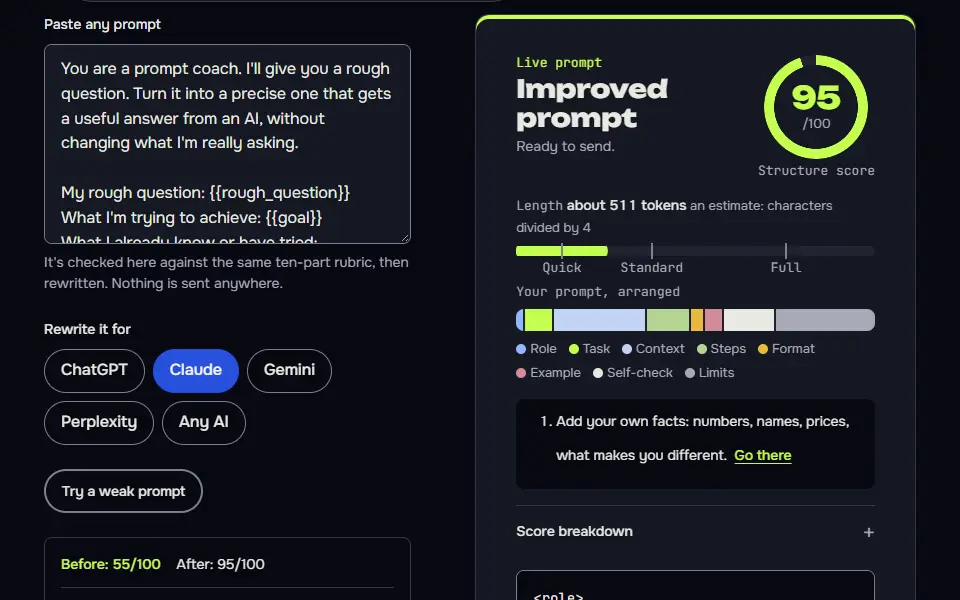
Fill in the fields and the prompt updates as you type.
Turn a rough question into a precise one
A prompt coach that won't answer the question forces you to see what your question was missing before you spend a turn on it.
Your details
Type in any field. The prompt fills in as you go. Leave one empty? It stays a highlighted blank.
Your prompt
You are a prompt coach. I'll give you a rough question. Turn it into a precise one that gets a useful answer from an AI, without changing what I'm really asking.

My rough question: {{rough_question}}
What I'm trying to achieve: {{goal}}
What I already know or have tried: {{known}}
Who the answer is for and their level: {{level}}
The shape I want the answer in: {{shape}}

Give me
1. What's unclear or missing in my rough question, in two or three bullets.
2. The improved question as a ready-to-paste prompt, under 120 words.
3. Three follow-up questions to ask after the answer, each digging at something different: the reasoning, the exceptions and the next step.
4. One question I haven't thought to ask that an expert in the field would.

Don't answer the question itself. Don't change my intent. Don't use em dashes or en dashes.
How to use
- Copy it with the button above.
- Fill the blanks in {{double braces}} with your own details.
- Paste it into ChatGPT, Claude or Gemini and send it.
- Then follow up: ask for one change at a time.
Before you run “Turn a rough question into a precise one” for the first time, the lesson on how to use ChatGPT prompts walks through copying, filling and sending it.
What is a prompt question example for ChatGPT?
A prompt question example for ChatGPT is "I'm a homeowner with no engineering background; explain how a heat pump heats a house in 5 short points", which holds a goal, context, a limit and an answer format. This pack has 4 prompts, and the examples are grouped by goal: understand, decide, plan and test your thinking.
Prompt questions examples variations
Ask me clarifying questions before you answer
Surfacing assumptions up front gets an answer that fits you in one extra turn, instead of a generic list.
I'm going to ask you something. Before you answer, ask me the clarifying questions you need to give a good answer.

My question: {{question}}

How to do it
1. Ask at most five clarifying questions. Number them. Make each one short and answerable in a few words. Skip anything you can reasonably assume, and tell me the assumption in brackets instead.
2. Wait for my replies. Don't answer yet.
3. After I reply, answer my original question using my answers. Start with the answer in two sentences, then the detail.
4. At the end, list any assumptions you still made, so I can correct them.

If my question is already clear enough, say so and answer it. Don't use em dashes or en dashes.Challenge my thinking with the strongest opposing case
Asking for the best opposing case and the evidence that would change your mind pulls out the thinking that agreeable AI replies skip.
Here is something I believe or a plan I'm leaning toward. Don't agree with me by default. Test it.

My view or plan: {{claim}}
Why I believe it: {{reasons}}
What it would cost me to be wrong: {{stakes}}

Please
1. Restate my position in one sentence so I know you understood it. If you'd call it differently, say how.
2. Give the strongest case against it, written as someone who disagrees would write it, in about 120 words.
3. List the three assumptions my view depends on and how I could check each one cheaply.
4. Tell me what evidence would change your mind if you were me.
5. Say where my view is strong. Be specific, not polite.
6. Finish with the one question I should answer before I act.

Don't invent statistics or studies. If you're not sure of a fact, say so. Don't use em dashes or en dashes.
A grouped set of questions for any topic
Five fixed headings cover the whole path from vocabulary to action, so you don't end up with 20 variations of the basics.
Write a set of questions I can ask to learn about {{topic}}. I'm {{level}} and I want to {{purpose}}.

Group them under these five headings, with four questions each
1. Basics: what it is and the words I need to know.
2. How it works: the mechanism, step by step.
3. Decisions: the choices I'll have to make and the trade-offs.
4. Mistakes: what beginners get wrong and how to spot it early.
5. Next steps: what to do this week and how I'd know it's working.

Every question must be specific to {{topic}}, not generic. Phrase each as a question I can paste into an AI chat as it stands. After the list, pick the three questions I should ask first and say why. Don't use em dashes or en dashes.
What a good answer looks like
A good answer to “Turn a rough question into a precise one” looks like a finished piece in the format that prompt asks for, built only from your details. Yours will follow your own details.
Your country and the kind of accounts available to you are not stated. Account types, tax rules and providers differ a lot by location. - Your goal and time horizon are missing (retirement, a house, general wealth), as is roughly how much you could invest and whether you'd add money regularly. - Your comfort with risk, and whether you have an emergency fund set aside separately from the money you'd invest, are not mentioned.
Notes for each model
ChatGPT
works as pasted. For the clarify-first version, if it answers straight away, reply
ask first, answer after.Claude
usually asks good clarifying questions on its own. The prompts still help it keep to five questions.
Gemini
works as pasted. Ask for the improved prompt in a code block so it's easy to copy.
All models
they can't see what you do with the answer. Tell them the goal. It changes what a useful answer looks like.
Before you use it
The questions are short and easy to adapt, so you won't need to rewrite them. Every group on this page shows its parts: goal, context, constraints and answer format.
What makes a good question for ChatGPT?
A good question for ChatGPT has 4 parts: what you want, who you are, the limits and the shape of the answer, which are the goal, context, constraints and answer format. The coach prompt adds any part you left out. Four prompts make up the pack: the main coach and 3 variations.
The goal is what you'll do with the answer, the context is what you know and your level, the constraints keep it to one thing at a time, and the answer format is a list, a table or a short plan. Compare "How do I start investing?" with "I have a savings account and no debt. Give me a 5-step plan to learn the basics of investing before opening my first account, with each term explained in one sentence." It doesn't take long: the second takes ten more seconds to write, and it's worth it. You'll get a plan you can follow, not a lecture you can't use. The first prompt on this page does that rewrite for you and tells you what was missing.
Prompt questions that help you understand a topic
Prompt questions that help you understand a topic ask ChatGPT to explain at your level, give one example and then quiz you with 3 questions. Five patterns cover it, and you don't need to memorize them: a simple explanation, the common misunderstandings, a step-by-step walkthrough, an expert's view and a self-test.
Explain [topic] to me as if I'm new to it. Use one everyday example, then give me the three terms (with a one-line definition each) I must know.What are the three most common misunderstandings about [topic], and what is actually true?Walk me through how [process] works, step by step, and mark the step where it most often goes wrong.What would an expert notice about [topic] that a beginner wouldn't?Give me five questions (each with a short answer I can check against) that I should be able to answer once I understand [topic].
Prompt questions that help you decide or plan
Prompt questions that help you decide or plan give ChatGPT your options and criteria and ask for a table or a dated step list, not a single verdict; it's your decision. They work for work tasks too, such as a table comparing two vendors on cost, effort and risk.
I'm choosing between [A] and [B]. Ask me five questions that would settle it, then give a recommendation and say how confident you are.Make a table comparing [A] and [B] on cost, effort, risk and what I'd regret in a year.What would have to be true for [A] to be the better choice? And for [B]?What's the cheapest way to test [option] before I commit to it?Which parts of this decision are reversible and which aren't?
For planning, these patterns turn a goal into steps:
Turn [goal] into a plan for the next four weeks (week 1 to week 4), with a maximum of three tasks a week.What are the first three steps for [project] (in order), and what could block each one?I have [time] a day. What's the smallest version of [goal] I could finish?List what I'll need before I start [project] and what I can figure out as I go.What should I stop doing to make room for [goal]?
Prompt questions that test your own thinking
Prompt questions that test your own thinking ask ChatGPT to argue the other side, find the weakest point in your plan and list what you haven't considered. Five patterns cover it, and they're the ones people skip: a weakest-points check, a strongest counterargument, an assumptions check, a pre-mortem and a vagueness check.
Here is my plan: [plan]. What are the three weakest points?Argue against my view that [claim] as strongly as you can, then tell me what evidence would change your mind.What am I assuming in [plan] that I haven't checked?If this goes wrong in six months, what is the most likely reason?Where is my reasoning vague? Quote the sentence and ask me a question.
Is a prompt question the same as a school writing prompt?
No, a prompt question to an AI isn't the same as a school writing prompt; a writing prompt gives a student a topic to write about, and this page covers questions for ChatGPT.
If you meant the school kind, you'll want writing prompts or the guide to what a writing prompt is. A clear question is the first step of a site build too, and the AI website prompts page starts from one. Job hunters can turn these question patterns into bullets with the AI resume prompt.
For self-reflection, try the prompts about yourself, or head back to the ChatGPT prompts hub for more.
Prompt questions examples FAQ
Still stuck? Build it in Prompt Studio. It'll score each part as you go.
What is an example of a simple prompt for ChatGPT?
A simple prompt for ChatGPT is "List 5 dinner ideas with chicken and rice, each under 30 minutes", since it names the task, the limit and the format. Add who it's for and what you'll use it for, since a bare task gives a bare answer. It's short, and that's fine to get better results.
What are good examples of prompts for students?
Good prompt examples for students are "quiz me on chapter 3 with 5 questions" and "explain this formula step by step at a high school level". Both give the AI a task, a limit and a level.
How do I get ChatGPT to answer a question better?
To get ChatGPT to answer a question better, add context about you, a limit and the answer format you want, or paste your question into the coach prompt to rewrite it. Telling the AI your goal, which it can't guess, changes what a useful answer looks like.
Are there prompt instruction examples for work tasks?
Yes, the decide and plan groups hold prompt instruction examples for work tasks, such as a table comparing two vendors on cost, effort and risk, or a four-week plan with three tasks a week.